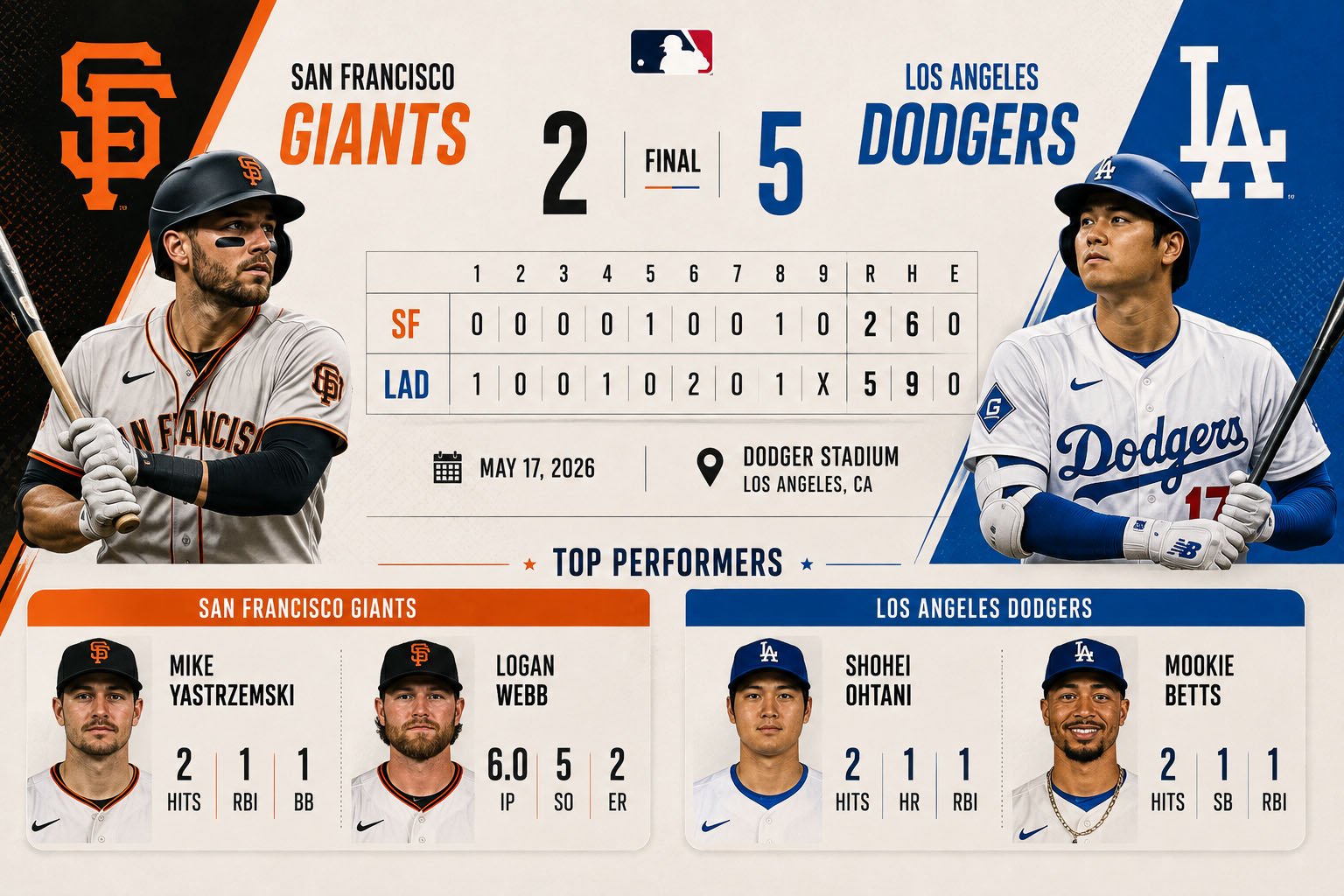
San Francisco Giants vs Dodgers is one of the oldest and most storied rivalries in baseball, and the 2026 season has added another interesting chapter. Los Angeles has spent most of the year atop the NL West standings, but San Francisco has managed to hold its own in head to head play, proving that a rivalry this old does not care much about the overall standings when these two teams take the field.
This article looks at where both teams stand as the season heads toward its final stretch, the top individual performers on each roster, and the long running history between these two franchises. Every stat below comes from official team reports and box scores from the 2026 season.
Quick Team Snapshot
| Team | Record | Division Standing | Season Series |
|---|---|---|---|
| Los Angeles Dodgers | 62-36 | 1st, NL West | Trail 3-4 |
| San Francisco Giants | 42-55 | Behind in NL West | Lead 4-3 |
Despite a wide gap in the overall standings, the Giants have managed to lead the season series against their rivals, a reminder that this matchup often plays out differently than the regular standings suggest.
San Francisco Giants Key Player Stats
Luis Arraez: A Pure Hitting Machine
Infielder Luis Arraez has been the most consistent bat in the Giants lineup all season, and his contact skills have made him a difficult out for any Dodgers pitching staff. Arraez currently holds the highest batting average on the Giants roster, a number that has stayed near .328 for much of the year, reflecting his reputation as one of the best pure hitters in the league.
Arraez brings a different offensive approach than most modern hitters, focusing on putting the ball in play and using the entire field rather than chasing home runs. That style has made him a tough matchup for Dodgers pitchers who prefer to attack hitters with swing and miss stuff, since Arraez rarely strikes out and consistently finds gaps in the defense.
Logan Webb and the Pitching Staff
Right hander Logan Webb has anchored the Giants rotation for several seasons, giving San Francisco a reliable arm capable of matching up with any team’s top starter, including the Dodgers. The rest of the rotation has included Landen Roupp, who posted a strong 3.09 ERA to go with a 5-3 record through his first several starts, and veteran left hander Robbie Ray, who has had a tougher season, sitting at 3-5 with his ERA fluctuating in recent outings.
That pitching depth has been a big reason San Francisco has stayed competitive in the season series against Los Angeles, even during stretches when the offense struggled to keep pace with the Dodgers’ power.
Matt Chapman: Defense and Timely Power
Third baseman Matt Chapman continues to provide elite defense at the hot corner for San Francisco, the kind of glove work that saves runs and shifts momentum in tight divisional games. Along with his defensive value, Chapman has chipped in timely power throughout the season, giving the Giants lineup a legitimate threat to change the score with one swing even on nights when the rest of the offense goes quiet.
Los Angeles Dodgers Key Player Stats
Shohei Ohtani: The Best Two Way Player in Baseball
Designated hitter and pitcher Shohei Ohtani remains the most talked about player in the sport, and his numbers back up every bit of that attention. As a hitter, Ohtani has produced 22 home runs while batting .289 with a .400 on base percentage and a .543 slugging percentage, numbers that would headline most lineups even without his contributions on the mound.
Ohtani has also shown he can be a difference maker as a starting pitcher, a role he took on for the first time as a Dodger this season. You can find detailed game logs and season stats through ESPN’s MLB coverage. His combination of power hitting and frontline starting pitching makes him a matchup nightmare for any opposing team, including a division rival like San Francisco.
Freddie Freeman and Mookie Betts
First baseman Freddie Freeman remains one of the most consistent hitters in the Dodgers lineup, providing steady production in the middle of the order throughout the season. Mookie Betts has continued to show off his versatility, moving around the infield for Los Angeles and giving the team defensive flexibility that few other players in baseball can match. His athleticism allows the Dodgers coaching staff to shuffle the defense depending on matchups, a luxury that has paid off in several close games against the Giants.
Dodgers Team Pitching
Beyond Ohtani, the Dodgers pitching staff has featured young arms like Emmet Sheehan working their way into bigger roles in the rotation. As a team, Los Angeles has built its staff around a mix of power arms and experienced veterans, giving manager Dave Roberts plenty of options when constructing a pitching plan against a Giants lineup that relies more on contact hitting than raw power.
San Francisco Giants vs Dodgers: Key Player Stats at a Glance
| Player | Team | AVG or ERA | Key Stat | Position |
|---|---|---|---|---|
| Luis Arraez | Giants | .328 | Contact hitting leader | Infield |
| Shohei Ohtani | Dodgers | .289, 22 HR | Two way superstar | DH/Pitcher |
| Logan Webb | Giants | Team ace | Rotation leader | Pitcher |
| Freddie Freeman | Dodgers | Consistent | Middle of order bat | First Base |
| Matt Chapman | Giants | Strong defense | Elite glove | Third Base |
Note: Some figures reflect season snapshots taken at different points in the 2026 schedule, since both rosters evolved as the year progressed.
The Century Old Roots of a Coast to Coast Rivalry
Long before either team called California home, the Giants and Dodgers were building one of the fiercest rivalries in American sports from opposite boroughs of New York City. That history matters because it shaped the identity of both franchises well before the move west in 1958, and much of the intensity fans see today traces directly back to those early decades of close pennant races and bitter competition. When both teams relocated to California within a year of each other, they brought that rivalry with them, and the geographic proximity between San Francisco and Los Angeles only intensified the natural tension between the two fan bases.
That century plus of history means every current player who suits up for either team inherits a rivalry far bigger than any single season. Luis Arraez and Shohei Ohtani are simply the latest chapter in a story that includes some of the greatest players in baseball history, and every home run, diving catch, or momentum shifting hit between these two teams gets added to a rivalry that shows no signs of cooling off, regardless of where either team sits in the standings during any particular season.
Statistical Deep Dive: Contact Hitting vs Power Hitting
The philosophical difference between these two rosters shows up clearly when you dig into the underlying numbers behind each team’s offensive approach. San Francisco’s lineup, anchored by Arraez, emphasizes a low strikeout, high contact approach that keeps the ball in play and forces opposing defenses to make plays rather than relying on the free pass of a walk or the automatic outcome of a punch out. That approach tends to produce more consistent, if less explosive, offensive output over the course of a long season, since it reduces the number of at bats that end without the ball ever leaving the bat.
Los Angeles, by contrast, has built a lineup that embraces modern power hitting principles, prioritizing exit velocity and launch angle in ways that produce more home runs but also more strikeouts. Ohtani himself represents an interesting hybrid of both approaches, since his .400 on base percentage shows real plate discipline even as his power numbers put him among the league leaders in home runs. That statistical profile makes him uniquely difficult to prepare for, since opposing pitching staffs cannot simply pitch around his power without risking a walk that still puts a dangerous baserunner in scoring position.
Pitching Matchup Trends Throughout the Season
Every time these two rotations collide, the pitching matchups tend to define how competitive the individual games become. San Francisco’s decision to lean on Logan Webb as its ace has paid dividends in head to head play against Los Angeles, since Webb’s sinker heavy approach and ability to generate ground balls plays well against a Dodgers lineup that, for all its power, can be vulnerable to pitchers who avoid the middle of the strike zone. Landen Roupp has emerged as an effective complement behind Webb, giving San Francisco a one two punch capable of slowing down even the most dangerous lineups in the league.
Los Angeles counters with a rotation built around a mix of established veterans and hard throwing younger arms like Emmet Sheehan, and of course Ohtani’s own presence on the mound whenever he takes his turn in the rotation. That depth gives the Dodgers options that few other teams in baseball can match, allowing manager Dave Roberts to align his best arms specifically for series against a division rival like San Francisco when the schedule allows for that kind of planning.
The Importance of Divisional Series in a Long Season
Baseball’s 162 game schedule means that no single series ever defines a season on its own, but divisional matchups carry extra weight because of how frequently the two teams face off and how directly those results affect the standings. Every win in a Giants vs Dodgers series counts double in a sense, since it simultaneously helps one team’s record while directly hurting the other’s positioning in the crowded NL West race.
That dynamic explains why both fan bases treat these games with such intensity, even in seasons like 2026 when the overall gap between the two teams’ records has been significant. San Francisco’s ability to win the head to head season series against a Los Angeles team with a considerably better overall record speaks to just how much extra motivation and preparation goes into these particular matchups, regardless of what else is happening elsewhere in the standings.
Manager Philosophies and In Game Decision Making
The contrast in coaching philosophies between these two organizations adds another layer to the rivalry. Dave Roberts has built a reputation in Los Angeles for aggressive bullpen usage and a willingness to deploy his best relievers earlier in games than many traditional managers would, a strategy made possible by the sheer depth of talent on the Dodgers roster. That approach has generally served Los Angeles well over a long season, even if it occasionally leads to questions about bullpen fatigue during particularly demanding stretches of the schedule.
San Francisco’s coaching staff has taken a more traditional approach, built around clearly defined roles in the bullpen and a greater reliance on starting pitchers going deeper into games. That philosophy fits a roster that lacks the same top end power as Los Angeles but makes up for it with pitching depth and situational hitting, a formula that has kept the Giants competitive in this rivalry even during a season when the overall talent gap between the two rosters has been noticeable.
Fan Culture and Regional Identity
Beyond the players and the numbers, the Giants vs Dodgers rivalry carries a cultural weight that few other matchups in American sports can match. Fans in both cities view games against the other team as measuring sticks for regional pride, a dynamic that traces back to the New York origins of both franchises and has only grown stronger since the move to California. Oracle Park and Dodger Stadium both transform into some of the loudest, most electric environments in baseball whenever these two teams meet, regardless of where either club sits in the standings during a given season.
That atmosphere has a real effect on how players approach these games. Veterans on both rosters have spoken openly about the extra intensity that surrounds matchups against the other team, and younger players quickly learn to understand the significance of the rivalry once they experience their first series against the opposing side. That cultural weight helps explain why San Francisco has been able to compete so effectively in the head to head series this season, even during a stretch when the team’s overall performance has lagged behind Los Angeles.
Ballpark Factors and Style of Play
Where these two teams play their home games also shapes how this rivalry unfolds. Oracle Park in San Francisco tends to favor pitching and contact hitting, with cool, swirling winds off the bay that can knock down fly balls that would otherwise leave the yard in a different ballpark. That environment fits perfectly with a Giants roster built around hitters like Arraez, who thrive on putting the ball in play rather than trying to hit for maximum power.
Dodger Stadium, by contrast, has historically played a bit more neutral but still rewards a lineup with the kind of raw power that Los Angeles boasts throughout its order. That difference in home ballparks adds another layer of strategy to this rivalry, since both coaching staffs have to adjust their approach depending on which stadium is hosting a given series.
Bullpen Depth and Late Game Situations
Beyond the starting rotations, bullpen performance has played a real role in deciding close games between these two rivals throughout the season. Los Angeles has generally been able to lean on a deeper group of relievers to protect leads in the late innings, giving the Dodgers an edge in tight, low scoring contests. San Francisco has had to be more careful about matchups late in games, often relying on specific relievers to get through the heart of a powerful Dodgers lineup in high leverage situations.
Prospect Pipelines and Future Roster Direction
Looking beyond the current season, both organizations have invested heavily in player development systems designed to keep this rivalry competitive for years to come. San Francisco’s front office has prioritized building a farm system capable of producing the kind of disciplined, contact oriented hitters that fit the club’s overall offensive philosophy, while also developing pitching depth that can eventually complement or replace veterans like Webb and Ray as their careers progress. That long term planning matters in a rivalry where both teams know that success cannot rely solely on a handful of star players.
Los Angeles has taken a different but equally deliberate approach, often supplementing a strong internal player development pipeline with aggressive moves in free agency and trades for established stars. That strategy, combined with the financial resources available to the organization, has allowed the Dodgers to maintain a roster stacked with talent at nearly every position, a luxury that has helped the team stay near the top of the NL West standings for an extended stretch of seasons. Both approaches carry their own advantages and risks, and the ongoing competition between these two philosophies adds yet another dimension to a rivalry that already carries more than a century of history.
Injury Management and Roster Depth
Every long baseball season tests the depth of a roster, and this year has been no exception for either the Giants or the Dodgers. Los Angeles has had to navigate injury concerns across multiple positions, testing the organization’s ability to plug in replacement level talent without a significant drop off in production. That depth has generally held up well, a testament to the resources the front office has committed to building a roster capable of absorbing injuries without derailing the season.
San Francisco has faced similar challenges, particularly in the starting rotation, where inconsistency from pitchers like Robbie Ray has forced the coaching staff to lean more heavily on younger arms than originally planned entering the season. That adjustment has produced mixed results, but it has also given the organization valuable information about which young pitchers might be ready to take on larger roles in future seasons, information that will directly shape how the front office approaches roster construction going into the offseason.
The Mental Game: Handling Pressure in Rivalry Games
Baseball players across both organizations consistently point to the mental preparation required for games against a rival as different from the routine grind of a typical regular season series. The heightened atmosphere, the extra media attention, and the knowledge that fans on both sides are paying closer attention than usual all combine to create a different kind of pressure, one that can bring out either the best or the worst in a player depending on how well they manage that intensity.
Veterans like Freeman and Chapman have talked openly in interviews about how experience playing in high pressure divisional games helps them stay composed in these matchups, while younger players sometimes need a season or two of exposure to the rivalry before they fully settle into the moment. That psychological dimension is difficult to measure statistically, but anyone who has watched enough Giants versus Dodgers games understands that something intangible shifts in the atmosphere whenever these two teams take the field against each other, a factor that likely contributes to some of the surprising results that have defined the 2026 season series.
Broadcast Coverage and National Attention
The scale of national media attention devoted to this rivalry reflects its outsized importance in the baseball landscape. National broadcast partners regularly schedule marquee Giants versus Dodgers matchups for premium television windows, recognizing that the rivalry draws viewership well beyond the two teams’ immediate fan bases. That level of exposure means every notable individual performance, whether it comes from an established star like Ohtani or a rising player like Arraez, receives amplified coverage compared to a similar performance in a less prominent matchup.
That national spotlight adds yet another layer of pressure and opportunity for players on both rosters. A standout performance in a nationally televised Giants versus Dodgers game can meaningfully raise a player’s profile, while a poor outing tends to draw more scrutiny than it might in a lower profile series. Both organizations understand this dynamic and often factor it into decisions about which pitchers to line up for these particular series, further reinforcing just how significant this rivalry remains within the broader baseball ecosystem.
Team Comparison
The contrast between these two teams tells a clear story about two different styles of winning baseball. The Dodgers built their roster around power and star talent, headlined by Ohtani’s rare two way ability and complemented by proven veterans like Freeman and Betts. That approach has helped Los Angeles build a comfortable lead in the NL West standings over the course of the season.
San Francisco, on the other hand, has relied on contact hitting from players like Arraez, strong defense from Chapman, and a deep, reliable pitching staff led by Webb. That formula has not produced the same overall record as Los Angeles, but it has been enough to give the Giants a slight edge in the head to head season series, proving that different styles can both find success against the same opponent.
Head to Head History
The Giants and Dodgers rivalry stretches back more than a century, predating both franchises’ moves to the West Coast, and it remains one of the most storied rivalries in American professional sports. Complete historical breakdowns of every meeting between these two clubs are available through Sports Reference’s head to head comparison tool.
In the current 2026 season, the Giants have managed to win the season series 4 games to 3 despite trailing significantly in the overall standings, a reminder that rivalry games often produce results that do not match up with each team’s overall record.
Recent Matchup Recap
One of the more memorable recent meetings between these two teams came in mid May, when Ohtani tossed four hit ball over seven shutout innings in his second consecutive seven inning start, backed by his best run support of the season in a 4-0 Dodgers win. That performance snapped a Los Angeles losing streak that had reached four games, showing just how valuable Ohtani’s dual role can be when both his pitching and hitting are working at the same time.
Robbie Ray started that game for the Giants and struggled, allowing four runs on seven hits over 4 and 2 thirds innings. That loss was part of a stretch where San Francisco dropped a couple of games in a short series, even though the Giants had won the two previous meetings in that same stretch to keep the overall season series close.
What to Watch Next
For the Dodgers, the biggest storyline remains how they manage Ohtani’s workload between hitting and pitching duties as the season progresses toward the playoffs. Keeping him healthy and effective in both roles will be critical if Los Angeles wants to make a deep postseason run.
For the Giants, the focus will be on getting more consistent offensive production to support a pitching staff that has kept San Francisco competitive all year. If hitters like Arraez and Chapman can get more help from the rest of the lineup, the Giants could make things even more difficult for a Dodgers team that has otherwise dominated the division.
Conclusion
San Francisco Giants vs Dodgers remains one of baseball’s must watch rivalries, and the 2026 season has shown that close standings are not required for compelling baseball. Luis Arraez and the Giants pitching staff have kept San Francisco competitive in head to head play, while Shohei Ohtani’s rare two way brilliance has helped the Dodgers build a comfortable lead in the division.
With the Giants holding a slight edge in the season series despite trailing significantly in the overall standings, this rivalry continues to prove that anything can happen when these two historic franchises take the field against each other.
Frequently Asked Questions
Who is leading the 2026 season series between the Giants and Dodgers?
The San Francisco Giants lead the season series 4 games to 3, despite the Los Angeles Dodgers holding a significantly better overall record.
Who is the Giants’ best hitter this season?
Luis Arraez leads San Francisco with a batting average around .328, making him one of the toughest outs in the entire league.
How has Shohei Ohtani performed for the Dodgers?
Ohtani has hit 22 home runs while batting .289 with a .400 on base percentage, and he has also emerged as an effective starting pitcher in his first season taking on that dual role for Los Angeles.
Which team has the better pitching staff?
The Dodgers hold a team ERA advantage overall, but the Giants rotation, led by Logan Webb and Landen Roupp, has kept San Francisco competitive in nearly every meeting against Los Angeles.
What makes the Giants vs Dodgers rivalry so significant?
The rivalry dates back more than a century and remains one of the most storied matchups in American sports, with both franchises battling for supremacy in the NL West for generations.