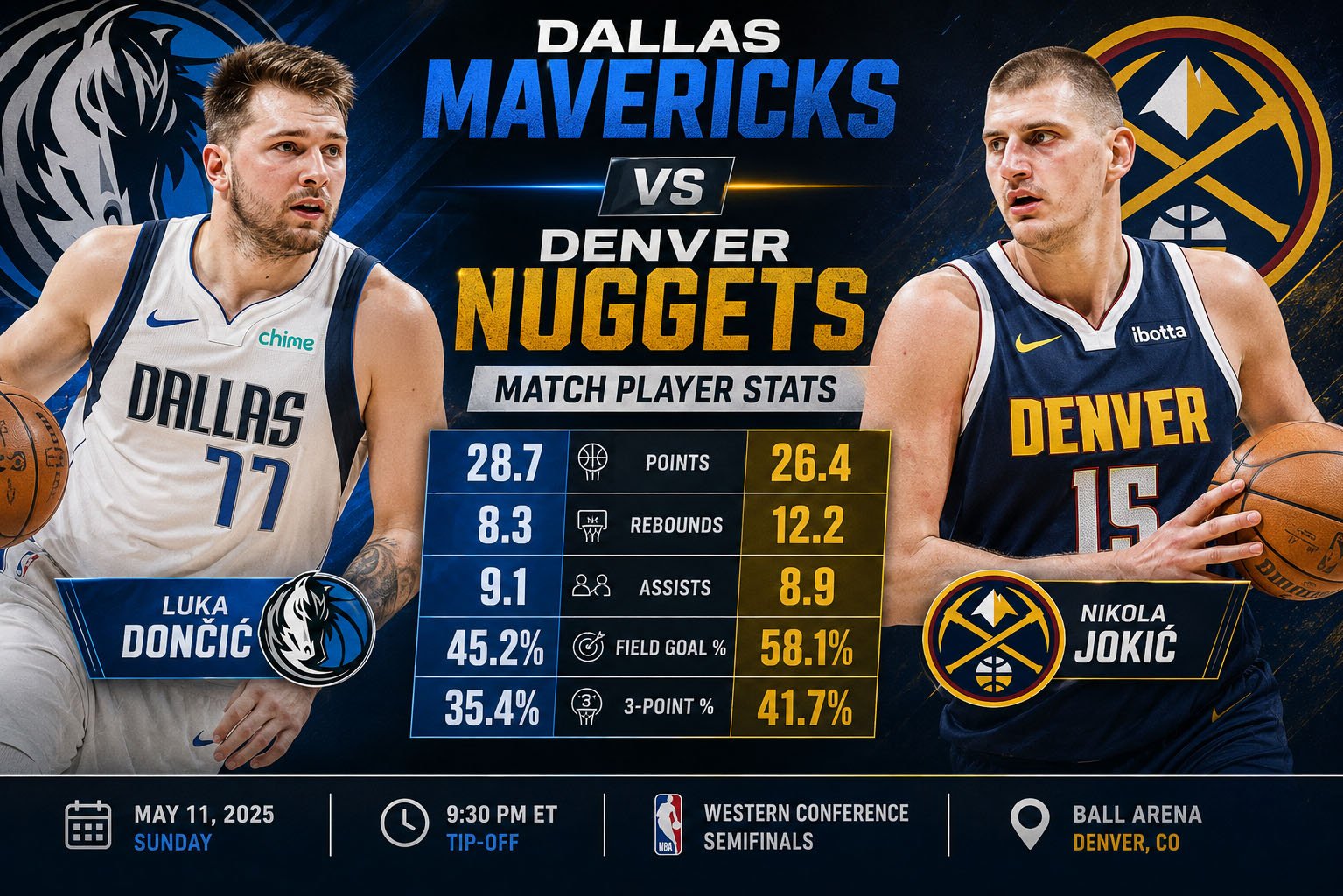
Dallas Mavericks vs Denver Nuggets tells the story of a Mavericks team that started its season series against a championship contender on a genuine high note before injuries and inconsistency sent the club into one of its most difficult stretches of the year. Rookie sensation Cooper Flagg and a healthy Anthony Davis gave Dallas real hope in a pair of December wins, but Denver’s dual superstar combination of Jamal Murray and Nikola Jokic ultimately proved too much once both stars aligned in March.
This article breaks down Dallas’ season long trajectory across this three game series, the top individual performers on both rosters, and what these results reveal about the Mavericks’ path forward compared to Denver’s championship level ceiling. Every stat below comes from official box scores and season reports.
Quick Team Snapshot
| Team | Early Series Form | Late Series Form | Season Trajectory |
|---|---|---|---|
| Dallas Mavericks | Won first two meetings | Lost finale during 5-game skid | Lost 24 of 28 games in one stretch |
| Denver Nuggets | Lost first two meetings | Dominant March win | Tied for 4th in the West |
Dallas controlled the opening two meetings of the season series before Denver’s stars combined for a decisive statement win in the finale, a result that mirrored the Mavericks’ broader late season struggles.
Dallas Mavericks Key Player Stats
Cooper Flagg: A Rookie Making an Immediate Impact
Rookie forward Cooper Flagg announced himself as a legitimate difference maker during Dallas’ December meetings against Denver, tying his career high with 14 points in a single quarter during the December 23 game, connecting on all seven of his field goal attempts including two three pointers. His fourth three pointer of that same contest gave Dallas the lead late in the fourth quarter, and he added a crucial assist on Naji Marshall’s go ahead corner three that ultimately sealed a narrow 131-130 victory.
That kind of composed, high impact performance from a rookie against a championship caliber opponent like Denver offered genuine validation for Dallas’ decision to build around Flagg as a foundational piece. Even during the team’s difficult late season stretch, Flagg continued producing at a high level, scoring 26 points in the March finale despite Dallas’ eventual loss, showing a level of consistency uncommon for a first year player facing the grind of an 82 game NBA season.
Anthony Davis: A Promising Return Derailed by Inconsistency
Forward Anthony Davis delivered a season high 32 points in his second game back from injury during Dallas’ December 1 win over Denver, immediately showing the two way impact that made him such a significant offseason investment for the organization. That performance gave Mavericks fans real reason for optimism about the team’s championship potential once Davis returned to full health and integrated fully with the rest of the roster.
However, sustaining that level of production and availability proved to be an ongoing challenge as the season progressed, with Dallas’ subsequent late season collapse coinciding with continued questions about the roster’s overall health and consistency. That disconnect between Davis’ considerable individual talent and the team’s inability to translate it into sustained winning basketball became one of the more frustrating storylines of Dallas’ season.
Denver Nuggets Key Player Stats
Jamal Murray and Nikola Jokic Deliver the Decisive Blow
Guard Jamal Murray exploded for a career high 53 points in the March meeting, shooting an efficient 19 of 28 from the field while draining 9 of 14 three point attempts, finally breaking through against a Dallas team that had frustrated Denver in the season series’ first two meetings. His 33 point first half alone matched what many players produce across a full game, showing the kind of scoring explosion capable of single handedly deciding a contest against any opponent.
Center Nikola Jokic complemented that outburst with 23 points, 21 rebounds, and a season high 19 assists in that same decisive win, reaching his 6,000th career assist milestone in the process. Full details from that game are available through CBS Sports’ game recap. That combination of historic playmaking and complete two way dominance gave Denver exactly the kind of simultaneous star performance that had eluded the Nuggets in the season series’ earlier, more competitive meetings against Dallas.
Denver’s Response to Early Series Frustration
Denver’s ability to bounce back decisively after dropping the first two meetings of the season series reflected the kind of championship level resilience that has defined the organization since its title winning run. Rather than allowing frustration over the earlier narrow losses to compound, the Nuggets coaching staff and players used those competitive defeats as motivation heading into the March rematch, ultimately producing one of the most dominant complete team performances of the entire season against Dallas.
That response showed Denver’s institutional depth and championship experience, qualities that gave the Nuggets an advantage over a Dallas roster still developing the same level of continuity and shared understanding among its core pieces, particularly given the disruptions injuries caused throughout Dallas’ season.
Mavericks vs Nuggets: Key Player Stats at a Glance
| Player | Team | Standout Game | Trend Across Series | Key Storyline |
|---|---|---|---|---|
| Cooper Flagg | Mavericks | 14 pts in one quarter | Consistent rookie production | Poise beyond his experience |
| Anthony Davis | Mavericks | 32 points (season high) | Injury-affected availability | Promising but inconsistent |
| Jamal Murray | Nuggets | 53 points (career high) | Saved best for decisive game | Elevated play in biggest moment |
| Nikola Jokic | Nuggets | 19 assists, 6,000 career | Consistent triple-double pace | Historic milestone reached |
Note: All figures reflect specific games from the three-game Mavericks-Nuggets season series during the 2025-26 season, spanning from December through March.
Team Comparison
Dallas’ season series against Denver captured the broader arc of the Mavericks’ entire year, genuine early promise undermined by an inability to sustain that level of play across a full season. Flagg’s rookie brilliance and Davis’ impactful return gave Dallas real competitive advantages in the series’ opening two meetings, but the team’s late season collapse, losing 24 of 28 games in one stretch, ultimately caught up with the Mavericks by the time Denver’s stars aligned in March.
Denver’s response showed exactly why the Nuggets remain championship contenders even when facing early series adversity. Rather than a roster reliant on a single dominant performer, Denver’s combination of Murray’s shot creation and Jokic’s complete all around game gives the team multiple paths to victory, a luxury that proved decisive once both stars performed at peak efficiency simultaneously in the season series’ final, most important meeting.
Head to Head History
Dallas has historically presented Denver with a challenging matchup given the Mavericks’ size and shooting, a pattern reflected in the competitive nature of this season’s first two meetings between the teams. However, Denver’s championship pedigree and the sheer individual talent gap at the top of its roster has generally allowed the Nuggets to find a way to control the most important, highest stakes meetings against Dallas in recent seasons.
Recent Matchup Recap
Dallas opened the season series with back to back victories, first behind Davis’ season high scoring return on December 1, then through Flagg’s rookie heroics in the dramatic December 23 rematch that Dallas won by a single point. Those two wins gave Mavericks fans genuine reason to believe their team could compete with one of the league’s true championship contenders throughout the full season.
That optimism faded considerably by the March finale, with Dallas mired in a five game losing streak that was part of a broader stretch of 24 losses in 28 games. Denver capitalized fully on Dallas’ struggles, riding Murray’s career night and Jokic’s milestone reaching performance to a decisive 142-135 win that closed out the season series in the Nuggets’ favor, 2 games to 1.
What to Watch Next
For the Mavericks, addressing the health and consistency issues that turned early season promise into a prolonged late season slide represents the most urgent organizational priority. Flagg’s continued strong individual play, even during Dallas’ most difficult stretches, offers a genuine foundation to build around, but the front office will need to find ways to keep Davis healthy and productive alongside the rookie standout if the team hopes to sustain the competitiveness shown in its early meetings against Denver.
For the Nuggets, building on the championship level performance shown in the March finale, when both Murray and Jokic peaked simultaneously, will be key to Denver’s continued postseason push. The tiebreaker advantages the team has built throughout the season position Denver well for favorable playoff seeding, assuming that same level of dual star dominance can be sustained into the postseason.
Dallas’ Front Office Decisions Under Scrutiny
Dallas’ late season struggles inevitably raised questions about the front office decisions that shaped the current roster, particularly regarding depth beyond the team’s top few contributors. General manager Nico Harrison’s strategy of building around a core of Davis and the promising young Flagg reflected a clear long term vision, but the roster’s inability to remain competitive during stretches when either star was unavailable or underperforming exposed real depth concerns that would need to be addressed heading into future roster construction decisions.
That kind of organizational evaluation, balancing continued faith in the core strategic vision against the need for practical adjustments following a difficult stretch, represents a common challenge for franchises navigating the gap between promising individual talent and complete team success. Dallas’ performance against a true championship contender like Denver throughout this season series offered a useful, if occasionally difficult, measuring stick for exactly how much work remained before the Mavericks could be considered a genuine title contender themselves.
Cooper Flagg’s Case as a Building Block
Beyond the immediate results of this season series, Flagg’s performances against a quality opponent like Denver offered some of the clearest evidence yet that Dallas had found a legitimate foundational piece in the rookie forward. His ability to produce at a high level regardless of the broader team context, whether during Dallas’ competitive December stretch or its difficult March form, suggests a level of individual consistency that often predicts sustained NBA success.
That kind of rookie performance against championship caliber competition gives Dallas’ front office confidence in building the next era of Mavericks basketball around Flagg, even as other roster questions remain unresolved. His continued development throughout the rest of the season and into future years will likely play a significant role in determining how quickly Dallas can close the competitive gap with teams like Denver that currently sit atop the Western Conference hierarchy.
The Emotional Arc of Dallas’ Season Through This Lens
Few individual matchups capture a team’s broader season narrative as clearly as Dallas’ series against Denver did throughout 2025-26. The optimism generated by two competitive December wins, punctuated by standout performances from both Davis and Flagg, mirrored the genuine hope Mavericks fans felt about the roster’s potential heading into the meat of the schedule. That same series’ disappointing conclusion in March, arriving during the depths of a crushing losing streak, similarly mirrored the broader disillusionment that set in as the season’s difficulties mounted.
That parallel between a single opponent series and an entire season’s emotional trajectory offers a useful lens for understanding just how significant health and consistency became for Dallas as the year progressed. A roster that looked genuinely competitive with a championship contender in December had, by March, become unable to sustain that same level of play, a transformation that speaks to the fragility of NBA success even for rosters containing considerable individual talent.
Naji Marshall’s Underrated Contributions
While Flagg and Davis rightfully captured most of the individual storyline attention throughout this season series, forward Naji Marshall’s contributions deserve specific recognition, particularly his game sealing corner three in the dramatic December 23 win. That kind of complementary, momentum shifting production from a role player often determines close games as much as star power, and Marshall’s ability to deliver in that specific moment reflected positively on Dallas’ overall roster depth during the team’s competitive stretch against Denver.
Marshall’s continued presence throughout the season series, including meaningful minutes in the March finale despite Dallas’ struggles, showed the kind of reliable two way contribution that complements star talent effectively. Building a sustainable competitive roster requires exactly this kind of complementary production beyond a team’s top few options, and Marshall’s performances against Denver offered evidence that Dallas possessed at least some of those necessary supporting pieces.
Denver’s Depth Beyond Its Two Stars
While Murray and Jokic rightfully dominate most discussion of Denver’s success, the Nuggets’ supporting cast played meaningful roles throughout the season series against Dallas as well. Peyton Watson’s contributions, including receiving Jokic’s pinpoint feed for a corner three during the decisive March run, showed the kind of connective, complementary talent that allows Denver’s two stars to operate at maximum effectiveness rather than needing to manufacture every possession individually.
That supporting cast depth gives Denver considerably more margin for error than a roster reliant purely on its top stars, an advantage that showed up clearly across the full season series against Dallas. Even during the two meetings Denver lost, the underlying talent and system remained evident, suggesting the Nuggets’ eventual dominant March performance reflected the team’s true competitive level once health and execution aligned favorably.
Health Management Across Both Rosters
Both Dallas and Denver navigated significant health related challenges throughout the season series, though with considerably different outcomes. Davis’ injury recovery, while producing an immediately impactful return performance, ultimately could not be sustained consistently enough to anchor Dallas’ championship aspirations throughout the full season. That contrast with Denver’s relative roster stability throughout the same stretch highlights just how much health and availability can influence competitive outcomes across a long NBA season.
Denver’s own health management, including careful attention to Jokic and Murray’s workloads during less consequential stretches of the schedule, reflected lessons learned from the team’s championship run, understanding that peak availability during the most important games often matters more than maximizing every individual regular season statistic. That contrast in overall roster health and management philosophy between the two organizations offers important context for understanding why Denver ultimately controlled the season series’ most decisive meeting.
What This Series Reveals About Playoff Positioning
Beyond the individual game results, this season series offers valuable insight into how both teams might fare in a potential postseason meeting. Dallas’ competitive December performances suggest the Mavericks possess genuine talent capable of challenging even championship level competition when healthy and playing with confidence. However, Denver’s decisive March response demonstrates the kind of championship level ceiling that separates true title contenders from teams still developing that same level of sustained excellence.
That distinction matters significantly for playoff basketball specifically, where series often come down to which team can most reliably access its highest level of play across multiple consecutive games rather than any single standout performance. Denver’s demonstrated ability to elevate its game specifically when facing early series adversity, as shown in this regular season series against Dallas, offers a positive indicator for how the Nuggets might perform in an actual playoff series requiring similar sustained excellence across a full seven game format.
Fantasy and Betting Considerations From Dallas’ Perspective
For fantasy basketball managers who rostered Dallas players throughout this season series, the experience offered a microcosm of the broader Mavericks fantasy landscape, genuine early season value from Flagg and a returning Davis, followed by increasing unpredictability as the team’s form declined. That kind of volatility often creates both opportunity and risk for fantasy managers, rewarding those who correctly identified buying and selling windows based on Dallas’ shifting team context throughout the season.
Betting market perceptions of Dallas shifted considerably across the season series as well, with the Mavericks representing reasonable value as underdogs during their competitive December stretch before becoming increasingly difficult to back as the team’s late season struggles mounted. That evolution in market perception reflects the broader challenge of evaluating a roster with genuine top end talent but significant consistency questions, exactly the profile Dallas exhibited throughout its season long series against a more stable, championship tested Denver squad.
Coaching Adjustments Throughout the Season Series
Dallas head coach Jason Kidd made notable adjustments across the three meetings against Denver, initially emphasizing the physical, defensive minded approach that produced the team’s competitive December performances before searching for solutions as the roster’s form declined heading into March. That search for answers, while ultimately unsuccessful in reversing Dallas’ late season slide specifically against Denver, reflected the broader coaching challenge of managing a talented but inconsistent roster through a demanding 82 game schedule.
Denver’s coaching staff, by contrast, maintained a more consistent overall approach throughout the season series, trusting the fundamental system built around Murray and Jokic’s partnership even during the two games Dallas won. That coaching stability and continued faith in the underlying system paid clear dividends in the March finale, when the accumulated continuity and trust between coaching staff and players translated into the decisive performance that closed out the season series in Denver’s favor.
Looking Ahead to Future Seasons Between These Teams
As both organizations look beyond this particular season series toward their respective long term trajectories, the contrasting patterns shown throughout these three meetings offer useful context for understanding each franchise’s development path. Dallas’ genuine competitiveness during healthy stretches, combined with Flagg’s continued promising development, suggests the foundation for future improvement exists, assuming the front office can address the depth and consistency issues exposed during the team’s difficult late season stretch.
Denver’s demonstrated championship level ceiling, validated once again through this season series’ decisive conclusion, positions the Nuggets as a team other Western Conference contenders, including Dallas, will need to specifically build toward matching in future seasons. Whether that gap narrows depends heavily on Dallas’ ability to translate the promise shown during this season’s competitive stretches into more sustained, complete team success capable of matching Denver’s championship level consistency across a full season and playoff run.
Conclusion
Dallas Mavericks vs Denver Nuggets captured a season series defined by contrasting trajectories, Dallas’ promising early competitiveness against Denver’s championship level response once adversity struck. Cooper Flagg’s rookie brilliance and Anthony Davis’ impactful return gave the Mavericks real hope in the series’ opening two meetings, but Jamal Murray’s career night and Nikola Jokic’s milestone reaching performance in the decisive March finale reinforced exactly why Denver remains one of the league’s most dangerous championship contenders.
With Dallas working to translate individual talent into sustained team success and Denver building momentum toward a potential deep playoff run, this season series offered a revealing look at where both franchises currently stand in the increasingly competitive Western Conference landscape.
Frequently Asked Questions
How did Dallas perform in its first two meetings against Denver?
The Mavericks won both early meetings, first behind Anthony Davis’ season-high 32 points on December 1, then through a dramatic 131-130 win on December 23 sealed by Cooper Flagg’s late-game heroics.
What derailed Dallas’ momentum by the March finale?
The Mavericks were in the midst of a difficult stretch, having lost five straight games and 24 of their previous 28, which contributed to their inability to match Denver’s complete performance in the decisive final meeting.
How did Cooper Flagg perform against Denver as a rookie?
Flagg tied his career high with 14 points in a single quarter during the December 23 win and continued producing at a high level even in Dallas’ March loss, scoring 26 points.
What was the final result of the season series?
Denver won the season series 2 games to 1, closing it out with a decisive 142-135 win in March behind Jamal Murray’s career-high 53 points and Nikola Jokic’s milestone-reaching triple-double.
Why is Anthony Davis’ health such an important storyline for Dallas?
Davis showed significant two-way impact immediately upon returning from injury, scoring a season-high 32 points, but sustaining his availability and production throughout the season proved to be an ongoing challenge for the Mavericks.