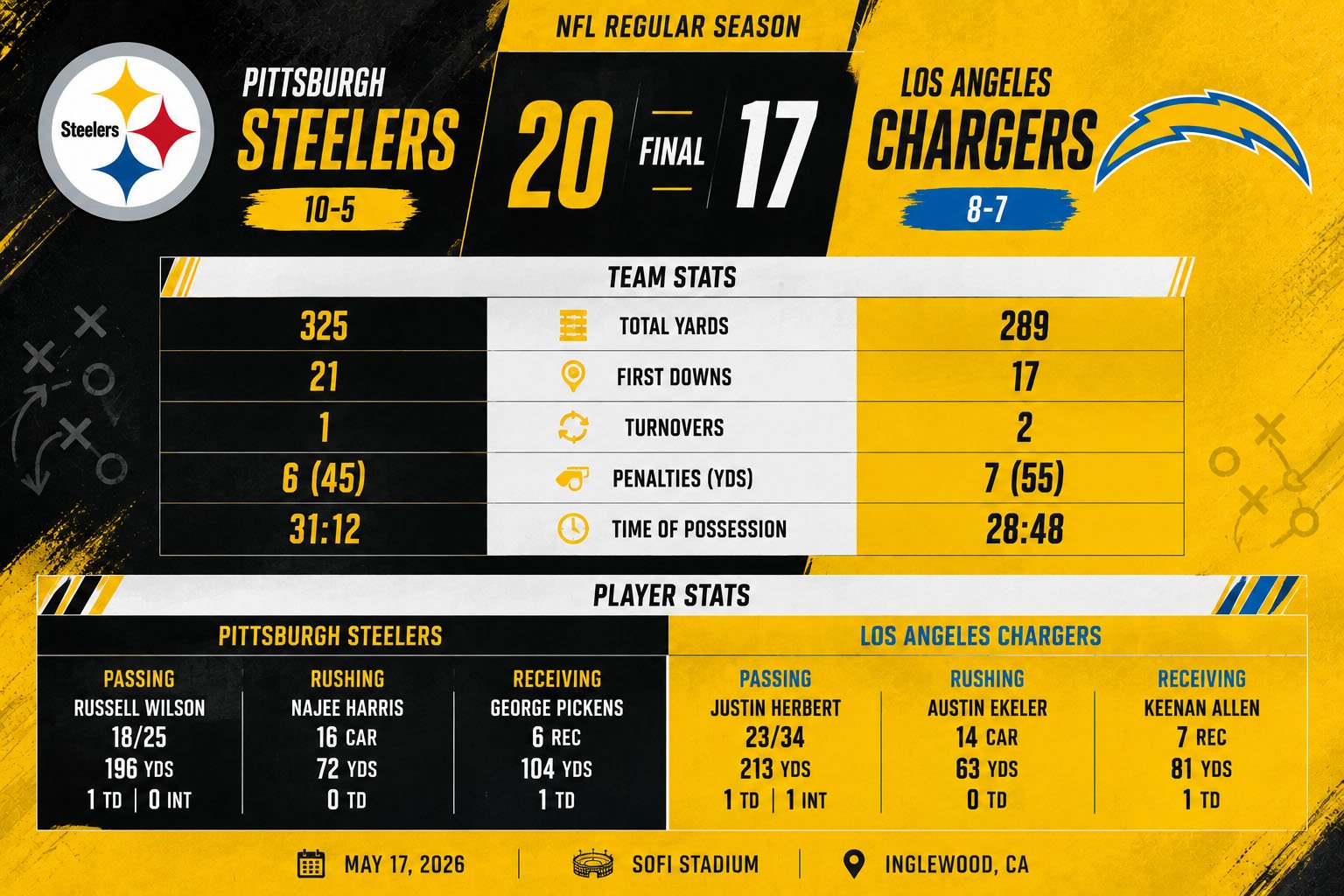
Pittsburgh Steelers vs Chargers delivered a statement game in the 2025 NFL season, with major implications for the AFC playoff picture. This matchup pitted two proven veteran quarterbacks against each other for the first time, and it turned into a showcase for Los Angeles, who used a strong all around performance to hand Pittsburgh one of its most lopsided losses of the year.
This article breaks down that primetime showdown, the top individual performances from both rosters, and the head to head history between these two franchises. Every stat below comes from official box scores and team reports.
Quick Team Snapshot
| Team | Game Result | Passing Leader | Key Stat |
|---|---|---|---|
| Los Angeles Chargers | Won 25-10 | Justin Herbert, 220 yards | Third straight win |
| Pittsburgh Steelers | Lost 25-10 | Aaron Rodgers, 161 yards | Two interceptions |
The Chargers dominated most phases of the game, using efficient quarterback play, a productive rushing attack, and a defense that forced three Pittsburgh turnovers to secure a comfortable win at SoFi Stadium.
Los Angeles Chargers Key Player Stats
Justin Herbert: Efficient and Mistake Free
Quarterback Justin Herbert delivered a clean, efficient performance in this matchup, completing 20 of 33 passes for 220 yards and a touchdown without throwing a single interception. That outing extended his streak to four consecutive games with at least 200 passing yards, showing the kind of consistency that has made him one of the league’s premier quarterbacks.
Herbert also contributed with his legs, rushing for 19 yards on five carries while absorbing five sacks from a Pittsburgh pass rush that generated steady pressure throughout the night. Despite that pressure, Herbert avoided the turnovers that plagued his counterpart, a difference that proved decisive in the final result. Full details from the box score are available through CBS Sports’ game tracker.
Kimani Vidal and Ladd McConkey
Running back Kimani Vidal provided the Chargers with a physical rushing presence, carrying the ball 25 times for 95 yards and a touchdown that helped put the game out of reach in the second half. His touchdown run gave Los Angeles a commanding 22-3 lead late in the game, a cushion the Pittsburgh offense could never fully overcome.
Wide receiver Ladd McConkey made one of the biggest plays of the night, hauling in a 58 yard catch on an extremely tight window throw from Herbert that set up additional points for Los Angeles. That connection showcased the trust between Herbert and his top receiving weapons, even against a Steelers secondary missing key contributors due to injury.
Cameron Dicker and the Chargers Defense
Kicker Cameron Dicker turned in a franchise record tying performance, connecting on field goals from 32, 59, and 42 yards. His 59 yard attempt matched his own Chargers franchise record for the longest field goal in team history, adding valuable points throughout the contest. On defense, the Chargers forced three Pittsburgh turnovers while Alex Highsmith and the rest of Pittsburgh’s pass rush recorded four sacks on Herbert, showing that both units brought physicality to the matchup even though the final score favored Los Angeles.
Pittsburgh Steelers Key Player Stats
Aaron Rodgers: A Rare Rough Outing
Quarterback Aaron Rodgers endured one of his more difficult games of the season, completing just 16 of 31 passes for 161 yards with one touchdown and two interceptions, finishing with a passer rating of 50.6. The two interceptions gave Rodgers six on the season through ten games, a higher total than he had produced in stretches earlier in the year when he was playing some of the best football of his late career.
Even in a difficult night statistically, Rodgers still found the end zone, connecting with receiver Roman Wilson on a 27 yard touchdown pass with under three minutes remaining. That score came too late to change the outcome, but it prevented Pittsburgh from being completely shut out offensively in a game where the Steelers struggled to find rhythm for most of the night.
Jaylen Warren and the Running Game
Running back Jaylen Warren gave Pittsburgh some production on the ground, carrying the ball 14 times for 70 yards, but the Steelers’ overall rushing attack managed only 73 total yards as a team. That lack of balance put more pressure on Rodgers to produce through the air, a difficult task against a Chargers defense that generated consistent pressure and forced costly mistakes.
Tight end Pat Freiermuth added a modest contribution with three receptions for 33 yards, but Pittsburgh’s passing attack struggled to find the same rhythm and explosiveness that had defined the team’s offense in wins earlier in the season. Wide receiver DK Metcalf was targeted but could not connect with Rodgers on a crucial fourth down attempt in the end zone, a missed opportunity that summed up a frustrating night for the Pittsburgh offense.
Pittsburgh Steelers vs Chargers: Key Player Stats at a Glance
| Player | Team | Comp/Att or Carries | Yards | Touchdowns |
|---|---|---|---|---|
| Justin Herbert | Chargers | 20/33 | 220 | 1 |
| Aaron Rodgers | Steelers | 16/31 | 161 | 1 |
| Kimani Vidal | Chargers | 25 carries | 95 | 1 |
| Jaylen Warren | Steelers | 14 carries | 70 | 0 |
| Ladd McConkey | Chargers | 1 key catch | 58 | 0 |
Note: Some figures reflect this single primetime matchup rather than full season career totals, since the game produced such a complete statistical picture for both offenses.
Defensive Line Battle
The trenches played a significant role in shaping this game, even though the final score was decided largely through the air and on special teams. Pittsburgh’s pass rush, led by Alex Highsmith, generated consistent pressure on Herbert throughout the night, recording four total sacks and forcing him into several uncomfortable throws. That kind of pressure would normally be enough to disrupt an opposing offense, but the Chargers offensive line, even in a patchwork configuration due to injuries, did enough to protect Herbert on the throws that mattered most.
On the other side, the Chargers defensive front also made its presence felt, sacking Rodgers three times and consistently collapsing the pocket on passing downs. That pressure contributed directly to at least one of Rodgers’ interceptions, since rushed decisions under duress often lead to costly mistakes for even the most experienced quarterbacks.
Injury Context Heading Into the Game
Both teams dealt with notable injury situations heading into this matchup. The Chargers were missing key pieces along the offensive line, forcing backup options into significant roles protecting Herbert, yet the unit still managed to give him enough time to operate effectively for most of the night. Pittsburgh, meanwhile, lost cornerback Joey Porter Jr. to injury during the game, further thinning out a secondary that was already being tested by the Chargers’ passing attack.
Two Veteran Quarterbacks, Two Different Career Arcs
This matchup carried extra intrigue because of the contrasting career paths of the two starting quarterbacks. Justin Herbert entered the league as a highly touted prospect who has steadily built his reputation as one of football’s most physically gifted passers, known for his arm strength, mobility, and ability to make difficult throws look routine. His performance against Pittsburgh fit that established profile, showing off both the accuracy and poise that have made him a perennial Pro Bowl caliber player even on a Chargers team that has dealt with its share of roster turnover in recent seasons.
Aaron Rodgers, by contrast, arrived in Pittsburgh as a future Hall of Famer looking to add one more meaningful chapter to an already legendary career. At 42 years old, Rodgers has continued to defy typical aging curves for NFL quarterbacks, and for much of the 2025 season he played some of the best football of his late career, helping guide Pittsburgh to a strong divisional position. This particular game against Los Angeles represented one of the rare rough patches in an otherwise impressive season, a reminder that even elite quarterbacks experience difficult nights, particularly against a defense as well prepared and physical as the one Los Angeles fielded.
Breaking Down the Chargers’ Complete Game Plan
Los Angeles entered this matchup with a clear defensive strategy built around pressuring Rodgers early and often, understanding that forcing quick, uncomfortable decisions from an experienced quarterback could yield turnovers even against a player with Rodgers’ pedigree. That plan worked to near perfection, as the Chargers defense sacked Rodgers three times and consistently disrupted the timing of Pittsburgh’s passing attack throughout the game.
On offense, Los Angeles balanced its attack effectively between Herbert’s efficient passing and a physical rushing attack led by Vidal. That balance made the Chargers offense difficult to defend, since Pittsburgh’s defense could never fully commit resources to stopping the run without opening up opportunities for Herbert to exploit through the air. The complete nature of the Chargers’ performance, spanning offense, defense, and special teams, reflected a level of team wide execution that Los Angeles had been building toward across its three game winning streak entering this matchup.
Pittsburgh’s Offensive Struggles in Context
While Rodgers’ individual struggles drew significant attention following this game, the broader context of Pittsburgh’s offensive performance tells a more complete story. The Steelers rushing attack managed only 73 total yards as a team, a number well below what the offense had produced during its stronger stretches earlier in the season. That inability to establish any consistent ground game forced Pittsburgh into a more one dimensional offensive approach, making it easier for the Chargers defense to key in on the passing game and generate the kind of pressure that ultimately led to Rodgers’ costly turnovers.
Beyond the statistical struggles, Pittsburgh’s offense also dealt with the absence of key contributors in the receiving corps, a factor that limited the number of reliable targets available to Rodgers throughout the game. Without full support from the running game or the full complement of pass catchers, Rodgers found himself in difficult down and distance situations more often than usual, a recipe that rarely favors even the most accomplished quarterbacks in the league.
The AFC Playoff Picture Entering This Game
Both teams entered this primetime showdown with legitimate playoff aspirations, adding significant weight to every play. Los Angeles came in having lost three of four games after a strong start to the season, making this matchup a critical opportunity to reestablish momentum in a crowded AFC West race that included a strong Denver team at the top of the standings. Pittsburgh, meanwhile, held a comfortable lead in the AFC North at the time of this matchup, giving the Steelers a chance to further separate themselves from divisional competition with a statement win on the road against a quality opponent.
The Chargers’ decisive victory accomplished exactly what Los Angeles needed, moving the team back within striking distance of the division lead while also serving as a signature win against a team many considered a serious AFC contender. For Pittsburgh, the loss represented a rare stumble during an otherwise strong season, one that the coaching staff and players alike would need to address quickly given the caliber of competition still remaining on the schedule.
Coaching Strategy and Game Management
Chargers head coach Jim Harbaugh has built a reputation throughout his career for physical, disciplined football, and that identity was on full display in this matchup. The decision to lean heavily on Vidal in the rushing attack, even with a talented passing game led by Herbert, reflected Harbaugh’s preference for controlling tempo and wearing down opposing defenses over the course of a full game. That approach paid dividends in the second half, as Pittsburgh’s defense showed visible fatigue by the fourth quarter after repeated exposure to Los Angeles’ physical rushing attack.
Pittsburgh’s coaching staff, meanwhile, faced difficult decisions throughout the game as the Chargers’ lead grew. The offensive game plan shifted toward more aggressive passing concepts in an attempt to catch up quickly, a strategy that ultimately contributed to some of the turnovers that plagued Rodgers throughout the night. In hindsight, a more patient, balanced approach might have better served an offense that struggled to establish any consistent rhythm once Los Angeles built its early lead.
Statistical Anomalies and What They Reveal
Several statistical elements from this game stood out as notable departures from each team’s typical performance profile during the 2025 season. Rodgers’ passer rating of 50.6 represented one of the lowest marks of his entire career at that point, a stark contrast to the efficient, high level play he had shown throughout most of the season leading up to this matchup. That kind of outlier performance often draws significant attention from analysts trying to determine whether it reflects a genuine decline or simply a difficult night against a well prepared opponent.
Herbert’s performance, by contrast, fit squarely within his established pattern of consistency, extending his streak of 200 yard passing games to four in a row. That kind of reliability has become a hallmark of his career, and this game added another data point to a growing body of evidence suggesting Herbert has developed into one of the most dependable quarterbacks in the league, particularly in high stakes, nationally televised matchups like this Sunday night showdown.
Team Comparison
This game highlighted a clear gap in execution between the two teams on that particular night. Los Angeles played a complete game, combining efficient quarterback play from Herbert, a productive rushing attack led by Vidal, explosive plays through the air from McConkey, and mistake free football that allowed the Chargers to control the pace throughout.
Pittsburgh’s defense actually held up its end, generating four sacks and consistent pressure on Herbert, but the offense could not reward those efforts. Rodgers’ two interceptions and the team’s inability to establish any real rushing threat put the Steelers in difficult positions on the scoreboard for most of the night, turning what many expected to be a competitive divisional style battle into a comfortable Chargers win.
Roman Wilson and the Development of Pittsburgh’s Young Receivers
While much of the attention following this game focused on the veterans involved, the performance of younger players on both rosters offered a glimpse into each team’s future. Roman Wilson’s touchdown catch, though it came too late to affect the outcome, represented an encouraging sign for a Pittsburgh receiving corps still developing behind established options like Metcalf. Building chemistry between Rodgers and his younger targets remains an important storyline for the Steelers offense, particularly given the uncertainty around how much longer a 42 year old quarterback can continue playing at a high level.
For Los Angeles, the continued emergence of McConkey as a reliable target for Herbert reflects the kind of young talent development that has helped the Chargers build a foundation for sustained competitiveness. His 58 yard catch in this game showcased the trust that has developed between the two players in a relatively short period of time, a dynamic that bodes well for the Chargers offense as both players continue to grow together in future seasons.
The Physical Toll of a Division Rivalry Style Game
Even though the Steelers and Chargers do not share a division, this game carried the physical intensity often associated with divisional matchups, largely due to the playoff stakes involved for both teams. The number of sacks recorded by both defenses, combined with the hip drop tackle controversy involving Pittsburgh’s Nick Herbig, highlighted just how physical this particular contest became as both teams fought for a critical late season win.
That physicality took a toll on both rosters, with Pittsburgh losing a key defensive back to injury during the game and the Chargers offensive line already dealing with significant absences heading into the matchup. Games of this intensity often produce lingering effects that extend beyond the final score, testing the depth and resilience of both rosters in the weeks that followed as each team continued pushing toward the postseason.
Historical Context for Primetime Quarterback Duels
Sunday Night Football matchups featuring two accomplished veteran quarterbacks have historically drawn significant national attention, and this game fit that pattern perfectly. The narrative framing of Herbert, a rising star still building his legacy, against Rodgers, a future Hall of Famer looking for one final deep playoff run, gave this matchup a storyline appeal that extended well beyond the two teams’ immediate fan bases.
That kind of primetime spotlight often produces memorable individual performances, and while this particular game will likely be remembered more for Rodgers’ struggles than for a signature Herbert performance, the broader trend of closely watched quarterback duels continues to be one of the NFL’s most reliable sources of appointment viewing television, drawing significant ratings and generating extended media coverage well into the following week.
Fantasy Football and Betting Market Reactions
For fans invested in fantasy football, this game produced a clear split in outcomes. Herbert delivered solid, if unspectacular, fantasy production given his lack of a big statistical day, while Rodgers’ two interceptions made him a significant fantasy disappointment for managers who had started him in that particular week. Vidal’s touchdown and strong rushing total made him one of the standout fantasy performers of the week among running backs, a reminder that committee based backfields can still produce standout individual performances when a player gets enough volume in a favorable game script.
Betting markets, which had favored Los Angeles heading into the game given the team’s recent form and home field advantage, saw the Chargers cover comfortably, extending a strong stretch of performances against the spread for a team that had been building momentum throughout the second half of the season. That kind of consistent performance against betting expectations often reflects genuine team improvement rather than simply variance, a distinction that sharp bettors and analysts continued to track as both teams moved further into their playoff pushes.
What This Game Revealed About Both Teams’ Ceilings
Games like this one often serve as useful benchmarks for evaluating a team’s true ceiling heading into the postseason. For Los Angeles, the complete performance across all three phases of the game suggested a team capable of competing with anyone in the AFC, provided Herbert and the offense could maintain that level of consistency over a longer stretch of the season. The Chargers’ ability to force turnovers, control the line of scrimmage, and execute in the kicking game all pointed toward a roster with legitimate championship caliber pieces in place.
For Pittsburgh, the loss served as a humbling reminder that even a strong divisional position does not guarantee success against elite competition. The Steelers’ inability to run the ball effectively or protect the football against a well prepared Chargers defense exposed real vulnerabilities that playoff caliber opponents would likely look to exploit in a similar fashion during any potential postseason matchup. Addressing those issues in the weeks following this game became an important priority for Pittsburgh’s coaching staff as the team continued its push toward the playoffs.
Head to Head History
The rivalry between these two franchises has been played 37 times, including three postseason meetings, with Pittsburgh holding a 25-12 edge in the all time series. A full breakdown of every meeting between the two clubs is available through Football Database’s team versus team records.
Despite Pittsburgh’s historical advantage in the series, this particular meeting went firmly in the Chargers’ favor, showing that recent form and matchup specifics can outweigh long term series trends on any given Sunday, or in this case, Sunday night.
Recent Matchup Recap
The November 2025 meeting between these two teams carried significant playoff implications, with both squads entering the game in the thick of their respective divisional races. The Chargers grabbed control in the second quarter and never let go, using a Vidal touchdown run to build a 22-3 lead that Pittsburgh could not overcome.
A costly special teams mistake compounded Pittsburgh’s problems, as a muffed punt late in the fourth quarter allowed Los Angeles to extend the lead even further. Rodgers’ late touchdown pass to Wilson made the final score respectable, but by that point the outcome was no longer in doubt, and the Chargers improved to 7-3 on the season with their third consecutive win.
Special Teams Impact
Special teams play often gets overlooked in games decided by quarterback performance, but it mattered in this matchup. Cameron Dicker’s franchise record tying 59 yard field goal added valuable points for Los Angeles at a moment when the Chargers offense needed a lift, and his overall accuracy from long range gave the team confidence to attempt kicks that many other units would avoid. That kind of reliability from the kicking game gives Los Angeles a real advantage in close divisional matchups where every point counts.
What to Watch Next
For the Chargers, building on this kind of complete team performance will be key as Los Angeles continues to push for a playoff spot in a competitive AFC West. Herbert’s efficient play combined with Dicker’s reliable leg and a defense capable of forcing turnovers gives Los Angeles a formula that can compete with any team in the conference.
For the Steelers, cleaning up the turnover issues that plagued Rodgers in this game will be essential going forward. Pittsburgh’s defense showed it can still generate pressure and disrupt opposing quarterbacks, but the offense needs more consistency and better ball security if the team hopes to hold off divisional challengers like Baltimore down the stretch.
Conclusion
Pittsburgh Steelers vs Chargers turned into a lopsided affair despite the star power at quarterback on both sidelines. Justin Herbert played a clean, efficient game and got support from a productive running game and a defense that forced key turnovers, while Aaron Rodgers endured a rare rough outing that included two costly interceptions.
With Pittsburgh holding the long term historical edge in this rivalry but Los Angeles taking control of this particular meeting, the matchup remains a reminder that recent form often matters more than history once these two teams actually take the field against each other.
Both teams will look back at this game as a data point in their broader playoff push, one that carried real weight in a competitive AFC picture during the middle of the 2025 season.
Frequently Asked Questions
Who won the most recent Steelers vs Chargers game?
The Los Angeles Chargers won 25-10, extending their winning streak to three games behind an efficient performance from quarterback Justin Herbert.
How did Justin Herbert perform against Pittsburgh?
Herbert completed 20 of 33 passes for 220 yards and a touchdown without throwing an interception, extending his streak to four straight games with at least 200 passing yards.
How did Aaron Rodgers perform against Los Angeles?
Rodgers struggled in this game, completing 16 of 31 passes for 161 yards with one touchdown and two interceptions, finishing with a passer rating of 50.6.
What is the all time head to head record between the Steelers and Chargers?
The Pittsburgh Steelers hold a 25-12 edge over the Los Angeles Chargers across 37 all time meetings, including three postseason matchups.
What was the turning point in this game?
A Kimani Vidal touchdown run gave the Chargers a 22-3 lead in the second half, and a Pittsburgh muffed punt later in the game extended that advantage even further.