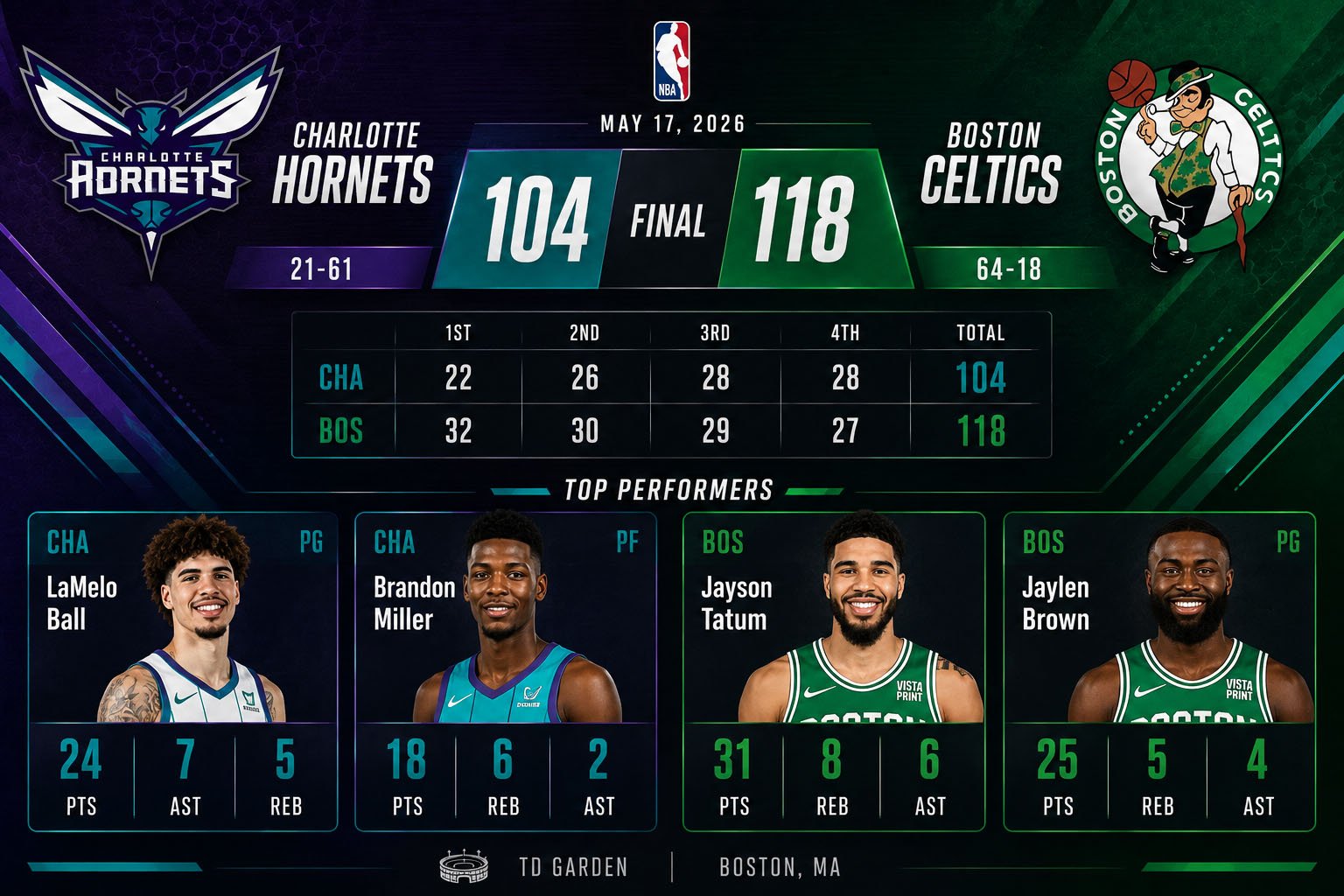
Charlotte Hornets vs Boston Celtics has turned into one of the more entertaining regular season matchups in the Eastern Conference, mostly because of the fireworks LaMelo Ball and Boston’s stars bring every time these two teams meet. The Celtics have used their depth and star power to control the season series, but Ball has made sure Charlotte never goes down without a fight, filling up the box score in nearly every meeting.
This article breaks down the most recent matchups between these two teams, the top individual performances from both rosters, and what the season series says about each team heading toward the playoffs. Every stat below comes from official box scores and team reports.
Quick Team Snapshot
| Team | Record | Conference Rank | Season Series |
|---|---|---|---|
| Boston Celtics | 56-26 | 2nd, Eastern Conference | Leads 2-1 |
| Charlotte Hornets | 44-38 | 9th, Eastern Conference | Trails 1-2 |
Boston has controlled the season series against Charlotte, with the Celtics locking up a strong playoff seed while the Hornets fight to secure their spot in the play in tournament.
Charlotte Hornets Key Player Stats
LaMelo Ball: Putting the Team on His Back
Point guard LaMelo Ball has been the engine of the Hornets offense every time Charlotte has faced Boston this season. In one of the two teams’ most recent meetings, Ball exploded for 36 points, marking his second straight 30 point outing and reminding everyone why he remains one of the most electric scorers in the league even on a team still fighting for a playoff spot.
Ball’s production against Boston has been remarkably consistent, and his ability to score from all three levels, the perimeter, the midrange, and at the rim, makes him one of the toughest covers in basketball on any given night. Even when Charlotte has come up short in the final score, Ball’s individual performances have kept these games competitive deep into the fourth quarter.
Brandon Miller and the Supporting Cast
Forward Brandon Miller has developed into a legitimate second scoring option for Charlotte, adding 20 points in the same game where Ball erupted for 36. His combination of size and shooting touch gives the Hornets a matchup problem on the wing, forcing Boston to choose between multiple defenders to try to contain him.
Forward Miles Bridges has also factored heavily into these matchups, contributing double figure scoring and strong rebounding numbers, including a 13 point, 12 rebound effort in one recent meeting. That kind of two way production from Bridges gives Charlotte a physical presence that helps offset some of Boston’s size advantage in the frontcourt.
Boston Celtics Key Player Stats
Jaylen Brown and Jayson Tatum: A Dominant Duo
Forward Jaylen Brown delivered one of his best individual performances of the season against Charlotte, scoring 35 points and grabbing nine rebounds in a Celtics win. Brown has scored 26 or more points in ten straight games during that stretch, showing off the kind of consistent scoring that makes Boston’s offense so difficult to slow down. Full box score details from that game are available through ESPN’s game recap.
Jayson Tatum has been equally important in these matchups, adding 23 points in that same contest while extending his own streak of at least 20 points in six consecutive games. Tatum’s return from a torn Achilles earlier in the season has been one of the biggest storylines in the league, and his performances against Charlotte have shown he is rounding back into elite form, including a season high 32 point outing against the Hornets earlier in his return.
Payton Pritchard and Derrick White
Guard Payton Pritchard has provided valuable scoring off the bench in matchups against Charlotte, once posting 22 points in a blowout Celtics win. His ability to space the floor and knock down shots off the bench gives Boston another dimension when the starters need a breather. Derrick White has also factored into these games as a steady two way presence, contributing scoring, playmaking, and perimeter defense that helps neutralize some of Charlotte’s offensive firepower.
Hornets vs Celtics: Key Player Stats at a Glance
| Player | Team | Points | Rebounds | Notable Stat |
|---|---|---|---|---|
| LaMelo Ball | Hornets | 36 | N/A | Second straight 30-point game |
| Jaylen Brown | Celtics | 35 | 9 | 10 straight 26+ point games |
| Jayson Tatum | Celtics | 23-32 | Varies | 20+ points in 6 straight games |
| Brandon Miller | Hornets | 20 | N/A | Second scoring option |
| Miles Bridges | Hornets | 13 | 12 | Physical two way presence |
Note: Some figures reflect standout individual games from the season series rather than full season career averages, since these matchups produced such complete statistical performances from both rosters.
Coaching Philosophies and Style of Play
Boston’s coaching staff, led by Joe Mazzulla, has built a system that maximizes spacing around Tatum and Brown, surrounding the two stars with shooters and connective playmakers who can capitalize whenever a defense collapses to help. That approach has made the Celtics one of the most efficient offensive teams in the league, and it showed up clearly in matchups against Charlotte, where Boston’s ball movement consistently generated open looks even against a Hornets defense keyed in on stopping the team’s top scorers.
Charlotte’s coaching staff has taken a different approach, building the offense heavily around Ball’s playmaking and shot creation ability. That system puts enormous pressure on Ball to produce every night, but it has also allowed Charlotte to stay competitive against far more talented rosters, since a hot shooting night from Ball can single handedly keep the Hornets in any game. The challenge for Charlotte’s coaching staff has been finding ways to generate more consistent secondary scoring so the offense does not become too predictable when opposing defenses key in on containing Ball.
The Impact of Tatum’s Return From Injury
Jayson Tatum’s return from a torn Achilles tendon represents one of the most significant storylines in the entire NBA this season, and his performances against Charlotte have offered valuable data points for evaluating his recovery. His season debut, which came on the road against the Hornets, saw him post 15 points, 12 rebounds, and seven assists, an encouraging all around performance that suggested he had not lost his feel for the game despite the extended layoff.
Subsequent matchups against Charlotte showed continued progress, including a season high 32 point outburst that included the exact kind of shot making, quick decisive moves off ball fakes followed by decisive jumpers, that had defined his game before the injury. Teammates and coaches have both praised how quickly Boston has been able to reintegrate him into the rotation, crediting both his own work ethic during rehabilitation and the team’s ability to remain competitive during his absence, which reduced the pressure on him to immediately carry the offense upon his return.
Fantasy and Betting Considerations
For fans tracking fantasy basketball or betting markets, matchups between these two teams have consistently provided value. LaMelo Ball’s usage rate against Boston has remained extremely high, making him a reliable fantasy option even in difficult matchups, since his role as Charlotte’s primary offensive engine does not change regardless of opponent. Brown and Tatum have similarly provided strong, consistent fantasy production in these games, reflecting Boston’s offensive game plan of leaning heavily on its two stars in big moments.
Betting markets have generally favored Boston significantly in these matchups, reflecting the gap in overall team quality, though Charlotte has occasionally covered spreads behind explosive individual scoring performances from Ball. That pattern, competitive point spreads despite one sided final scores in team success, reflects how much individual star power can influence betting outcomes even in games where the final result is rarely in serious doubt.
The Eastern Conference Landscape This Season
Understanding this matchup requires understanding the broader Eastern Conference picture both teams are operating within. Boston has spent the season positioning itself as one of the top contenders in the conference, and every game against a team like Charlotte carries importance not just for the individual result but for playoff seeding purposes. A higher seed generally means a more favorable path through the postseason, home court advantage in potential series, and additional rest between games, all factors that matter enormously once the playoffs begin.
Charlotte, meanwhile, has spent the season fighting for playoff relevance in a conference that has grown increasingly competitive from the middle seeds down. The play in tournament format has added extra stakes to games against teams like Boston, since every regular season result affects positioning for that crucial stretch run. Even games the Hornets ultimately lose can carry value if the performance shows the kind of competitiveness that builds confidence heading into high pressure play in matchups later in the season.
Statistical Efficiency Metrics Worth Tracking
Beyond the traditional box score numbers, advanced statistical measures help explain why Boston has controlled this matchup despite Charlotte’s individual scoring outbursts. Boston’s offensive rating, which measures points produced per 100 possessions, has consistently ranked among the league’s best, reflecting the efficiency of a system built around ball movement and quality shot selection. That efficiency advantage often shows up most clearly in the fourth quarter of close games, exactly the pattern seen in several meetings between these two teams this season.
Charlotte’s own offensive numbers, while respectable given Ball’s individual brilliance, have generally trailed Boston’s efficiency marks, particularly when it comes to turning possessions into quality shot attempts against a set defense. That gap helps explain why games between these two teams have often followed a similar pattern, with Charlotte competitive for stretches but Boston’s more efficient half court execution eventually pulling games out of reach in the fourth quarter.
The Development Arc of Charlotte’s Young Core
Charlotte’s roster construction reflects a franchise firmly in a talent accumulation and development phase, built around a core of Ball, Miller, and other young pieces still growing into their NBA roles. Each meeting against a contender like Boston serves as a valuable measuring stick for that development, showing coaches and evaluators exactly where the gap remains between Charlotte’s current level and true championship contention.
Miller in particular has shown significant growth this season, evolving from a promising rookie into a legitimate secondary scoring threat capable of taking pressure off Ball in crucial moments. His continued development, along with growth from other young Hornets players, represents the clearest path toward Charlotte eventually competing on more equal footing with teams like Boston in future seasons. The organization’s patience with this development process, even during a season with mixed results, reflects a long term view of roster building rather than a focus on immediate results.
Boston’s Championship Pedigree and Playoff Experience
One often overlooked factor in this matchup involves the significant playoff and championship experience present on Boston’s roster compared to Charlotte’s younger core. Players like Brown and Tatum have been through deep playoff runs together, including a championship run, giving them a level of composure and situational awareness that shows up in close games, including several tight moments in matchups against Charlotte this season.
That experience gap matters enormously in professional basketball, where knowing how to execute in late game situations, manage fouls, and make winning plays under pressure often separates good teams from great ones. Charlotte’s young players are still accumulating that kind of experience, and games against a battle tested opponent like Boston provide valuable lessons, even in defeat, about the poise and execution required to compete at the highest level of the league.
Injury Management and Load Considerations
Both organizations have had to navigate injury and load management considerations throughout the season, decisions that have occasionally affected the composition of these matchups. Boston’s medical and performance staff have carefully managed Tatum’s workload as he continues working back from his Achilles injury, sometimes limiting his minutes or resting him entirely in certain situations to protect his long term health, even during meaningful regular season games.
Charlotte has dealt with its own injury concerns throughout the season, with players like Ball and Bridges occasionally missing games due to various ailments. Those absences have tested the Hornets’ depth and provided opportunities for other players to step into larger roles, valuable experience for a young roster even when the immediate results have not always been favorable. Navigating those injury situations while still trying to compete for playoff positioning has added an extra layer of complexity to Charlotte’s season.
Media Coverage and National Attention
Games between these two teams have drawn increasing national media attention throughout the season, partly due to Ball’s individual star power and highlight reel playing style, and partly due to genuine interest in Tatum’s recovery story following his Achilles injury. National broadcast partners have recognized the appeal of showcasing these individual storylines, even in games where the final outcome has often favored Boston by a comfortable margin.
That attention has helped raise Charlotte’s profile as an organization, even during a season focused more on development than immediate championship contention. Ball’s growing national reputation as one of the league’s most exciting players to watch has given the Hornets increased visibility, a valuable asset for a smaller market franchise working to build sustained interest and support as the young core continues developing toward what the organization hopes will be sustained future success.
Team Comparison
The gap between these two teams often comes down to overall roster depth. Boston has built a championship caliber roster with multiple All-Star caliber scorers in Brown and Tatum, complemented by reliable role players like Pritchard and White who can step up on any given night. That depth allows the Celtics to weather foul trouble, injuries, or an off shooting night from any single player.
Charlotte has leaned heavily on Ball to create most of its offense, with Miller and Bridges providing solid complementary scoring. When Ball gets hot, as he has in several meetings against Boston, the Hornets can hang with almost any team in the league. The challenge for Charlotte has been finding enough consistent scoring beyond its top few players to complete fourth quarter comebacks against a deep, well coached Boston roster.
Coaching Adjustments Across Multiple Meetings
Throughout the season series, both coaching staffs have made in game and between game adjustments based on what worked and did not work in previous matchups. Boston’s staff has consistently emphasized sending multiple defenders at Ball whenever he gets going, a strategy that forces the ball out of his hands and tests whether Charlotte’s other players can create quality offense on their own. That approach has generally worked, even in games where Ball still managed to score prolifically, since the extra defensive attention often disrupted the flow of Charlotte’s offense in other areas.
Charlotte’s coaching staff has countered by designing more off ball actions to get Ball easier looks without requiring him to create every shot himself, an adjustment that showed up in his more efficient scoring performances against Boston later in the season. That kind of iterative, game to game strategic evolution reflects the chess match that unfolds over a season series between two teams that face off multiple times, with each coaching staff constantly searching for new wrinkles to exploit or counter.
The Business of Basketball: Market Size and Revenue Implications
Beyond the pure basketball considerations, the contrast between these two franchises reflects broader trends in market size and revenue generation across the league. Boston operates in one of the largest and most historically significant basketball markets in the country, generating substantial local revenue that helps fund a payroll capable of retaining stars like Brown and Tatum on long term maximum contracts while still adding complementary pieces around them.
Charlotte operates in a considerably smaller market, which creates real financial constraints on roster construction compared to larger market teams. That reality makes the draft and player development even more critical for the Hornets organization, since the team cannot simply outspend competitors to acquire star talent the way larger market franchises sometimes can. Ball’s development into a genuine star has been especially valuable in that context, giving Charlotte a marketable, exciting player around whom to build both the roster and the franchise’s broader business operations.
Historical Perspective on the Hornets Organization
Charlotte’s current rebuilding effort exists within a broader organizational history that has included periods of both success and struggle since the franchise’s original founding and subsequent relocation and rebranding over the years. Longtime fans of the organization have seen multiple eras of competitive basketball followed by rebuilding stretches, and the current core built around Ball represents the latest attempt to establish sustained success in a challenging Eastern Conference landscape.
That historical context matters for understanding fan expectations and organizational patience during the current developmental phase. Charlotte’s front office has generally prioritized building through the draft and internal development rather than aggressive free agent spending, a philosophy that requires patience but can produce sustainable long term success if the young talent continues developing as hoped, a pattern the organization is clearly betting on with its current roster construction around Ball, Miller, and the rest of the young core.
Advanced Metrics Comparing the Two Rosters
Looking beyond traditional counting statistics, several advanced metrics help contextualize the gap between these two rosters. Boston’s net rating, which measures point differential per 100 possessions, has consistently ranked among the best in the league, reflecting a team that dominates opponents on both ends of the floor rather than simply outscoring them in track meet style games. Charlotte’s net rating has been considerably lower, a fair reflection of a team still developing the two way consistency that characterizes true championship contenders.
Player efficiency ratings for the top performers on both rosters also tell an interesting story. Tatum and Brown both rank among the league leaders in this metric when healthy and playing at full strength, reflecting their status as legitimate superstars. Ball’s own efficiency numbers, while impressive for a player his age carrying such offensive responsibility, still show room for growth, particularly in translating his scoring volume into more consistent winning outcomes for his team, a natural part of the development process for a young star still learning to balance individual brilliance with optimal team success.
What This Rivalry Could Look Like in Future Seasons
Looking ahead, this matchup has the potential to evolve significantly depending on how both rosters develop over the coming seasons. If Charlotte’s young core continues progressing at its current rate, games against Boston could become considerably more competitive, potentially even shifting the balance of power if the Hornets can add the kind of complementary pieces and coaching continuity that has helped Boston sustain its championship level play.
For Boston, the challenge will involve managing the aging curve of its current core while continuing to develop young talent capable of extending the team’s championship window. Games against rebuilding teams like Charlotte currently serve as useful measuring sticks for evaluating bench players and younger rotation pieces, even while the primary focus remains on maximizing the current championship window built around Brown and Tatum. How both franchises navigate these respective challenges will likely determine whether this matchup remains lopsided in Boston’s favor or evolves into a more genuinely competitive rivalry in the years ahead.
Head to Head History
Boston has generally held the edge in recent meetings between these two teams, a trend that continued into the current season with the Celtics controlling the head to head series. That dominance reflects the gap in overall roster construction between a Boston team built for a deep playoff run and a Charlotte team still developing its young core around Ball, Miller, and the rest of a talented but less experienced roster.
Recent Matchup Recap
One of the most memorable recent meetings between these two teams saw Boston pull away in the second half, outscoring Charlotte 35-26 in the third quarter to take control after trailing by 11 points in the first half. The Celtics then limited the Hornets to just 15 points in the fourth quarter, extending their lead to 13 points and closing out a 113-102 win that moved Boston closer to locking up the number two seed in the Eastern Conference.
Ball’s 36 points were not enough to overcome Boston’s balanced attack, which saw both Brown and Tatum score more than 20 points while playing the entire fourth quarter to close out the win. That game gave Boston a 2-1 edge in the season series, a result that could carry extra significance if these two teams meet again in a potential first round playoff matchup.
What to Watch Next
For the Celtics, continuing to build chemistry around a healthy Tatum will be the biggest storyline as the playoffs approach. His return from a torn Achilles has been a resounding early success, and if he continues trending toward his peak form, Boston looks like a legitimate championship contender once again.
For the Hornets, the development of the young core around Ball, Miller, and Bridges remains the priority. Charlotte has shown flashes of real competitiveness against a top tier team like Boston, and continued growth from that trio could position the Hornets as a team nobody wants to face in the play in tournament or an early playoff round.
Conclusion
Charlotte Hornets vs Boston Celtics has delivered plenty of individual fireworks this season, even as the Celtics have controlled the overall head to head results. LaMelo Ball’s scoring explosions have kept Charlotte competitive in nearly every meeting, while Jaylen Brown and Jayson Tatum have shown exactly why Boston remains one of the top teams in the Eastern Conference.
With Boston holding the edge in the season series and potentially finalizing a stronger playoff position, and Charlotte continuing to develop its talented young core, future meetings between these two teams should remain must watch basketball for fans of both franchises.
Frequently Asked Questions
Who has controlled the season series between the Hornets and Celtics?
The Boston Celtics have controlled the season series, winning the head to head matchup 2-1 against the Charlotte Hornets this season.
How has LaMelo Ball performed against Boston?
Ball has been extremely productive against the Celtics, scoring 36 points in one recent meeting for his second consecutive 30 point game, showing off his ability to carry the Hornets offense.
How have Jaylen Brown and Jayson Tatum performed against Charlotte?
Brown scored 35 points and grabbed nine rebounds in one recent meeting, while Tatum added 23 points in that same game, extending his streak of 20 or more points to six straight contests.
Which team has the deeper roster?
Boston has significantly more depth, with reliable scorers like Payton Pritchard and Derrick White able to contribute alongside Brown and Tatum, while Charlotte relies heavily on Ball, Miller, and Bridges to carry the offensive load.
Could the Hornets and Celtics meet in the playoffs?
Given their positioning in the Eastern Conference standings, a first round playoff matchup between the two teams remained a real possibility as the regular season wound down.