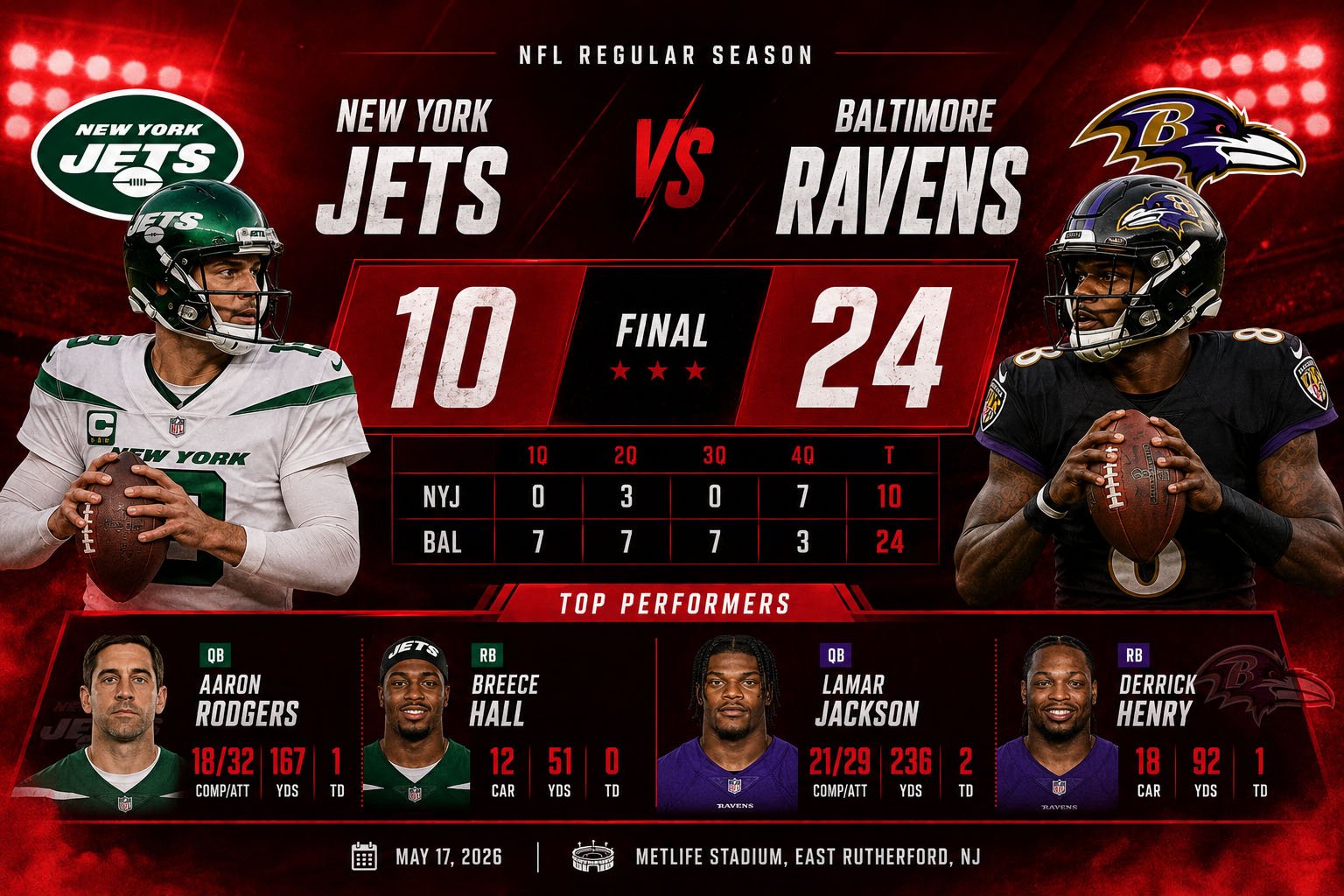
New York Jets vs Baltimore Ravens tells the story of two franchises on opposite ends of the standings during the 2025 season. While Baltimore fought its way back from an early hole to reestablish itself as an AFC North contender, New York spent much of the year searching for answers at quarterback and struggling to find consistency on either side of the ball. Their meeting in November became a useful measuring stick for just how far apart these two rosters had drifted.
This article looks at both teams’ season long numbers heading into that matchup, the top individual performers on each roster, and what the game revealed about New York’s rebuilding process compared to Baltimore’s playoff push. Every stat below comes from official team reports and box scores.
Quick Team Snapshot
| Team | Record Entering Game | Recent Form | Key Storyline |
|---|---|---|---|
| New York Jets | 2-8 | Struggling | Quarterback change at midseason |
| Baltimore Ravens | 5-5 | Won 4 straight | Recovering from 1-5 start |
New York entered this matchup as one of the league’s struggling teams, while Baltimore had already completed a significant turnaround from its slow start to the season.
New York Jets Key Player Stats
Justin Fields: A Season of Ups and Downs Before the Benching
Quarterback Justin Fields had shown real promise through the first nine games of the season before losing his starting job, completing 62.7 percent of his passes for 1,259 yards with seven touchdowns against just one interception. Those efficiency numbers reflected genuine progress in Fields’ decision making, a notable improvement from earlier points in his career when turnovers had been a more consistent issue.
Fields also remained a dangerous rushing threat throughout the season, adding four rushing touchdowns and 383 rushing yards, the second highest rushing total on the Jets roster. Despite those respectable numbers, New York’s coaching staff made the decision to bench Fields ahead of the Baltimore matchup, turning to veteran Tyrod Taylor in a search for more consistent overall team performance during a difficult stretch of the season.
Breece Hall: A Steady Offensive Weapon
Running back Breece Hall has been one of the most reliable pieces of New York’s offense throughout the season, leading the team with 722 rushing yards and two touchdowns while averaging 72.2 yards per game and 4.8 yards per carry, a mark that ranked 13th among all NFL rushers at that point in the season. Hall’s dual threat ability has made him a focal point of New York’s offensive game plan regardless of which quarterback has been under center.
Beyond his rushing production, Hall has also contributed significantly as a receiver, catching 24 passes for 226 receiving yards, an average of 22.6 yards per game out of the backfield. That kind of versatility has made him one of the few consistent bright spots for a Jets offense that has otherwise struggled to find its footing through the first two thirds of the season.
Baltimore Ravens Key Player Stats
Lamar Jackson: Battling Through Injuries to Lead a Turnaround
Quarterback Lamar Jackson entered the Jets matchup having thrown for 1,442 yards with 15 touchdowns against just three interceptions on the season, numbers that reflected efficient, if occasionally limited, play as he worked his way back from injuries that had cost him time earlier in the year. Averaging 206 passing yards per game and 8.4 yards per attempt while completing 68 percent of his throws, Jackson had shown flashes of his MVP caliber form during Baltimore’s four game winning streak heading into this matchup. You can find detailed game logs and season stats through ESPN’s NFL coverage.
Jackson had also remained a persistent rushing threat even while managing physical setbacks, adding 226 rushing yards on the season, second on the Ravens roster behind only Derrick Henry. Over his three starts immediately before the Jets game, Jackson had completed 64 percent of his passes for five touchdowns against two interceptions, numbers that helped fuel Baltimore’s dramatic turnaround from its rocky start to the season.
Derrick Henry and Zay Flowers
Running back Derrick Henry entered the Jets matchup averaging 4.9 yards per carry, 11th best in the NFL, with 80.7 rushing yards per game and 807 total rushing yards on the season, sixth most in the league. His seven rushing touchdowns on the year reflected the kind of consistent goal line and short yardage production that had made him one of the most important pieces of Baltimore’s offensive turnaround.
Wide receiver Zay Flowers had emerged as Jackson’s top target through the air, totaling 703 receiving yards on 53 catches from 71 targets, giving Baltimore a legitimate perimeter threat to complement its dominant rushing attack. That combination of Henry’s power running and Flowers’ downfield playmaking had helped Baltimore climb from the bottom of the AFC North standings into direct playoff contention by the time the Ravens hosted the Jets.
Jets vs Ravens: Key Player Stats at a Glance
| Player | Team | Season Yards | Touchdowns | Key Stat |
|---|---|---|---|---|
| Justin Fields | Jets | 1,259 passing | 7 passing, 4 rushing | 62.7% completion rate |
| Breece Hall | Jets | 722 rushing | 2 | 4.8 yards per carry |
| Lamar Jackson | Ravens | 1,442 passing | 15 | 68% completion rate |
| Derrick Henry | Ravens | 807 rushing | 7 | 4.9 yards per carry |
| Zay Flowers | Ravens | 703 receiving | 1 | 53 catches on 71 targets |
Note: Figures reflect each player’s statistics through the point in the season when these two teams met, since both rosters continued to develop as the year progressed.
Evaluating the Quarterback Decision in Real Time
The decision to bench Fields in favor of Taylor represented one of the more scrutinized coaching decisions of New York’s season, and it split opinion among analysts and fans alike. Supporters of the move pointed to the Jets’ overall record and the need to evaluate every possible option in a lost season, while critics noted that Fields’ underlying statistics, particularly his low interception total and improved rushing production, suggested real developmental progress that a benching might interrupt at a critical stage of his career.
Taylor’s performance against Baltimore added another data point to that ongoing debate. His 222 passing yards and touchdown pass showed he could still operate an NFL offense effectively even after years spent primarily in backup roles, but the late interception that sealed New York’s fate also reinforced concerns about relying on a 36 year old journeyman quarterback as anything more than a short term bridge option. That tension, between wanting to evaluate Fields’ long term potential and needing to maximize competitiveness in the present, remained unresolved heading into the following weeks of the season.
Draft Positioning and Long Term Roster Building
New York’s struggles throughout the season inevitably raised questions about how the losses might translate into draft positioning for the following offseason. A 2-9 record at this point in the season placed the Jets firmly among the teams picking near the top of the draft order, a reality that some analysts suggested could influence in season decisions, including how the coaching staff approached the quarterback rotation and other personnel choices down the stretch.
That dynamic, balancing the desire to win games in the present against the long term benefits of higher draft positioning, creates a complicated set of incentives for struggling franchises. New York’s front office faced difficult decisions about how much to prioritize development of young talent like Hall and other emerging players against simply trying to be competitive on a week to week basis, a challenge that would continue to shape the organization’s approach through the remainder of the season and into the following offseason.
Contrasting Organizational Philosophies
Beyond the immediate quarterback controversy, this matchup highlighted a broader contrast in organizational philosophy between the two franchises. Baltimore’s front office, led by general manager Eric DeCosta, has built a reputation for identifying value through the draft and free agency while maintaining roster continuity around a core group of players, an approach that had paid dividends during the team’s turnaround from its early season struggles.
New York, by contrast, had cycled through significant roster and coaching changes in recent seasons, reflecting a franchise still searching for the right combination of philosophy and personnel to build sustained success. That instability made it more difficult for the Jets to develop the kind of complementary, well rounded roster that Baltimore had assembled, even though New York possessed individual talents like Fields and Hall capable of competing with players on far more successful rosters.
Zay Flowers and Baltimore’s Receiving Corps Depth
Beyond his individual statistics, Zay Flowers’ emergence as a legitimate number one target reflected broader depth improvements across Baltimore’s receiving corps throughout the season. His ability to separate from coverage and create yards after the catch gave Jackson a reliable outlet even during games, like the one against New York, when the passing offense struggled to find consistent rhythm. That reliability had become increasingly important as Baltimore worked to diversify its offensive attack beyond simply relying on Henry’s power running.
Flowers’ development also represented a broader trend of the Ravens successfully developing young receiving talent, a departure from previous seasons when Baltimore’s passing attack had sometimes lacked explosive playmakers outside of Jackson’s individual rushing ability. That improved receiving corps gave Baltimore’s offense a more complete identity heading into the final stretch of the season, one capable of beating opponents through the air as well as on the ground, even during games when one phase of the attack struggled to find its footing early.
Analyzing New York’s Offensive Line Struggles
Beyond the quarterback controversy that dominated headlines, New York’s offensive line performance throughout the season played a significant role in the team’s overall struggles. Consistent pressure allowed against the Jets’ front had limited both Fields’ and, subsequently, Taylor’s ability to operate comfortably in the pocket, forcing quicker decisions and occasionally rushed throws that contributed to some of the team’s offensive inconsistency throughout the season. That protection issue had been a persistent theme in New York’s difficulties, regardless of which quarterback took the majority of snaps in any given week.
Addressing offensive line depth and overall quality became an increasingly important priority for New York’s front office as the season progressed, with evaluators recognizing that even talented skill position players like Hall and capable quarterback play from either Fields or Taylor would struggle to translate into consistent winning football without more reliable protection up front. That structural issue represented one of the clearer, more fixable problems facing the organization heading into future roster building decisions, distinct from the more complicated quarterback evaluation questions that had dominated media coverage throughout the season.
Comparing Two Different Team Building Philosophies
The contrast between how Baltimore and New York have approached roster construction offers a useful case study in different organizational philosophies within the modern NFL. Baltimore has built its success around a stable core of drafted talent, particularly at the skill positions, complemented by shrewd free agency additions like Henry that fit specific scheme needs. That approach has allowed the organization to maintain continuity even through difficult stretches, like the team’s early season struggles, ultimately trusting the underlying talent and system to produce results once health and execution improved.
New York’s approach has featured more significant roster and coaching turnover in recent seasons, reflecting an organization still searching for the right combination of philosophy, personnel, and coaching staff to build sustained success. That instability, while understandable given the team’s competitive struggles, has made it more difficult to develop the kind of continuity and shared understanding between quarterback, coaching staff, and skill position players that often characterizes the league’s more consistently competitive franchises, a challenge new head coach Aaron Glenn had been working to address throughout his tenure.
The Psychological Impact of a Midseason Benching
Benching a starting quarterback midseason carries significant psychological implications, both for the player directly affected and for the broader locker room culture. Fields had shown genuine statistical progress throughout the season before losing his starting job, and how he responded to that benching, whether with continued professionalism and preparation or with visible frustration, would likely influence how teammates and coaches viewed his long term fit within the organization moving forward.
Similarly, Taylor’s insertion into the starting lineup after years primarily spent in backup roles required its own psychological adjustment, suddenly facing the pressure and increased scrutiny that comes with being a starting NFL quarterback rather than simply preparing as a backup option. His respectable performance against Baltimore, despite the eventual loss, suggested he handled that transition with the kind of professionalism and preparation that veteran players often bring to unexpected opportunities, even in the midst of a difficult team wide season.
Breece Hall’s Broader Role in New York’s Offense
Beyond his statistical production, Hall’s value to New York’s offense extended into his ability to provide stability and reliability regardless of which quarterback was under center. His familiarity with the offensive system and chemistry with the offensive line gave New York’s coaching staff a dependable option to lean on during the transition between Fields and Taylor, a valuable stabilizing presence during a period of genuine uncertainty at the game’s most important position.
That kind of positional stability matters enormously for young, developing rosters navigating difficult seasons, since it allows coaching staffs to maintain some offensive consistency even while other aspects of the game plan undergo significant change. Hall’s continued development as both a runner and receiver throughout the season offered one of the clearer positive storylines for a Jets organization otherwise searching for answers across multiple areas of the roster heading into an important offseason of evaluation and potential changes.
Media Narratives Surrounding the Jets’ Season
National football media coverage of New York’s season had increasingly focused on questions about the organization’s overall direction, with the quarterback benching serving as just one data point in a broader narrative about roster construction, coaching decisions, and long term planning. Analysts and former players turned broadcasters offered varying opinions about whether the Fields benching represented a reasonable evaluation decision or a premature abandonment of a player still developing within a new system.
That media scrutiny added external pressure to an already challenging season, with every decision facing amplified analysis and criticism given the historically high expectations that come with playing in the New York media market. Navigating that pressure while still making sound, long term focused decisions about player development and roster construction represented an ongoing challenge for Glenn and the rest of New York’s coaching and front office staff throughout this difficult season.
Team Comparison
The numbers heading into this matchup told a clear story about two teams in very different positions. Baltimore’s offense, even while working through injuries to Jackson, had built a well rounded attack featuring an elite power runner in Henry and a legitimate downfield threat in Flowers. That balance had allowed the Ravens to win consistently once their defense also began improving after the team’s early struggles.
New York’s offense showed real flashes of talent, particularly from Fields before his benching and from Hall throughout the season, but the team’s overall record reflected deeper issues beyond just quarterback play. The decision to bench Fields, despite his respectable statistical output, showed a coaching staff still searching for the right formula to turn promising individual performances into consistent team success.
Head to Head History
The Ravens have generally held a strong recent record against the Jets, a trend that reflects Baltimore’s overall stability as a franchise compared to a Jets team that has cycled through multiple coaching staffs and quarterback situations in recent seasons. This particular era of the rivalry had continued to favor Baltimore heading into their most recent meeting.
Recent Matchup Recap
The Ravens took control of this matchup in the second half, using a Derrick Henry touchdown drive that consumed more than six minutes of the third quarter to overcome a slow start and eventually win 23-10. New York, with Taylor now under center in place of the benched Fields, competed well for a half but could not sustain that level of play once Baltimore’s rushing attack found its rhythm after the break. A full breakdown of the matchup is available through The Football Database’s team versus team records.
That result extended Baltimore’s winning streak to five games and dropped New York to 2-9 on the season, continuing a difficult stretch that had defined much of the Jets’ 2025 campaign despite flashes of promise from individual players like Fields and Hall.
What to Watch Next
For the Jets, the biggest storyline going forward involves settling the quarterback situation heading into future seasons. Fields showed genuine statistical progress before his benching, and how the organization evaluates that body of work against Taylor’s veteran presence will shape one of the most important decisions facing the franchise.
For the Ravens, continuing to manage Jackson’s health while maintaining the offensive balance provided by Henry and Flowers will be critical as Baltimore pushes toward the postseason. The turnaround from a 1-5 start to playoff contention represents one of the more impressive midseason transformations in recent NFL history, and sustaining that momentum will require continued strong play across all three phases of the game.
Zay Flowers and the Evolution of Baltimore’s Passing Attack
Beyond his individual season statistics, Flowers’ continued development reflected a broader evolution in how Baltimore approached its passing offense compared to previous seasons that had relied more heavily on Jackson’s individual playmaking ability, both through the air and on the ground. Having a legitimate number one receiving option gave Baltimore’s coaching staff more diverse play calling options, particularly valuable during stretches when Jackson’s mobility was limited by injury and the offense needed alternative ways to generate explosive plays through the air rather than relying primarily on quarterback scrambles and designed runs.
That receiving corps development represented an important organizational priority for Baltimore heading into the season, recognizing that sustained championship contention typically requires a more balanced offensive attack capable of beating defenses through multiple methods rather than depending too heavily on any single dimension. Flowers’ emergence, alongside continued contributions from other receiving options on the roster, gave Baltimore’s offense the kind of multifaceted identity that had proven difficult for opposing defenses, including a competitive Jets unit for a half, to consistently contain throughout the season.
The Long Term Outlook for Both Franchises
Looking beyond this single matchup, the trajectories of these two franchises heading into future seasons appeared to be diverging significantly based on performances throughout 2025. Baltimore’s combination of a top tier quarterback in Jackson, complemented by elite skill position talent in Henry and Flowers, positioned the organization for continued competitiveness assuming the team could maintain roster continuity and manage the aging curves of key veteran contributors like Henry in the coming seasons.
New York’s path forward remained considerably less certain, with fundamental questions about quarterback play, offensive line quality, and overall coaching philosophy still requiring resolution before the organization could reasonably expect to compete with teams like Baltimore on a consistent basis. That uncertainty, while challenging for Jets fans to endure during difficult seasons like this one, also represented an opportunity for significant organizational improvement if the front office and coaching staff could successfully address the multiple structural issues that had contributed to the team’s struggles throughout the 2025 campaign.
Statistical Trends Worth Monitoring Going Forward
Several statistical trends from this matchup and the broader 2025 season offered useful indicators for what to watch as both organizations moved toward the following offseason. Baltimore’s ability to win games even during stretches of below average passing production from Jackson, as seen in this particular contest, suggested a level of roster balance and complementary football that many teams struggle to achieve, a positive indicator for sustained success even during individual games when the passing offense might not operate at peak efficiency.
For New York, the underlying efficiency numbers from both Fields and Taylor throughout the season provided front office decision makers with meaningful data for evaluating the quarterback position heading into a critical offseason. Completion percentage, touchdown to interception ratio, and overall offensive production under each quarterback would likely factor heavily into decisions about roster construction and potential free agency or draft investments at the position, decisions that would significantly shape the organization’s competitive outlook for the 2026 season and potentially beyond, depending on how thoroughly the front office chose to address the multiple questions still surrounding New York’s roster heading into an important stretch of organizational decision making.
Conclusion
New York Jets vs Baltimore Ravens highlighted the gap between a Ravens team that had successfully turned its season around and a Jets team still searching for stability at multiple positions. Justin Fields and Breece Hall showed real individual promise for New York, but Baltimore’s more complete roster, led by Lamar Jackson’s efficient play, Derrick Henry’s power running, and Zay Flowers’ emergence as a top target, proved too much to overcome.
With Baltimore continuing its push toward the playoffs and New York facing important decisions about its quarterback position and overall roster direction, this matchup offered a clear picture of two franchises at very different points in their respective journeys during the 2025 season. How each organization builds on these divergent trajectories will likely define the broader storyline of this rivalry heading into the years ahead.
Frequently Asked Questions
Why was Justin Fields benched before the Ravens game?
The Jets coaching staff turned to veteran Tyrod Taylor in search of more consistent team performance, despite Fields posting respectable numbers, including a 62.7 percent completion rate and seven touchdown passes against just one interception on the season.
How did Breece Hall perform for the Jets this season?
Hall led New York with 722 rushing yards and two touchdowns while averaging 4.8 yards per carry, also adding 226 receiving yards on 24 catches out of the backfield.
How had Lamar Jackson performed before the Jets matchup?
Jackson had thrown for 1,442 yards with 15 touchdowns against three interceptions on the season, completing 68 percent of his passes while battling through injuries during Baltimore’s turnaround.
What made Derrick Henry so effective for Baltimore this season?
Henry averaged 4.9 yards per carry with 807 total rushing yards and seven touchdowns, ranking among the NFL’s top rushers and anchoring Baltimore’s physical offensive identity.
How significant was Baltimore’s turnaround from its early season struggles?
The Ravens climbed from a 1-5 start to a winning record behind five consecutive victories, pulling the team into playoff contention after one of the more notable midseason transformations of the 2025 NFL season.