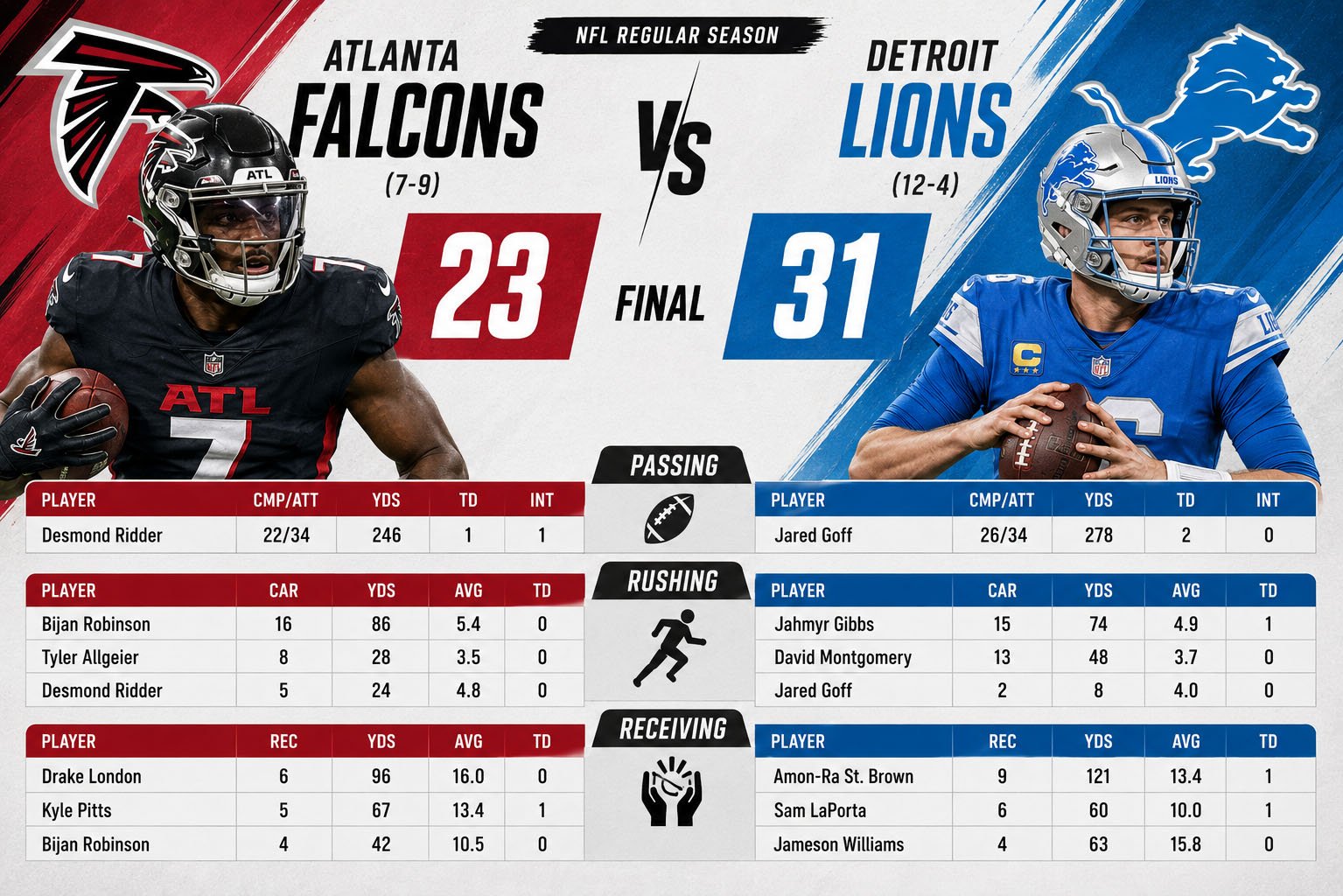
Atlanta Falcons vs Detroit Lions opened the 2025 preseason with a storm delayed thriller that offered an early glimpse of both teams’ quarterback depth, even though the game’s outcome carried little bearing on either franchise’s actual regular season fortunes. Detroit controlled most of the action behind a pair of backup quarterbacks, while Atlanta continued evaluating its own depth chart with starter Michael Penix Jr. held out of action. Both teams’ full 2025 seasons would go on to tell much larger and more complicated stories.
This article breaks down that preseason opener, the full season statistical profiles of the key quarterbacks involved, and what both performances revealed about each franchise heading into a season that ultimately left both teams outside the playoffs. Every stat below comes from official box scores and season reports.
Quick Team Snapshot
| Team | Game Result | Passing Leader | 2025 Season Record |
|---|---|---|---|
| Detroit Lions | Won 17-10 | Kyle Allen, 2 TD passes | 9-8, missed playoffs |
| Atlanta Falcons | Lost 17-10 | Easton Stick, 159 yards | 8-9, missed playoffs |
Detroit’s backup quarterbacks controlled this preseason opener before the game was ultimately suspended due to weather, while both teams’ full seasons ended in disappointing fashion despite standout individual quarterback performances from their respective starters.
Detroit Lions Key Player Stats
Jared Goff: An Efficient Season That Fell Just Short
While Jared Goff did not play in this preseason opener, his full 2025 regular season stood among the most efficient statistical campaigns of his career, even though it ultimately was not enough to return Detroit to the playoffs. Goff threw for 4,564 yards and 34 touchdowns against just eight interceptions across 623 dropbacks, earning a 77.7 overall PFF grade that ranked 12th among qualified quarterbacks league wide.
Despite that individual excellence, Detroit finished the season at 9-8, missing the playoffs after posting a combined 27-7 record over the two previous seasons. That disconnect between strong individual quarterback play and disappointing team results frustrated Lions fans throughout the year, with the defense and other complementary units unable to match the level of consistency Goff provided from the quarterback position on a game to game basis.
Kyle Allen and Detroit’s Backup Quarterback Battle
With Goff resting for this preseason opener, backup quarterback options Hendon Hooker and Kyle Allen split time behind center, with the two competing directly for Detroit’s backup job. Hooker’s night ended prematurely after losing fumbles on back to back drives, prompting head coach Dan Campbell to turn to Allen, who responded by completing a 68 yard pass to Jackson Meeks before finding Isaac TeSlaa for an 11 yard touchdown. Full details from that game are available through CBS Sports’ game recap.
That kind of decisive backup quarterback performance carried real stakes for Allen’s roster chances, showing exactly the composed, opportunistic play that coaching staffs look for when evaluating depth options at the position. Detroit’s ability to identify a capable backup quarterback proved valuable insurance for a team that would go on to lean heavily on Goff’s durability and consistency throughout the difficult 2025 campaign.
Atlanta Falcons Key Player Stats
Michael Penix Jr.: A Promising Season Cut Short
Quarterback Michael Penix Jr. did not play in this preseason opener, but his full 2025 season told a story of genuine promise interrupted by a significant injury. Penix started nine games, completing 166 of 276 passes for 1,982 yards with nine touchdowns against just three interceptions, posting an 88.5 passer rating before a torn ACL in Week 11 ended his season prematurely. His pace through those nine starts, more than 2,000 combined passing yards, represented the most produced by any quarterback through their first nine career starts in Falcons franchise history.
That injury forced Atlanta to turn to veteran Kirk Cousins for the remainder of the season, disrupting the offensive continuity the team had hoped to build around its younger passer. Penix’s strong underlying performance before the injury, including multiple games with a passer rating above 90, offered genuine reason for optimism about his long term outlook once he returned to full health.
Easton Stick and Atlanta’s Preseason Quarterback Evaluation
With both Penix and Cousins held out of this preseason opener, third string option Easton Stick made a strong bid to secure a roster spot, completing 15 of 18 passes for 159 yards, including a 13 yard touchdown pass to Chris Blair late in the first half. That efficient, high completion percentage performance gave Atlanta’s coaching staff valuable confidence in the team’s depth at the position heading into the regular season.
Emory Jones took over for Atlanta in the second half, continuing the team’s evaluation process for backup roles behind the two established options at the top of the depth chart. The game was ultimately suspended due to weather with Detroit leading 17-10, adding an unusual footnote to what had otherwise been a fairly standard preseason evaluation contest for both organizations.
Falcons vs Lions: Key Player Stats at a Glance
| Player | Team | 2025 Season Stats | Key Achievement | Season Outcome |
|---|---|---|---|---|
| Jared Goff | Lions | 4,564 yards, 34 TD, 8 INT | 77.7 PFF grade | 9-8, missed playoffs |
| Michael Penix Jr. | Falcons | 1,982 yards, 9 TD, 3 INT | Franchise 9-start record | Season-ending ACL tear |
| Kyle Allen | Lions | 2 TD passes (preseason) | Won backup competition | N/A |
| Easton Stick | Falcons | 159 yards (preseason) | 15/18 completions | N/A |
Note: The preseason statistics reflect backup quarterback performances, since both teams’ primary starters did not play in this particular contest, while the season totals reflect Goff’s full campaign and Penix’s production before his season-ending injury.
Team Comparison
Both organizations experienced statistically productive but ultimately disappointing 2025 seasons, missing the playoffs despite strong individual quarterback performances for large portions of the year. Detroit’s situation reflected a roster that had regressed somewhat from its dominant two year stretch prior to 2025, with Goff’s continued excellence unable to fully offset weaknesses elsewhere on the roster, particularly on the defensive side of the ball.
Atlanta’s season told a more complicated story, with Penix’s promising early season play offering genuine hope before his injury forced a difficult transition to Cousins for the remainder of the year. That kind of season altering injury at the quarterback position often derails a team’s competitive trajectory, and Atlanta’s eventual 8-9 finish reflected the challenge of maintaining offensive consistency after losing a quarterback playing at such a high level through his first nine career starts.
Head to Head History
Games between Atlanta and Detroit have been relatively infrequent given the two teams play in different divisions, meeting only periodically as part of the NFL’s scheduling rotation. This preseason opener provided a rare meeting between the two franchises, though its exhibition nature and ultimate weather suspension limited its significance within any broader historical context between the two organizations.
Recent Matchup Recap
The August 2025 preseason opener between these two teams featured extensive backup quarterback play from the outset, with both Goff and Penix resting for the contest. Detroit controlled the game behind Allen’s second half heroics after Hooker’s turnover troubles, building a 17-10 lead that held when the contest was ultimately suspended due to weather with just over six minutes remaining in the fourth quarter.
That suspended finish added an unusual footnote to the game, though the practical result, a Detroit lead that stood as the final outcome, mattered little for either team’s actual regular season preparations. Both coaching staffs used the available game action primarily to evaluate depth players and roster bubble candidates rather than to draw any meaningful conclusions about their respective teams’ regular season prospects.
Detroit’s Defensive Struggles in Context
While Goff’s passing production remained elite throughout the 2025 season, Detroit’s defensive performance told a considerably different story, one that ultimately explains much of the gap between the team’s individual quarterback excellence and its disappointing overall record. The Lions defense struggled with consistency throughout the year, particularly in critical late game situations where the unit had previously excelled during Detroit’s back to back strong regular seasons prior to 2025.
That defensive regression forced Goff and the offense into a difficult position, often needing to produce high scoring output simply to keep pace in games where the defense allowed opposing offenses to sustain long, productive drives. Analysts covering the team throughout the season frequently pointed to specific defensive personnel losses and scheme adjustments as contributing factors, suggesting the issues were identifiable and potentially correctable heading into future roster construction decisions for the organization.
Kirk Cousins’ Transition Into the Starting Role
Atlanta’s transition to Kirk Cousins following Penix’s injury represented a significant adjustment for an offense that had been building specifically around its younger quarterback’s skill set through the season’s first ten weeks. Cousins, a veteran with extensive starting experience from his previous tenure with other organizations, brought a different set of strengths and tendencies to the position, requiring Atlanta’s coaching staff to make in season adjustments to their offensive game plan.
That kind of midseason quarterback transition rarely produces seamless results, even when the replacement option brings substantial professional experience to the role. Cousins’ performance over the remainder of the season reflected the natural challenges of stepping into a starting role under difficult circumstances, working with a supporting cast and offensive system that had been specifically tailored around a different quarterback’s particular strengths and preferences heading into the year.
The Weather Suspension and Its Aftermath
The unusual weather suspension that ended this preseason opener between Atlanta and Detroit added an unconventional footnote to what had otherwise been a fairly standard exhibition contest focused on roster evaluation. Games suspended due to weather remain relatively rare in NFL history, and the circumstances surrounding this particular postponement drew some additional media attention beyond what a typical preseason opener between these two teams might have generated.
That weather related disruption ultimately had minimal practical impact on either team’s roster evaluation process, since both coaching staffs had already gathered sufficient game action from their backup quarterbacks and depth players before the suspension occurred. The final 17-10 score stood as the official result, with neither organization requesting or requiring any makeup action given the exhibition nature of the contest and the limited stakes involved for either team’s actual competitive standing.
Comparing Two Different Approaches to Quarterback Competition
Atlanta’s ongoing situation at quarterback throughout the 2025 season, first with Penix as the clear starter before his injury and subsequently transitioning to Cousins, contrasted with Detroit’s more stable approach built around Goff’s continued status as the unquestioned starter. That difference in organizational certainty at the position created meaningfully different planning environments for each team’s coaching staff throughout the season.
Detroit’s stability allowed offensive coordinator Morton to build his entire system around Goff’s specific strengths without needing to account for potential midseason changes at the position. Atlanta’s situation required considerably more flexibility and adaptation, first building around Penix’s mobile, downfield throwing style before adjusting to accommodate Cousins’ different but still effective approach following the injury driven transition.
Draft Investment and Long Term Quarterback Planning
Atlanta’s significant draft investment in Penix, selected eighth overall in the 2024 draft, reflected the organization’s clear long term plan to build around a young quarterback with substantial physical talent and draft pedigree. His promising performance through nine starts before the injury validated much of that original evaluation, even though the season ending nature of his injury prevented a complete assessment of his rookie contract development arc.
Detroit’s situation with Goff reflected a different kind of quarterback investment, having acquired him via trade rather than through the draft and subsequently signing him to a significant contract extension based on his strong performance with the organization. That contrast between draft developed and trade acquired quarterback talent offers an interesting comparison point for evaluating different team building philosophies at the league’s most important position.
Statistical Deep Dive Into Efficiency Metrics
Beyond the basic counting statistics, advanced efficiency metrics offer additional insight into both quarterbacks’ performances during the 2025 season. Goff’s 76.8 PFF passing grade reflected considerable ball placement precision and decision making consistency across a massive workload of 623 dropbacks, numbers that placed him firmly among the league’s more productive and reliable passing options despite his team’s disappointing overall record.
Penix’s smaller sample size through nine starts still produced an impressive 88.5 passer rating, a number that, had it been sustained across a full season, would have ranked among the league’s better performances at the position. That statistical projection, while necessarily speculative given the incomplete season, offered analysts and evaluators genuine reason to believe Atlanta had found a legitimate long term answer at quarterback before the unfortunate injury interrupted that developmental trajectory.
The Role of Supporting Cast in Both Teams’ Struggles
Neither Goff’s continued excellence for Detroit nor Penix’s promising early season play for Atlanta occurred in a vacuum, with each quarterback’s performance shaped significantly by the supporting cast around them. Detroit’s receiving corps, featuring established stars like Amon-Ra St. Brown alongside developing playmakers, gave Goff reliable targets throughout the season, even as other roster deficiencies, particularly on defense, undermined the team’s overall competitive success.
Atlanta’s situation involved its own supporting cast considerations, with receiver Drake London serving as Penix’s primary target during his healthy stretch of the season. The continuity of that specific quarterback and receiver relationship, disrupted by the midseason injury and subsequent transition to Cousins, represents exactly the kind of chemistry building that often takes considerable time to fully develop, adding another layer of complexity to Atlanta’s season long offensive performance evaluation.
Coaching Evaluations Following Disappointing Seasons
Both organizations faced significant internal evaluation processes following their disappointing 2025 seasons, with coaching staffs and front office personnel working to identify the specific factors that prevented playoff caliber individual quarterback performances from translating into playoff berths. Detroit’s evaluation likely centered heavily on defensive personnel and scheme questions, while Atlanta’s assessment necessarily included consideration of the team’s quarterback depth and contingency planning following Penix’s significant injury.
Those organizational evaluation processes, while occurring largely behind closed doors, ultimately shape the roster construction and coaching decisions that determine each team’s competitive trajectory heading into future seasons. Both Detroit and Atlanta entered their respective offseasons with clear individual quarterback talent to build around, even as each organization worked to address the specific complementary factors that had prevented that talent from producing more successful overall team outcomes during the 2025 campaign.
What to Watch Next
For the Lions, addressing the roster deficiencies that prevented a talented, Goff led offense from translating into a playoff berth remains the top priority heading into future seasons. The departure of offensive coordinator Ben Johnson prior to the 2025 season added an adjustment period for Goff and the rest of Detroit’s offense, and continued chemistry development with new play caller John Morton could help the Lions return to the playoff caliber form they showed in previous seasons.
For the Falcons, Penix’s continued recovery from his ACL tear represents the most significant storyline heading into the future. His strong underlying performance before the injury suggested a legitimate franchise quarterback in the making, and how quickly and completely he returns to that level of play will significantly shape Atlanta’s competitive outlook, particularly amid an ongoing quarterback competition that continued even after his return to practice. New head coach Kevin Stefanski’s evaluation of that competition, including how he balances Penix’s recovery timeline against the team’s win now aspirations, will likely define Atlanta’s entire offensive identity heading into the 2026 season.
Detroit’s Offensive Coordinator Transition
The departure of Ben Johnson, who left Detroit’s offensive coordinator position prior to the 2025 season, represented a significant transition for an offense that had thrived under his play calling in previous years. New coordinator John Morton, who had previously worked as an assistant under Johnson before a two year stint in Denver, took over with the stated goal of maintaining the system’s core principles while putting his own stamp on specific elements of the offense.
That kind of coaching transition often produces some level of on field inconsistency during the adjustment period, even when a new coordinator shares philosophical similarities with his predecessor. Detroit’s offensive statistics under Morton remained strong by most measures, but the team’s overall record suggested the transition may have contributed to some of the execution inconsistencies that prevented the Lions from replicating their previous playoff caliber success.
The Impact of Season-Ending Injuries on Team Trajectories
Penix’s Week 11 ACL tear offers a valuable case study in how significant injuries can alter an entire franchise’s competitive trajectory over the course of a single season. Atlanta’s offense had shown clear positive momentum through Penix’s first nine starts, with his franchise record setting pace suggesting the team had found a legitimate long term answer at the quarterback position after years of instability following previous starters’ departures.
The transition to Cousins, while providing veteran stability, could not fully replicate the specific traits that had made Penix’s early season performance so promising, particularly his combination of accuracy and playmaking ability that had produced multiple games with passer ratings well above 90. That kind of disruption illustrates why NFL teams place such significant emphasis on quarterback health and depth chart planning, since even brief absences at the position can meaningfully alter a franchise’s season long outlook.
Jared Goff’s Continued Elite Level Production
Despite Detroit’s disappointing team record, Goff’s individual statistical output in 2025 continued a run of excellent quarterback play that had defined his tenure with the Lions since his previous stint with the Rams. His 34 touchdown passes against just eight interceptions reflected exactly the kind of efficient, high volume production that makes a quarterback a legitimate weekly fantasy football starter and a foundation for sustained team success, assuming the roster around him could be sufficiently upgraded in areas that held the team back during the 2025 campaign.
That continued excellence, even amid a disappointing team season, offered Detroit’s front office confidence that the quarterback position remained a strength rather than a concern heading into future roster construction decisions. Identifying and addressing the other factors that prevented Goff’s individual excellence from translating into playoff success became the clear organizational priority as Detroit’s coaching staff and front office evaluated the season in its aftermath.
Statistical Comparison Between Two Different Quarterback Situations
Comparing Goff’s full season production to Penix’s injury shortened campaign reveals two different but equally instructive quarterback situations. Goff’s larger sample size across a full 17 game season demonstrated sustained excellence, while Penix’s smaller but statistically impressive sample through nine starts suggested similar long term potential, even though the injury prevented a complete season long evaluation of his development.
Both situations underscore the premium NFL teams place on quarterback health and durability, since even the most talented passers cannot help their teams win games while sidelined by injury. Detroit’s ability to rely on Goff’s continued availability throughout the season, despite the team’s disappointing overall record, contrasted sharply with Atlanta’s disrupted season following Penix’s injury, offering a clear illustration of how quarterback availability itself represents a critical competitive advantage separate from raw statistical talent.
Conclusion
Atlanta Falcons vs Detroit Lions offered an early season preview that ultimately provided little indication of how complicated both franchises’ full 2025 seasons would become. Jared Goff continued producing at an elite statistical level for Detroit, even as the Lions missed the playoffs, while Michael Penix Jr. showed genuine promise for Atlanta before a season ending injury forced a difficult transition that contributed to the Falcons’ own disappointing finish.
With Detroit working to address the roster gaps that prevented Goff’s excellence from translating into playoff success, and Atlanta hoping for a full and complete recovery from Penix as he continues developing into the franchise quarterback his early season performance suggested he could become, both organizations enter future seasons with clear paths toward potential improvement, even after a shared disappointing conclusion to their 2025 campaigns.
Frequently Asked Questions
What was the result of the Falcons vs Lions preseason opener?
The Detroit Lions led 17-10 when the game was suspended due to weather, with backup quarterback Kyle Allen throwing two touchdown passes after replacing a turnover prone Hendon Hooker.
How did Jared Goff perform during the full 2025 season?
Goff threw for 4,564 yards and 34 touchdowns against eight interceptions, posting a 77.7 overall PFF grade, though Detroit still missed the playoffs with a 9-8 record.
What happened to Michael Penix Jr. during the 2025 season?
Penix started nine games, throwing for 1,982 yards with nine touchdowns and three interceptions, before a torn ACL in Week 11 ended his season and forced Atlanta to turn to Kirk Cousins.
Did either the Falcons or Lions make the playoffs in 2025?
No, both teams missed the playoffs, with Detroit finishing 9-8 and Atlanta finishing 8-9 despite strong individual quarterback performances for large portions of the season.
Why did Detroit’s offense change under a new coordinator in 2025?
Offensive coordinator Ben Johnson departed prior to the season, with John Morton taking over play calling duties while aiming to maintain the system’s core principles that had made Detroit’s offense successful in previous years.