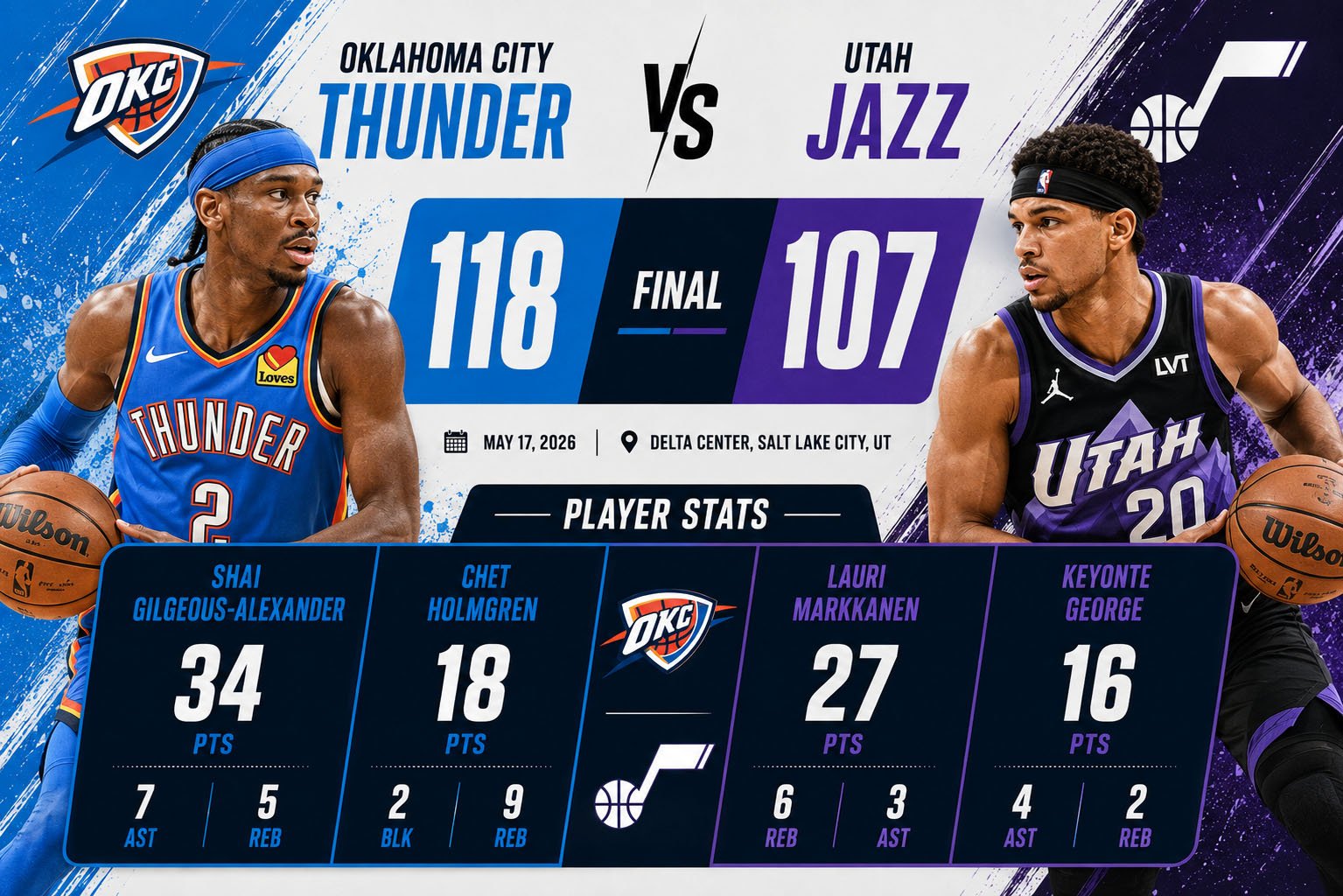
Oklahoma City Thunder vs Utah Jazz has been one of the most lopsided but statistically fascinating matchups of the 2025-26 NBA season, with reigning MVP Shai Gilgeous-Alexander delivering a string of historic individual performances against a rebuilding Utah roster. From a record breaking scoring streak to a career night that flirted with 50 points, nearly every meeting between these two teams produced a signature moment worth remembering.
This article breaks down several of the key matchups between these two teams during the 2025-26 season, the top individual performances from both rosters, and what these lopsided results revealed about two franchises at completely different points in their competitive timelines. Every stat below comes from official box scores and season reports.
Quick Team Snapshot
| Team | Season Record Trend | Key Performance | Notable Achievement |
|---|---|---|---|
| Oklahoma City Thunder | Defending champions, elite record | 46-point OT game from SGA | Extended 20-point streak to 138 games |
| Utah Jazz | Rebuilding, lottery-bound | Season-high 44 first quarter | Competitive stretches despite losses |
Oklahoma City has controlled every meeting between these two teams throughout the season, though Utah has shown flashes of genuine competitiveness, including a stretch where the Jazz actually led by 18 points in one contest before the Thunder ultimately pulled away.
Oklahoma City Thunder Key Player Stats
Shai Gilgeous-Alexander: A Historic Scoring Streak
Guard Shai Gilgeous-Alexander delivered several of the most statistically remarkable performances of his career against Utah throughout the season. In a January overtime thriller, Gilgeous-Alexander scored 46 points, including a clutch shot from near the free throw line at the regulation buzzer to force overtime before adding nine more points in the extra period to secure a 129-125 win. That performance extended his streak of games with at least 20 points to 109, at the time the second longest such streak in NBA history.
By April, that streak had grown to 138 consecutive games with 20 or more points, an NBA record pace that Gilgeous-Alexander continued building specifically during a blowout win over Utah, even though he sat out the entire fourth quarter of that contest with the outcome no longer in doubt. His full season body of work against the Jazz, spanning multiple games and a full range of statistical outputs from efficient starter’s minutes to a full 48 minute overtime workload, showcased the remarkable consistency that has defined his MVP caliber play throughout the season.
Chet Holmgren and the Supporting Cast
Center Chet Holmgren has been a consistent complementary force in Oklahoma City’s matchups against Utah, scoring 23 points with 12 rebounds in the January overtime win and adding another 21 point performance in an April rout that saw the Thunder post a season high point total. His combination of rim protection, floor spacing, and finishing ability gives Oklahoma City a legitimate second scoring option capable of taking pressure off Gilgeous-Alexander on nights when Utah’s defense keys in specifically on the reigning MVP. Full details from that April game are available through ESPN’s game recap.
Guards Jalen Williams and Cason Wallace have also factored significantly into Oklahoma City’s dominance throughout the season series, with Williams contributing double figure scoring in multiple meetings and Wallace chipping in 16 points during the Thunder’s April blowout win. That depth across the roster has allowed Oklahoma City to maintain its dominance over Utah even during stretches when Gilgeous-Alexander received extended rest in games that were already well in hand.
Utah Jazz Key Player Stats
Lauri Markkanen: A Consistent Scoring Threat
Forward Lauri Markkanen has provided Utah’s most consistent offensive production throughout the season series against Oklahoma City, scoring 19 points in a November meeting and following that up with a 29 point, 13 rebound performance in the January overtime loss. His reverse putback with just three seconds remaining in regulation of that January game briefly gave Utah a 114-112 lead, setting up the dramatic finish that saw Gilgeous-Alexander force overtime with his own buzzer beating shot.
Markkanen’s ability to consistently produce at a high level, even against a Thunder defense that has been among the league’s best throughout the season, reflects his standing as a legitimate All-Star caliber talent on a rebuilding roster. His performances against Oklahoma City throughout the season offered some of the clearest evidence of his continued value, even during a campaign that saw Utah finish near the bottom of the Western Conference standings.
Keyonte George and Utah’s Young Core
Guard Keyonte George has shown flashes of real promise in Utah’s matchups against Oklahoma City, scoring 20 points in the November meeting and adding an even more impressive 25 points with 11 assists in the January overtime contest. That kind of scoring and playmaking combination from a young guard offers genuine hope for Utah’s rebuilding timeline, even amid a season defined largely by lopsided losses to the league’s top teams.
Forward Brice Sensabaugh delivered one of the most eye catching individual performances of the entire season series in an April meeting, scoring 34 points even in a lopsided loss, while center Kyle Filipowski added 20 points and 14 rebounds in that same contest. Those kinds of individual scoring outbursts, even in defeat, gave Utah’s coaching staff valuable data about which young players might form the foundation of the franchise’s next competitive core.
Thunder vs Jazz: Key Player Stats at a Glance
| Player | Team | Best Performance | Season Context | Notable Achievement |
|---|---|---|---|---|
| Shai Gilgeous-Alexander | Thunder | 46 pts (OT win) | Reigning MVP | Extended streak to 138 straight 20-pt games |
| Chet Holmgren | Thunder | 23 pts, 12 reb | Elite two-way center | Consistent complementary scoring |
| Lauri Markkanen | Jazz | 29 pts, 13 reb | Utah’s top scorer | All-Star caliber production |
| Keyonte George | Jazz | 25 pts, 11 ast | Emerging young guard | Playmaking development |
| Brice Sensabaugh | Jazz | 34 points | Breakout scoring game | Individual ceiling flash |
Note: All figures reflect specific games from the Thunder-Jazz season series during the 2025-26 NBA season, spanning from November through April meetings between the two teams.
Team Comparison
This season series highlighted perhaps the widest talent gap between any two teams in the league, with defending champion Oklahoma City routinely overwhelming a Utah roster still in the early stages of a significant rebuild. The Thunder’s depth, anchored by Gilgeous-Alexander’s historic individual excellence and complemented by Holmgren, Williams, and Wallace, gave Oklahoma City multiple paths to victory in every meeting, regardless of how well Utah competed in any particular stretch of a game.
Utah’s competitiveness, when it appeared, came almost entirely through individual scoring outbursts from young talents like Markkanen, George, and Sensabaugh rather than complete team execution across a full 48 minutes. That pattern, flashes of promising individual play amid consistently lopsided final scores, reflected exactly the kind of developmental season typical of a rebuilding franchise still years away from competing with a true championship contender like Oklahoma City.
Head to Head History
The Thunder have dominated recent meetings with the Jazz, a trend that has only intensified since Oklahoma City’s rise to championship contention and eventual title behind Gilgeous-Alexander’s MVP level play. Utah’s own rebuilding timeline, accelerated by trading away established veterans in recent seasons, has widened the competitive gap between these two Western Conference franchises considerably compared to earlier points in both teams’ histories.
Recent Matchup Recap
The season series featured several memorable individual moments despite the largely one sided final scores. The November meeting saw Oklahoma City overcome a 39-30 first quarter deficit, the most points scored against the Thunder in any quarter all season, to eventually win 144-112 behind a decisive 33-4 run to close the third quarter. The January overtime thriller proved considerably more competitive, with Gilgeous-Alexander’s dramatic buzzer beating shot forcing extra time before his 46 point outburst sealed a narrow 129-125 win.
By April, Oklahoma City’s dominance had reasserted itself fully, with the Thunder posting a season high point total in a 146-111 rout that saw Gilgeous-Alexander sit the entire fourth quarter as his team’s lead ballooned well past 30 points. That final meeting extended Oklahoma City’s win streak to five games and 17 of its last 18, showing the kind of sustained excellence that had defined the team’s championship defense throughout the season.
What to Watch Next
For the Thunder, continuing to manage Gilgeous-Alexander’s remarkable consecutive 20 point game streak while maintaining the roster health and depth necessary for a deep playoff run remains the primary organizational focus. His historic individual consistency, combined with strong complementary play from Holmgren and the rest of Oklahoma City’s roster, positions the Thunder as legitimate favorites to defend their championship as the postseason approaches.
For the Jazz, continuing to develop the promising young talent shown throughout this season series, particularly from George and Sensabaugh, represents the clearest path toward future competitiveness. Utah’s front office will likely continue prioritizing draft positioning and player development over immediate results, understanding that building a roster capable of competing with a team like Oklahoma City requires a patient, long term approach to talent acquisition.
Gilgeous-Alexander’s Historic Consistency in Full Context
Gilgeous-Alexander’s streak of consecutive 20 point games represents one of the most remarkable individual achievements in recent NBA history, a testament to both his offensive skill and his durability across an demanding 82 game regular season schedule. That kind of sustained excellence, night after night regardless of opponent or matchup, places him in rare historical company among the league’s greatest individual scorers.
His performances specifically against Utah throughout the season offered some of the clearest examples of that consistency, ranging from efficient, relatively low usage outings in blowout wins to his full workload, franchise defining overtime performance in January. That range, excelling both when games remained competitive and when Oklahoma City’s lead allowed for reduced playing time, reflects the complete, well rounded superstar Gilgeous-Alexander has developed into during his time with the Thunder organization.
Mark Daigneault’s Coaching Excellence
Oklahoma City head coach Mark Daigneault has built one of the league’s most complete and disciplined rosters around Gilgeous-Alexander’s individual brilliance, emphasizing defensive pressure and ball movement that has made the Thunder nearly impossible for lesser opponents like Utah to consistently compete with. His in game adjustments, including the aggressive defensive pressure that helped Oklahoma City force 28 turnovers in one November meeting against the Jazz, exemplify the kind of detailed, disciplined coaching that has defined the Thunder’s championship level success.
That coaching excellence extends to how Daigneault manages his roster’s health and rest throughout a long season, including decisions like resting Gilgeous-Alexander during the fourth quarter of comfortable wins to preserve his legs for more competitive stretches of the schedule. That kind of thoughtful, long term roster management reflects lessons learned from previous playoff runs, understanding that a healthy, well rested roster heading into the postseason often matters more than maximizing every individual regular season statistic.
Utah’s Rebuilding Timeline and Draft Strategy
Utah’s front office has approached the current rebuilding phase with a clear focus on accumulating draft capital and developing young talent, a strategy reflected in the significant playing time and offensive opportunities given to players like George, Sensabaugh, and Filipowski throughout the season series against Oklahoma City. That patient, long term approach to roster construction mirrors similar successful rebuilding strategies employed by other franchises that have eventually returned to championship contention after periods of intentional talent accumulation.
The individual breakout performances shown throughout this season series, particularly Sensabaugh’s 34 point outburst and George’s continued playmaking development, offer Utah’s front office valuable data points for evaluating which young players might form the foundation of the franchise’s next competitive core. Building a roster capable of eventually challenging a team like Oklahoma City requires exactly this kind of careful evaluation and patient development process, even if the immediate results throughout the current season remain difficult for Jazz fans to watch.
Statistical Trends Across the Full Season Series
Looking at the broader patterns across all the meetings between these two teams, Oklahoma City’s defensive pressure and turnover creation proved to be a decisive factor in nearly every contest, with the Thunder’s ability to force live ball turnovers and convert them into easy transition scoring opportunities overwhelming Utah’s offense regardless of how well the Jazz shot the ball in a given game. That defensive dominance, arguably even more significant than Oklahoma City’s individual offensive talent advantage, defined the competitive gap between these two franchises throughout the season.
Utah’s own statistical profile throughout the series showed a team still learning to consistently execute at the pace and precision required to compete with the league’s elite teams, even though individual talent flashes suggested the pieces for future competitiveness may already be present on the roster. That distinction, between individual talent and complete team execution, often separates good young players from winning basketball teams, and Utah’s continued development in translating individual promise into more consistent team success will likely determine how quickly the Jazz can close the gap with teams like Oklahoma City.
The Business Case for Rebuilding Through the Draft
Utah’s organizational strategy throughout this challenging season reflects a broader trend across professional basketball, where teams intentionally prioritize long term asset accumulation over short term competitiveness when a true championship window appears unlikely in the immediate future. That approach, while difficult for fans to watch during lopsided losses like several of the meetings against Oklahoma City, has historically proven successful for franchises willing to commit to the process over multiple seasons.
The Jazz front office’s willingness to give extended developmental minutes to players like George and Sensabaugh, even during blowout losses, reflects confidence that the on court education gained through significant playing time against elite competition like Oklahoma City ultimately outweighs the short term cost of additional losses. That philosophy has become increasingly common across the league as front offices better understand the value of accelerated player development through real game experience rather than limited garbage time minutes.
Isaiah Joe and Oklahoma City’s Bench Production
Beyond the headline performances from Gilgeous-Alexander and Holmgren, Oklahoma City’s bench has provided crucial complementary scoring throughout the season series against Utah, with guard Isaiah Joe contributing 16 points in the November blowout win. That kind of reliable bench production gives the Thunder coaching staff confidence to rest starters during comfortable leads without sacrificing offensive execution, a luxury that has helped Oklahoma City maintain its dominant record throughout the season.
Jaylin Williams also factored into that November victory, making five three pointers for a season high 15 points off the bench, showing the kind of shooting depth that has made Oklahoma City’s roster so difficult for opponents like Utah to consistently game plan against. That combination of star power at the top of the rotation and reliable production from bench contributors reflects exactly the kind of complete roster construction that championship level teams typically feature.
Walker Kessler and Utah’s Frontcourt Development
Beyond the perimeter talents already discussed, Utah’s frontcourt development has included meaningful contributions from center Walker Kessler, who has shown flashes of legitimate rim protection and rebounding ability even during difficult team losses to Oklahoma City. His continued development represents an important piece of Utah’s broader rebuilding puzzle, since a competitive roster ultimately requires contributions and development across multiple positions rather than just perimeter scoring talent.
That frontcourt development matters particularly given Oklahoma City’s own strength at the center position through Holmgren, meaning any future competitive matchups between these two franchises will likely hinge significantly on how well Utah’s own frontcourt talent develops relative to the standard Oklahoma City has already established. Kessler’s continued growth throughout the season offered Utah’s coaching staff valuable data about his potential role in the team’s eventual return to competitiveness.
Historical Context for Dominant NBA Rivalries
Lopsided regular season series like this one between Oklahoma City and Utah are not uncommon in NBA history, particularly when one franchise sits at the height of championship contention while another undergoes significant roster rebuilding. Historical parallels exist across multiple eras of the league, with dominant teams regularly producing similarly imbalanced results against rebuilding opponents before those competitive gaps eventually narrow as both franchises’ rosters evolve over subsequent seasons.
That historical pattern offers some perspective for Utah fans enduring a difficult current season, since NBA history has repeatedly shown that rebuilding processes, when executed properly through smart drafting and player development, can eventually produce rosters capable of competing with even the league’s most dominant teams. Oklahoma City’s own relatively recent history, having undergone its own rebuilding process before emerging as a championship contender, offers a useful blueprint that Utah’s front office has reportedly studied closely.
Media Coverage and National Attention on Gilgeous-Alexander
Gilgeous-Alexander’s individual excellence throughout the season, including his performances against Utah, has drawn significant national media attention, with analysts and former players regularly praising his consistency and scoring efficiency as among the best in the entire league. That level of recognition reflects not just his individual statistical output but also his growing reputation as a legitimate face of the league following his MVP season and Oklahoma City’s championship run.
That media attention adds extra significance to even seemingly routine regular season matchups against a rebuilding opponent like Utah, since every game represents another opportunity for Gilgeous-Alexander to extend his historic consecutive 20 point game streak and further cement his legacy among the league’s all time great scorers. National broadcast partners have taken notice of that ongoing storyline, ensuring continued attention on Thunder games throughout the season regardless of the specific opponent or expected competitiveness of any individual matchup.
Fantasy Basketball Implications From This Season Series
For fantasy basketball managers, Gilgeous-Alexander’s performances against Utah throughout the season provided some of the most valuable weekly production available at any position, with his combination of high volume scoring, efficient shooting, and continued durability making him a top tier fantasy asset regardless of format. His 46 point overtime performance, in particular, represented exactly the kind of ceiling game fantasy managers hope for from their top rostered players.
Utah’s young talents also provided intriguing fantasy value throughout the season series, particularly in deeper dynasty and keeper formats where identifying breakout candidates early can provide significant long term value. Sensabaugh’s 34 point outburst and George’s continued playmaking development both offered fantasy managers reasons to monitor these players closely as potential value additions heading into future fantasy basketball seasons.
What Analysts Predict for Both Franchises Going Forward
NBA analysts and league insiders have consistently praised Oklahoma City’s sustainable championship formula, built around Gilgeous-Alexander’s individual brilliance combined with a deep, well constructed supporting cast that gives the Thunder multiple paths to victory regardless of any single player’s specific performance on a given night. That formula, validated by both the team’s championship and its continued dominant play throughout the following season, positions Oklahoma City as a legitimate contender for sustained success in the years ahead.
Utah’s outlook remains considerably more uncertain in the eyes of most analysts, with the team’s ultimate competitive trajectory heavily dependent on continued development from young talents like George, Sensabaugh, and Kessler, along with successful future draft selections as the rebuilding process continues. How quickly Utah can translate individual talent flashes, like those shown throughout this season series against Oklahoma City, into complete, winning basketball will likely determine the franchise’s competitive outlook for years to come.
Conclusion
Oklahoma City Thunder vs Utah Jazz showcased one of the most talent imbalanced but statistically compelling matchups in the entire NBA throughout the 2025-26 season. Shai Gilgeous-Alexander’s historic scoring consistency, including a dramatic overtime performance and a record setting streak of 20 point games, reinforced his standing as one of the league’s must watch superstars, while Utah’s young talents like Lauri Markkanen, Keyonte George, and Brice Sensabaugh showed genuine flashes of promise even amid a difficult rebuilding season.
With Oklahoma City continuing to defend its championship behind Gilgeous-Alexander’s remarkable play and Utah patiently developing its next competitive core, this matchup figures to look very different in future seasons as both franchises continue along their current, very different competitive trajectories.
Frequently Asked Questions
How dominant has Shai Gilgeous-Alexander been against Utah this season?
Gilgeous-Alexander scored 46 points in a January overtime win, extending his consecutive 20-point game streak, which reached 138 straight games by April, one of the longest streaks in NBA history.
What was the closest game in the Thunder-Jazz season series?
The January 7 matchup went to overtime, with Oklahoma City winning 129-125 after Gilgeous-Alexander forced overtime with a buzzer-beating shot at the end of regulation.
Who has been Utah’s most consistent performer against Oklahoma City?
Lauri Markkanen has provided Utah’s most consistent production, including a 29-point, 13-rebound performance in the January overtime loss to the Thunder.
How many games did Oklahoma City win in the season series?
Oklahoma City won every meeting against Utah during the 2025-26 season, including a 144-112 rout in November and a season-high 146-111 win in April.
What young Utah players showed the most promise against Oklahoma City?
Keyonte George and Brice Sensabaugh both delivered standout scoring performances, with George posting 25 points and 11 assists and Sensabaugh scoring 34 points in separate meetings.