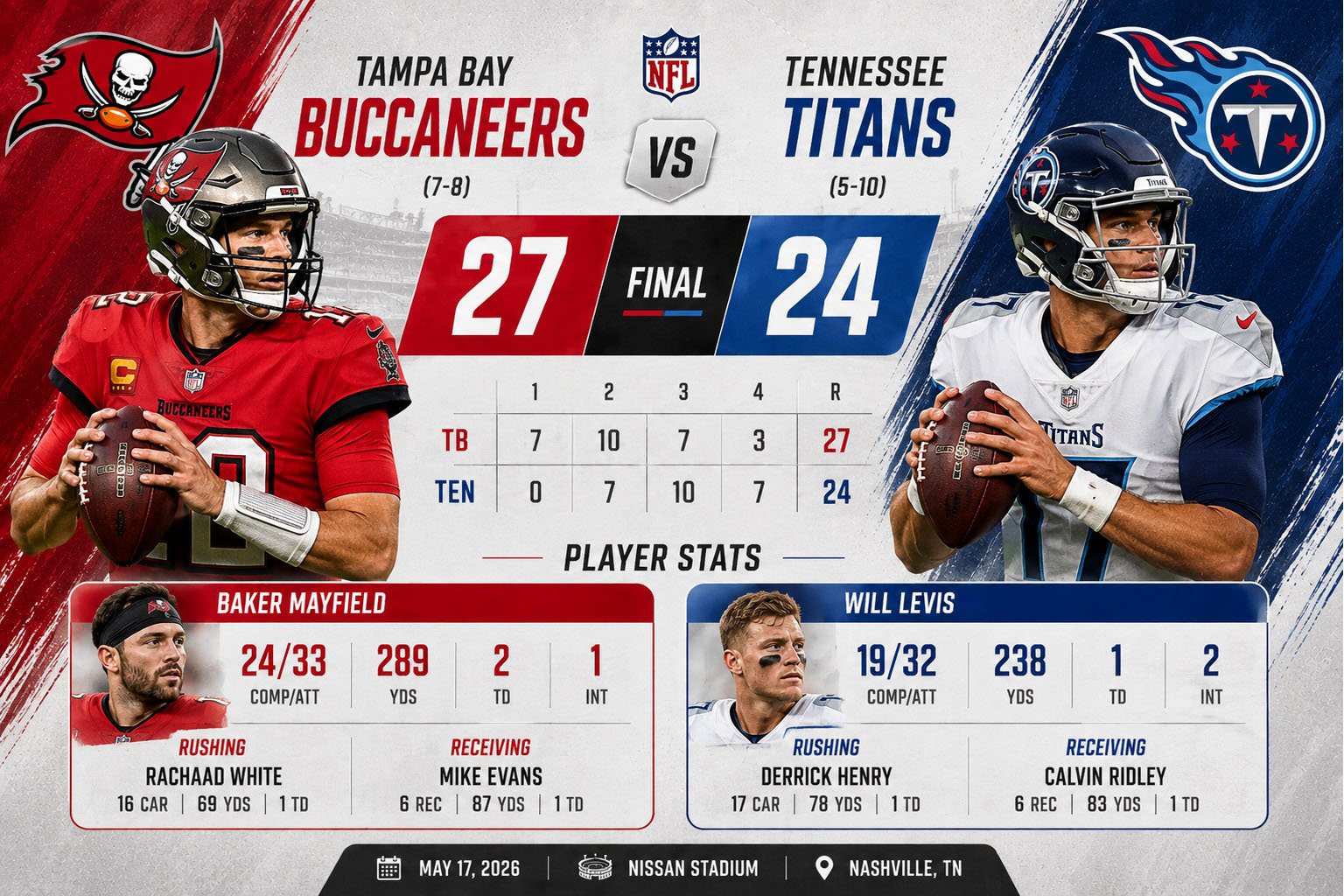
Tampa Bay Buccaneers vs Tennessee Titans marked an important early look at two teams heading in very different directions entering the 2025 season. Tampa Bay arrived as a playoff caliber roster built around an established veteran quarterback, while Tennessee showed up with the excitement of a brand new era led by the first overall pick in the NFL Draft. Their preseason meeting at Raymond James Stadium gave fans the first extended glimpse of that contrast, and the individual performances from both rosters carried storylines that extended well into the regular season.
This article breaks down that matchup, the full season statistical profiles of the top players on both rosters, and what the game revealed about each franchise heading into the year. Every stat below comes from official box scores and season reports.
Quick Team Snapshot
| Team | Game Result | Passing Leader | Notable Storyline |
|---|---|---|---|
| Tampa Bay Buccaneers | Won 29-7 | Kyle Trask, 129 yards | Backups controlled the game |
| Tennessee Titans | Lost 29-7 | Cam Ward, 67 yards | No. 1 pick’s pro debut |
Tampa Bay dominated the statistical battle, outgaining Tennessee 348 yards to 201 while controlling the clock for most of the contest, even with the Buccaneers resting the majority of their starters.
Tampa Bay Buccaneers Key Player Stats
Baker Mayfield: An MVP Caliber Regular Season
While starting quarterback Baker Mayfield sat out the preseason opener against Tennessee, his full 2025 season told the story of a player who established himself as one of the league’s more productive passers. Mayfield threw for 3,693 yards and 26 touchdowns against 11 interceptions on 630 dropbacks, posting a 70.0 overall grade that ranked among the better performances at the position across the league.
Mayfield also showed off his mobility throughout the season, adding 377 scramble yards and a rushing touchdown while posting an 86.8 rushing grade that ranked second among qualified quarterbacks at the position. That combination of efficient passing and dangerous scrambling ability made him one of the more complete quarterbacks in the league, even during a season that included stretches of inconsistency for the Buccaneers offense as a whole.
Kyle Trask: A Strong Preseason Audition
With Mayfield resting, backup quarterback Kyle Trask took the reins against Tennessee and delivered a precise, controlled performance, completing 12 of 16 passes for 129 yards and a 98.2 passer rating. Trask led Tampa Bay on a game opening field goal drive, connecting with wide receivers Jalen McMillan and rookie Emeka Egbuka for gains of 25 and 21 yards respectively to move the offense into scoring position.
That kind of composed, efficient outing gave the Buccaneers coaching staff confidence in their depth at the quarterback position, an important asset for any team hoping to withstand injuries over the course of a long season. Tampa Bay’s offensive line also excelled in the running game once reserves took over in the second half, rushing 41 times for 178 yards to close out the contest and remove any doubt about the final outcome.
Tennessee Titans Key Player Stats
Cam Ward: A Promising Pro Debut
The Titans’ investment in quarterback Cam Ward as the first overall pick in the 2025 NFL Draft began taking shape in this preseason opener, and while the box score numbers were modest, the underlying performance offered genuine encouragement. Ward completed 5 of 8 passes for 67 yards across two offensive series before giving way to the rest of Tennessee’s quarterback room. Full details from that game are available through CBS Sports’ game recap.
Ward’s highlight of the night came on an 11 play, 65 yard touchdown drive in the second quarter, where he completed three passes to veteran receiver Calvin Ridley for all but 15 yards of the drive before running back Tony Pollard punched it in from a yard out. Head coach Brian Callahan praised Ward’s composure after the game, noting that the rookie looked comfortable running the offense despite a somewhat disjointed first half that saw Tennessee’s offense sit on the sideline for more than 14 minutes of the opening quarter.
Ward’s Rookie Season Development
Beyond this preseason opener, Ward’s rookie campaign became one of the more closely watched storylines of the 2025 NFL season. He showed steady statistical growth as the year progressed, throwing for 175 yards and a touchdown in an early Week 2 loss to the Rams, then delivering his first career game winning drive in Week 5 to help Tennessee secure its first win of the season after an 0-4 start. By later stretches of the season, Ward was posting completion numbers in the 25 to 28 range on 34 to 42 attempts per game, with passing totals regularly topping 250 yards, a clear sign of a rookie quarterback settling into the speed of the professional game.
That development arc, from a modest preseason debut to increasingly confident regular season performances, reflected exactly the kind of trajectory Tennessee’s front office hoped for when the franchise used the top overall pick on Ward. His combination of arm talent and rushing ability, including a touchdown run that briefly gave Tennessee a lead against Atlanta later that preseason, gave the Titans genuine hope for a new era at the quarterback position after years of instability.
Buccaneers vs Titans: Key Player Stats at a Glance
| Player | Team | Season Stats | Key Metric | Notable Achievement |
|---|---|---|---|---|
| Baker Mayfield | Buccaneers | 3,693 yards, 26 TD | 70.0 PFF grade | 2nd in rushing grade among QBs |
| Cam Ward | Titans | Rookie season | 5/8 in preseason debut | First overall pick, 2025 draft |
| Kyle Trask | Buccaneers | 129 yards (preseason) | 98.2 passer rating | Strong QB2 depth |
| Tony Pollard | Titans | Season rushing leader | 1-yard TD vs Bucs | Veteran stability at RB |
Note: Some figures reflect the preseason meeting between these teams while others reflect full 2025 regular season totals, since Tampa Bay’s starters did not play in this particular contest.
Team Comparison
This matchup highlighted the difference between an established, playoff caliber roster and a franchise in the early stages of a quarterback led rebuild. Tampa Bay’s depth showed up clearly, with backup options like Trask capable of running the offense efficiently even without the team’s top playmakers on the field. That kind of organizational depth, built over years of consistent roster management, gave the Buccaneers a clear advantage in this particular contest.
Tennessee’s approach reflected a franchise squarely focused on developing its most important long term asset. Playing Ward extensively with the starting unit, even in a low stakes preseason game, showed the priority Tennessee placed on his development over the immediate result. That philosophy, prioritizing long term quarterback growth over short term preseason wins, is a common approach for rebuilding franchises that have invested significant draft capital in a new signal caller.
Head to Head History
Games between these two franchises have been relatively infrequent given that Tampa Bay and Tennessee play in different conferences and only meet as part of the NFL’s regular scheduling rotation every few years. This preseason matchup offered a rare glimpse of the two rosters on the same field, and while it carried limited historical weight given its exhibition status, it provided valuable early season context for evaluating both teams’ quarterback situations heading into the regular season.
Recent Matchup Recap
Tampa Bay’s approach to this preseason opener reflected a team already confident in its roster construction, resting virtually all of its starters, including Mayfield, while still controlling the game behind a strong performance from Trask and the Buccaneers’ reserve units. The final statistics told a clear story, with Tampa Bay outgaining Tennessee 348 yards to 201 and converting on seven of 16 third down attempts while holding the Titans to just five conversions on 13 attempts.
Tennessee, by contrast, used the game as an extended audition for Ward, playing him and the rest of the first team offense for the majority of the first half specifically to accelerate his development. Despite a slow start that included a three and out on the opening possession, the Titans offense found some rhythm on the touchdown drive that Ward orchestrated, offering genuine encouragement even in a lopsided final score.
The Evolution of Tennessee’s Offensive Identity
Tennessee’s coaching staff spent much of the 2025 season working to build an offensive system tailored specifically to Ward’s strengths as a mobile, big armed passer capable of extending plays outside the pocket. That process took time to develop, as is typical for any rookie quarterback learning a new system at the professional level, but the flashes shown against Tampa Bay and throughout the preseason offered encouraging signs about the eventual direction of the offense.
Offensive coordinators around the league have increasingly built schemes around quarterbacks who can threaten defenses both through the air and with their legs, and Tennessee’s approach with Ward reflected that broader trend. His touchdown run against Atlanta later in the preseason, along with his ability to extend the touchdown drive against Tampa Bay with accurate throws under pressure, suggested the foundation for exactly that kind of dual threat offensive identity, even as the surrounding personnel and scheme continued to develop around him.
Supporting Cast Development for Both Teams
Beyond the quarterback storylines, both organizations used this preseason window to evaluate depth players who would factor into their regular season plans. Tampa Bay’s receiving corps, including rising options like Egbuka and McMillan, showed promising chemistry with Trask in this game, suggesting the Buccaneers had developed meaningful depth beyond their established starters heading into the season.
Tennessee’s evaluation process focused heavily on the pieces surrounding Ward, particularly at the skill positions where the Titans hoped to find complementary weapons capable of elevating their rookie quarterback’s performance. Calvin Ridley’s continued involvement as a primary target, even in this limited preseason action, reflected his importance to Tennessee’s offensive plans, while younger players received extended opportunities to demonstrate their own potential contributions to the offense.
The Financial and Roster Building Context
Understanding the different competitive positions of these two franchises requires acknowledging the financial and roster building context surrounding each team. Tampa Bay’s ability to build meaningful depth at the quarterback position, with Trask serving as a capable backup option, reflected years of careful roster construction and salary cap management that allowed the organization to invest in multiple positions simultaneously.
Tennessee’s situation, by contrast, involved a more concentrated bet on a single transformational asset in Ward, a common approach for rebuilding franchises that have accumulated significant draft capital through difficult seasons. That kind of concentrated investment carries both higher risk and higher potential reward compared to Tampa Bay’s more distributed approach to roster construction, and how each strategy played out over the subsequent regular season offered valuable insight into the relative merits of each team building philosophy.
Historical Context for Rookie Quarterback Development
Ward’s rookie season fits within a broader historical pattern of first overall pick quarterbacks experiencing significant statistical growth as they gain experience at the professional level. Many of the league’s most successful quarterbacks, including several perennial All-Pro selections, showed similarly modest early statistical output before developing into elite performers over their first two or three professional seasons.
That historical context offers useful perspective for evaluating Ward’s development, suggesting that early season struggles, including the disjointed opening drive against Tampa Bay, should not be viewed as predictive of his long term ceiling as a professional quarterback. Patient organizational approaches, like the one Tennessee’s coaching staff has taken throughout Ward’s rookie season, have historically produced better long term outcomes than rushing young quarterbacks into situations before they are fully prepared to handle the speed and complexity of professional defenses.
Fantasy Football Implications From Both Quarterbacks
For fantasy football managers, Mayfield’s full 2025 season established him as a legitimate mid tier starting option, with his rushing production providing valuable floor even during games when his passing numbers were more modest. His 26 touchdown passes combined with his rushing touchdown and nearly 400 rushing yards gave fantasy managers a dual threat profile that added consistent weekly value throughout the season.
Ward’s fantasy relevance grew steadily as his rookie season progressed, with his rushing ability providing meaningful upside even during stretches when his passing efficiency lagged behind more established quarterbacks. By the later portions of the season, Ward had developed into a streaming option worth considering in deeper fantasy formats, reflecting the same statistical growth trajectory that had encouraged Tennessee’s coaching staff and front office throughout his rookie campaign.
Media Coverage and National Attention
As the first overall pick in the 2025 NFL Draft, Ward’s every performance drew significant national media attention throughout his rookie season, including this preseason opener against Tampa Bay. That level of scrutiny is standard for players selected at the top of the draft, particularly quarterbacks, who face immediate pressure to justify their draft position and demonstrate the skills that made them attractive prospects in the first place.
Mayfield’s continued strong play for Tampa Bay drew its own media narrative throughout the season, with analysts increasingly recognizing his value as one of the more underrated quarterbacks in the league despite playing in a media market that receives less national attention than some larger franchises. That combination of national rookie quarterback intrigue and veteran quarterback appreciation gave this otherwise low stakes preseason matchup more storyline value than a typical exhibition game between two teams from different conferences.
Long Term Outlook for Both Franchises
Looking beyond the 2025 season, both organizations appeared well positioned at the quarterback position for different reasons. Tampa Bay’s combination of Mayfield’s proven production and Trask’s capable backup play gave the Buccaneers rare stability at football’s most important position, a foundation that supported the team’s broader championship aspirations heading into future seasons.
Tennessee’s outlook depended more heavily on continued development from Ward, but the statistical growth shown throughout his rookie season offered genuine reason for optimism. If that trajectory continued, the Titans appeared to have found the kind of foundational quarterback talent capable of anchoring the franchise’s competitive turnaround for years to come, a outcome that would fully justify the organization’s significant investment in selecting him with the first overall pick.
What to Watch Next
For the Buccaneers, continuing to build depth behind Mayfield, whose strong 2025 season reinforced his status as one of the more underrated quarterbacks in the league, remains a priority heading into future seasons. Trask’s performance against Tennessee suggested Tampa Bay has a capable backup option, an important asset for a team with legitimate playoff aspirations.
For the Titans, Ward’s continued development represents the single most important storyline for the franchise’s future. His rookie season showed clear statistical progression as the year unfolded, and building a stronger supporting cast around him, particularly along the offensive line, will be critical to unlocking his full potential in the seasons ahead.
Draft Capital and Long Term Team Building
Tennessee’s decision to select Ward with the first overall pick represented a significant organizational bet on a single player transforming the franchise’s trajectory. That kind of investment carries substantial risk, but it also offers the potential for outsized reward if the quarterback develops into a legitimate franchise cornerstone, a pattern seen across the league whenever a team successfully identifies and develops a top tier quarterback prospect.
Tampa Bay’s roster construction took a different path, built gradually through a combination of the draft, free agency, and player development that produced a deep, well rounded roster capable of absorbing the loss of key starters without a significant drop in performance. Both approaches carry their own risks and potential rewards, and this preseason meeting offered an early snapshot of how those different organizational philosophies were playing out heading into the 2025 season.
Coaching Philosophy and Quarterback Development
Titans head coach Brian Callahan, in his second season leading the franchise, made clear through his comments and decisions throughout training camp that developing Ward properly took precedence over any single game result, including this preseason matchup against Tampa Bay. That patient approach reflected an understanding that rushing a rookie quarterback’s development in pursuit of short term results often produces worse long term outcomes than allowing him to learn through experience, even when that experience includes difficult stretches like the Titans’ early season struggles.
Tampa Bay’s coaching staff, led by Todd Bowles, took the opposite approach in this particular game, prioritizing rest and injury prevention for established starters over any competitive advantage a full strength lineup might have provided. That decision reflected the confidence of a coaching staff that had already established its team’s identity and did not need preseason results to validate the roster’s overall quality heading into a season with legitimate championship aspirations.
The Broader AFC and NFC Landscape
Understanding this matchup requires placing both teams within their broader conference contexts heading into the 2025 season. Tampa Bay entered the year as a legitimate contender in a competitive NFC South, with Mayfield’s continued development giving the Buccaneers confidence they could compete with the division’s other playoff caliber rosters. That confidence proved well founded as the season progressed, with Mayfield’s efficient full season numbers helping Tampa Bay remain in playoff contention.
Tennessee’s situation within the AFC South reflected a franchise still working through a rebuilding process, with Ward’s development representing the clearest path back toward competitiveness in a division that has produced some of the league’s most talented young quarterbacks in recent years. The Titans’ path forward would require not just Ward’s continued growth but also significant investment in the surrounding roster, particularly on the offensive line and at the skill positions, to fully capitalize on his potential.
Statistical Trends Worth Monitoring
Ward’s rookie season statistical progression offers a useful case study for evaluating first year quarterback development. His completion numbers and passing yardage totals showed a clear upward trend as the season progressed, moving from modest preseason numbers to increasingly confident regular season performances that included multiple 250 plus yard passing games later in the year. That kind of in season growth curve is exactly what evaluators hope to see from a top overall pick, suggesting Tennessee’s investment may pay dividends as Ward continues to develop.
Mayfield’s full season numbers, meanwhile, reinforced his standing as one of the more efficient and productive quarterbacks in the league, even though injuries affected his performance during portions of the season according to former teammates. His ability to both throw for nearly 3,700 yards and contribute significantly as a runner gave Tampa Bay’s offense a dual threat dimension that few other teams could match at the quarterback position.
Special Teams and Depth Chart Battles
Beyond the quarterback storylines, this preseason contest also served as an important evaluation opportunity for special teams units and depth chart battles across both rosters. Tampa Bay’s kicking game, led by veteran Chase McLaughlin, opened the scoring with a 45 yard field goal early in the contest, part of a broader evaluation process that helped solidify special teams roles heading into the regular season. Those unglamorous but important roster decisions often get overlooked in preseason recaps focused on quarterback performances, but they play a meaningful role in a team’s overall success once the regular season begins.
Tennessee used this game to evaluate depth at multiple positions beyond quarterback, with backup players at wide receiver, offensive line, and linebacker all receiving valuable game action against a Tampa Bay roster that, even with backups on the field, provided a legitimate NFL caliber test. That evaluation process, while less prominently covered than Ward’s development, played an important role in shaping Tennessee’s final roster construction heading into the regular season opener.
Conclusion
Tampa Bay Buccaneers vs Tennessee Titans offered an early season window into two franchises at very different points in their competitive cycles. Tampa Bay’s depth and organizational stability showed up clearly, even with virtually all of its key starters resting for the contest, while Tennessee used the opportunity to accelerate the development of its most important long term investment in Cam Ward.
With Mayfield continuing to establish himself as one of the league’s more productive quarterbacks and Ward showing clear signs of growth throughout his rookie season, both franchises have reasons for optimism heading into future seasons, even though their current competitive timelines remain in very different places. How quickly Tennessee can build a stronger supporting cast around its young quarterback will likely determine how soon the gap between these two franchises begins to close.
Frequently Asked Questions
What was the final score of the Buccaneers vs Titans preseason game?
The Tampa Bay Buccaneers won 29-7, with backup quarterback Kyle Trask leading an efficient offensive performance while most starters, including Baker Mayfield, rested for the contest.
How did Cam Ward perform in his professional debut?
Ward completed 5 of 8 passes for 67 yards across two offensive series, highlighted by an 11 play touchdown drive that included three completions to veteran receiver Calvin Ridley.
What were Baker Mayfield’s full 2025 season statistics?
Mayfield threw for 3,693 yards and 26 touchdowns against 11 interceptions on the season, while also adding 377 rushing yards and a rushing touchdown.
How did Cam Ward’s rookie season develop over time?
Ward showed steady statistical growth throughout the season, progressing from a modest preseason debut to regularly throwing for 250 or more yards by the later stretches of his rookie campaign.
Why did Tampa Bay rest its starters for this preseason matchup?
Head coach Todd Bowles prioritized injury prevention for established starters, reflecting the confidence of a coaching staff that had already established its roster’s quality heading into a season with playoff aspirations.