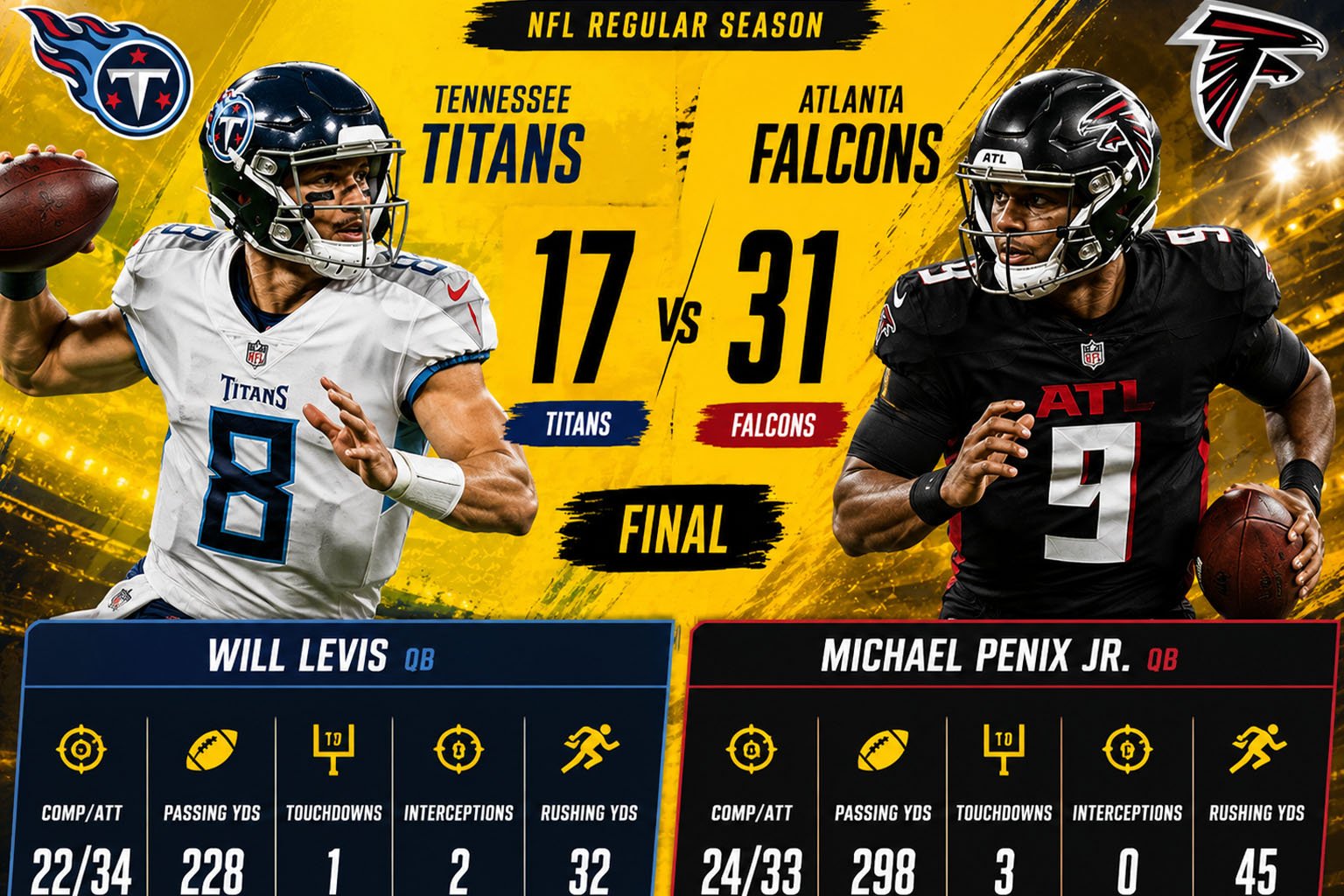
Tennessee Titans vs Atlanta Falcons gave fans an early look at two franchises working through very different quarterback situations heading into the 2025 season. Tennessee brought rookie sensation Cam Ward, the first overall pick in the NFL Draft, into hostile territory at Mercedes-Benz Stadium, while Atlanta kept its top two quarterbacks on the sideline as the Falcons continued evaluating their own depth chart. The result was a back and forth preseason battle decided in the final minutes.
This article breaks down that matchup, the full season statistical profiles of the key players involved, and what both performances revealed about each franchise’s development heading into the regular season. Every stat below comes from official box scores and season reports.
Quick Team Snapshot
| Team | Game Result | Passing Leader | Notable Storyline |
|---|---|---|---|
| Tennessee Titans | Won 23-20 | Brandon Allen, 25-yard TD pass | Cam Ward’s second career start |
| Atlanta Falcons | Lost 23-20 | Easton Stick, backup competition | Top two QBs held out again |
Tennessee improved to 1-1 in the preseason behind a game winning field goal in the fourth quarter, while Atlanta fell to 0-2 with its top two quarterbacks, Michael Penix Jr. and Kirk Cousins, sitting out for a second consecutive game.
Tennessee Titans Key Player Stats
Cam Ward: Mixed Results in a Difficult Environment
Quarterback Cam Ward faced a tougher test in his second career appearance, completing just 2 of 7 passes for 42 yards across three offensive series before giving way to backup Brandon Allen. Despite the modest completion numbers, Ward flashed real arm talent, connecting with fellow rookie Elic Ayomanor on a 35 yard completion that stood as the highlight of his night, and he nearly added another explosive play when a well placed deep ball to Van Jefferson slipped through the receiver’s hands.
Head coach Brian Callahan remained encouraged by what he saw from his young quarterback despite the modest statistical output, noting that Ward continued showing the operational command and poise the coaching staff wanted to see developing over the course of the preseason. That kind of patient, process oriented evaluation reflected Tennessee’s broader approach to developing its most important long term investment, understanding that box score numbers in exhibition games rarely tell the complete story of a rookie quarterback’s progress.
Kendell Brooks and Tennessee’s Defensive Playmaking
While the offensive storylines centered on Ward, Tennessee’s defense delivered the signature individual play of the game, with Kendell Brooks returning an interception 53 yards for a touchdown that proved to be a crucial score in the eventual one possession victory. That kind of explosive defensive play often gets overshadowed by quarterback story lines in preseason coverage, but it represented exactly the type of impact play Tennessee’s coaching staff hoped to see from its developing defensive units heading into the regular season.
Joey Slye’s 23 yard field goal with just over nine minutes remaining ultimately proved to be the decisive score, giving Tennessee the lead for good after a back and forth fourth quarter that saw both offenses trade opportunities. That kind of late game execution, converting scoring chances in the fourth quarter of a close game, offered an encouraging sign for a Titans team looking to build winning habits throughout the preseason and into the regular season.
Atlanta Falcons Key Player Stats
Backup Quarterbacks Battle for Roster Spots
With both Michael Penix Jr. and Kirk Cousins held out for a second consecutive preseason game, Atlanta’s quarterback competition shifted to the backup ranks, where Emory Jones took over play calling duties in the second half. Jones was stopped on a crucial fourth down run near Tennessee’s 20 yard line with under three minutes remaining, a play that effectively ended Atlanta’s final scoring opportunity and sealed the Titans’ victory. Full details from that game are available through CBS Sports’ game recap.
That quarterback evaluation process carried real stakes for players fighting to secure a spot on Atlanta’s final roster, even though the outcome had no bearing on the Falcons’ regular season plans given the presence of established starters Penix and Cousins on the depth chart. Backup quarterback battles like this one play out across the league every preseason, providing valuable data for coaching staffs making difficult final roster decisions.
Nathan Carter and Atlanta’s Rushing Attack
Running back Nathan Carter provided Atlanta’s most explosive offensive play of the night, breaking off a 43 yard touchdown run in the third quarter that briefly gave the Falcons momentum in an otherwise tightly contested game. That kind of big play ability from a depth running back option gave Atlanta’s coaching staff encouraging data about the team’s depth at the position heading into final roster cuts.
Kicker Younghoe Koo also factored into the scoring, connecting on field goals of 42 and 36 yards to keep Atlanta competitive throughout the contest. Koo’s continued reliability as a veteran special teams performer gave the Falcons a dependable scoring option even during a preseason game focused primarily on evaluating depth players and roster bubble candidates rather than the team’s established core contributors.
Titans vs Falcons: Key Player Stats at a Glance
| Player | Team | Stats | Key Metric | Notable Note |
|---|---|---|---|---|
| Cam Ward | Titans | 2/7, 42 yards | 35-yard completion to Ayomanor | Second career appearance |
| Kendell Brooks | Titans | Defensive TD | 53-yard INT return | Game-changing defensive play |
| Nathan Carter | Falcons | 43-yard TD run | Third quarter score | Depth RB opportunity |
| Younghoe Koo | Falcons | 2 field goals | 42 and 36 yards | Veteran reliability |
Note: All figures reflect this preseason meeting between the two teams, since both franchises’ primary starting quarterbacks did not play extensively in this particular contest.
Team Comparison
This matchup offered a study in contrasts regarding quarterback development philosophy. Tennessee committed to playing Ward extensively with the starting unit, even in a difficult road environment, prioritizing his real time development over the specific outcome of an exhibition game. That approach reflected the organization’s understanding that Ward’s long term growth as a franchise quarterback mattered far more than any individual preseason result.
Atlanta took a more conservative approach with its established quarterbacks, keeping both Penix and Cousins away from game action entirely for a second straight week while using the opportunity to evaluate depth players fighting for roster spots. That strategy reflected a franchise with more certainty at the quarterback position, allowing Atlanta’s coaching staff to focus preseason evaluation on other roster questions rather than needing extensive game reps from their top options.
Head to Head History
Games between Tennessee and Atlanta have been relatively infrequent in recent NFL history given the two teams play in different conferences and divisions. This preseason matchup provided a rare meeting between the two franchises, offering fans and evaluators alike a chance to compare roster development approaches, even though the exhibition nature of the game limited its broader historical significance within any ongoing rivalry between the two teams.
Recent Matchup Recap
Tennessee’s 23-20 victory came down to execution in the fourth quarter, with Slye’s field goal proving decisive after Atlanta’s final scoring threat stalled on Jones’ unsuccessful fourth down conversion attempt. The game featured a back and forth flow typical of preseason contests, with both teams generating some offense but relying heavily on defensive and special teams plays, including Brooks’ pick six, to determine the final outcome.
That result gave Tennessee a 1-1 preseason record heading into its exhibition finale against Minnesota, while Atlanta dropped to 0-2 with its own quarterback competition and roster bubble battles still very much undecided heading into the Falcons’ remaining preseason schedule. Neither result carried significant weight for either team’s regular season outlook, but both provided valuable evaluation data for coaching staffs finalizing their 53 man rosters.
What to Watch Next
For the Titans, Ward’s continued development remained the central storyline heading into the regular season, with his rookie campaign showing steady statistical growth as he gained more experience with Tennessee’s starting unit. The flashes of arm talent shown against Atlanta, including the deep completion to Ayomanor, offered genuine encouragement even amid a modest overall statistical performance.
For the Falcons, resolving the ongoing quarterback competition between Penix and Cousins remained the most important preseason storyline, a decision that would shape the team’s entire offensive approach heading into the regular season. The depth player evaluations from this game against Tennessee, including Carter’s rushing touchdown, provided valuable supplementary information for finalizing roster decisions beyond the quarterback position.
The Broader Context of NFL Quarterback Competitions
Atlanta’s decision to hold both Penix and Cousins out of extended preseason action reflected a broader trend across the league of teams protecting established or highly drafted quarterbacks from unnecessary preseason injury risk. That approach has become increasingly common as teams recognize the value of their investments at the quarterback position, preferring to have those players fully evaluate opposing schemes through practice reps and film study rather than risking injury in exhibition games with limited competitive stakes.
Tennessee’s contrasting approach with Ward reflected a different calculation entirely, one where the value of extended game reps for a developing rookie quarterback outweighed the marginal injury risk associated with preseason action. Both philosophies have merit depending on a team’s specific circumstances, and the different approaches taken by these two organizations in this game offered an interesting real time comparison of contrasting roster management strategies across the league.
Draft Investment and Quarterback Value
The Falcons’ situation at quarterback heading into this game reflected the franchise’s own significant draft investment in Penix, selected eighth overall in the 2024 NFL Draft. That investment created a similar organizational priority around his development as Tennessee’s commitment to Ward, even though the specific circumstances of this preseason game led to different in game decisions about playing time for the two respective rookie quarterbacks.
Atlanta’s addition of veteran Kirk Cousins as a bridge and mentor option added another dimension to the team’s quarterback room, giving the organization both immediate stability and long term development potential at the position. That combination of proven veteran presence and promising young talent represented a common team building strategy across the league, one that Tennessee’s organization would likely consider replicating as Ward continued his own development process throughout his rookie season and beyond.
Coaching Evaluations and Roster Construction
Both coaching staffs used this preseason matchup as a critical data point in finalizing their respective 53 man rosters heading into the regular season. Tennessee’s evaluation process focused heavily on continuing to build the offensive infrastructure around Ward, assessing which skill position players and offensive linemen showed the most promise in supporting their rookie quarterback’s development throughout the year ahead.
Atlanta’s evaluation process, conducted largely without its top two quarterbacks on the field, centered on depth chart battles at multiple positions, including the backup quarterback competition between Jones and other roster hopefuls. Those evaluations, while less prominently covered in national media compared to Ward’s ongoing development, played an equally important role in shaping each team’s final roster construction heading into a competitive regular season.
Statistical Context for Rookie Quarterback Evaluation
Evaluating Ward’s performance in this particular game requires appropriate context regarding the difficulty of the circumstances, including a hostile road environment and a defense that had extensively prepared for Tennessee’s offensive tendencies through joint practices held earlier in the week. Modest completion numbers in this kind of setting do not necessarily reflect a rookie quarterback’s overall trajectory, particularly when the underlying process, including accurate ball placement on contested throws, shows genuine positive signs.
That nuanced statistical interpretation matters significantly when evaluating young quarterbacks during their developmental period, since surface level box score numbers often fail to capture the more meaningful process oriented improvements that predict long term success at the position. Tennessee’s coaching staff clearly understood this distinction, maintaining their public confidence in Ward’s development despite the modest raw statistics from this particular preseason appearance.
Fantasy Football and Long Term Outlook
For fantasy football purposes, this preseason matchup carried minimal immediate relevance given the limited playing time for the primary quarterbacks on both rosters. However, Ward’s continued development throughout his rookie season would eventually make him a name worth monitoring in dynasty and keeper league formats, where his long term upside as a potential franchise quarterback carried significant value beyond his modest rookie season statistical output.
Atlanta’s quarterback situation remained more fantasy relevant in the near term, with the eventual resolution of the Penix versus Cousins competition carrying immediate implications for redraft fantasy formats heading into the regular season. That competition’s outcome would significantly shape expectations for Atlanta’s passing offense and the fantasy value of the team’s various pass catching options throughout the upcoming season.
Joint Practices and Pre-Game Preparation
The week leading up to this preseason matchup included joint practices between the two teams, a increasingly common approach across the NFL that allows coaching staffs to evaluate their players against different schemes and opponents in a controlled practice environment before the more chaotic conditions of an actual game. Those joint sessions gave both Tennessee and Atlanta valuable data about how their respective units, particularly on the offensive and defensive lines, performed against different competition than their usual training camp opponents.
For Ward specifically, those joint practices against Atlanta’s defense provided crucial preparation reps against NFL caliber competition, helping explain why Tennessee’s coaching staff remained confident in his underlying process despite the modest completion numbers in the actual game. Joint practices often reveal more about a player’s true development than the preseason games themselves, since practice reps typically feature less game planning and more straightforward evaluation of individual skill execution.
Elic Ayomanor’s Emerging Chemistry With Ward
The connection between Ward and fellow rookie receiver Elic Ayomanor represented one of the more promising storylines to emerge from Tennessee’s preseason schedule. Their 35 yard connection against Atlanta marked the second time in as many preseason games that the two rookies had connected on an explosive downfield play, suggesting the beginnings of meaningful chemistry between a quarterback and receiver who would need to develop that connection quickly given both players’ central roles in Tennessee’s long term offensive plans.
That kind of rookie to rookie chemistry, while still developing, offered encouraging signs for a Titans offense that would need multiple young playmakers to step up and support Ward as he continued his own development throughout his first professional season. Building those relationships during the preseason, even in games that do not count toward the regular season standings, provides valuable foundational value that often pays dividends once the stakes increase during actual regular season competition.
Atlanta’s Pass Rush Investment and Development
Beyond the quarterback storylines, Atlanta’s preseason evaluation process included significant attention on the development of the team’s revamped pass rush, anchored by first round picks Jalon Walker and James Pearce Jr. Both players started this game against Tennessee, continuing their development after the Falcons’ pass rush had finished among the league’s worst in sacks the previous season. That investment in improving the pass rush reflected a clear organizational priority heading into the 2025 season, one separate from but equally important as the ongoing quarterback competition.
Walker’s return to practice after a minor hamstring injury earlier in training camp represented a positive sign for Atlanta’s pass rush development, giving the coaching staff an opportunity to evaluate his game readiness against a Tennessee offensive line still developing its own chemistry and communication patterns. That kind of defensive line evaluation, while less prominently featured in game recaps focused on quarterback performances, played a significant role in Atlanta’s broader roster construction heading into the regular season.
The Weight of Preseason Evaluation in Modern NFL Roster Building
Modern NFL teams increasingly rely on preseason games and joint practices as critical data points in finalizing their 53 man rosters, particularly for bubble players fighting for the final spots on the depth chart. This game between Tennessee and Atlanta featured numerous players in exactly that situation, with performances in this contest potentially determining whether certain depth players made either team’s final roster heading into the regular season.
That evaluation pressure adds genuine stakes to preseason games, even when the primary storylines involve players like Ward and the ongoing Atlanta quarterback competition who have little roster uncertainty of their own. Understanding this broader context helps explain why coaching staffs from both organizations treated this game with real evaluative seriousness, despite its ultimate lack of impact on either team’s regular season record or playoff positioning.
Analyzing Tennessee’s Defensive Development
Beyond Brooks’ game changing interception return, Tennessee’s defense showed several other encouraging signs throughout this preseason contest, particularly in limiting Atlanta’s rushing attack for large portions of the game before Carter’s late breakout run. That kind of situational defensive execution, bending but ultimately preventing sustained scoring drives for most of the contest, reflected positive early development for a Titans defense that would need to support Ward and the offense throughout his rookie transition to the professional game.
Defensive coordinator adjustments throughout the game, particularly in how Tennessee’s staff deployed pressure packages against Atlanta’s backup quarterbacks, provided valuable data for refining defensive schemes heading into the regular season. Those kinds of tactical evaluations, while rarely discussed in mainstream preseason coverage, represent an essential part of how modern NFL coaching staffs prepare their teams for the different offensive schemes they will face throughout an actual regular season slate of opponents.
Comparing Two Different Quarterback Room Philosophies
The contrast between how Tennessee and Atlanta approached their respective quarterback rooms throughout this preseason offered an interesting case study in different organizational philosophies. Tennessee’s clear commitment to Ward as the unquestioned starter, even during his developmental rookie season, provided organizational clarity that allowed the coaching staff to focus entirely on his growth without the complications of an ongoing competition.
Atlanta’s situation, with an unresolved competition between Penix and Cousins, created a different set of organizational dynamics, one where coaching decisions about playing time and preparation needed to account for the possibility of either quarterback ultimately winning the starting job. That kind of quarterback uncertainty, while sometimes unavoidable given roster circumstances, generally creates additional complexity for coaching staffs compared to organizations with clear, established starters at the position.
What This Game Meant for Season Long Expectations
Neither team’s performance in this preseason contest carried significant predictive value for regular season success, a reality well understood by evaluators and analysts covering both organizations. However, the individual player development storylines, particularly Ward’s continued growth and the eventual resolution of Atlanta’s quarterback competition, would carry real implications for how each team’s season ultimately unfolded once meaningful games began.
That distinction between preseason evaluation value and preseason predictive value matters significantly for understanding how to properly interpret games like this one. Fans and analysts alike should view preseason performances as valuable data points for player development and roster construction rather than reliable indicators of regular season team success, a lesson well illustrated by the eventual divergent paths both franchises took once their actual regular seasons began in earnest.
Long Term Rivalry Potential
While this preseason meeting carried limited historical weight, the individual storylines involved, particularly Ward’s development as a potential franchise cornerstone for Tennessee, could eventually add meaning to future matchups between these two organizations if both franchises continue building around their current young cores. Atlanta’s own investment in young talent, both at quarterback and along the revamped pass rush, suggested a similar timeline for potential sustained competitiveness that could eventually produce more meaningful encounters between these two franchises in future seasons.
That kind of long term storyline building, even from a preseason exhibition game, reflects how modern NFL coverage increasingly frames individual player development within broader franchise trajectories, helping fans and analysts understand not just what happened in a single game but what it might mean for years of future competition between two organizations working to establish sustained success.
Conclusion
Tennessee Titans vs Atlanta Falcons offered fans a revealing glimpse into two franchises navigating different chapters of quarterback development and roster evaluation. Cam Ward’s mixed but ultimately encouraging preseason performance continued building toward his eventual regular season debut as Tennessee’s long term answer at the position, while Atlanta’s quarterback competition between Penix and Cousins remained the central storyline shaping the Falcons’ offensive approach heading into the year.
With Tennessee committed to Ward’s development regardless of preseason results and Atlanta still working through its own quarterback questions, both franchises entered the regular season with important storylines still unfolding, ones that would significantly shape each team’s competitive outlook for the 2025 season and beyond.
Frequently Asked Questions
What was the final score of the Titans vs Falcons preseason game?
The Tennessee Titans won 23-20, powered by a Kendell Brooks pick six and a fourth quarter go ahead field goal from Joey Slye.
How did Cam Ward perform in this game?
Ward completed 2 of 7 passes for 42 yards across three offensive series, highlighted by a 35 yard completion to fellow rookie Elic Ayomanor.
Why did the Falcons hold out their top quarterbacks again?
Atlanta kept both Michael Penix Jr. and Kirk Cousins out of game action for a second consecutive preseason contest, choosing to evaluate backup quarterbacks and depth players instead.
Who scored Atlanta’s touchdown in this game?
Running back Nathan Carter scored on a 43 yard touchdown run in the third quarter, providing the Falcons’ only offensive touchdown of the contest.
What did Tennessee’s coaching staff say about Cam Ward’s development?
Head coach Brian Callahan expressed continued encouragement about Ward’s operational command and poise, emphasizing the process of his development over the specific statistical outcome of this preseason game.