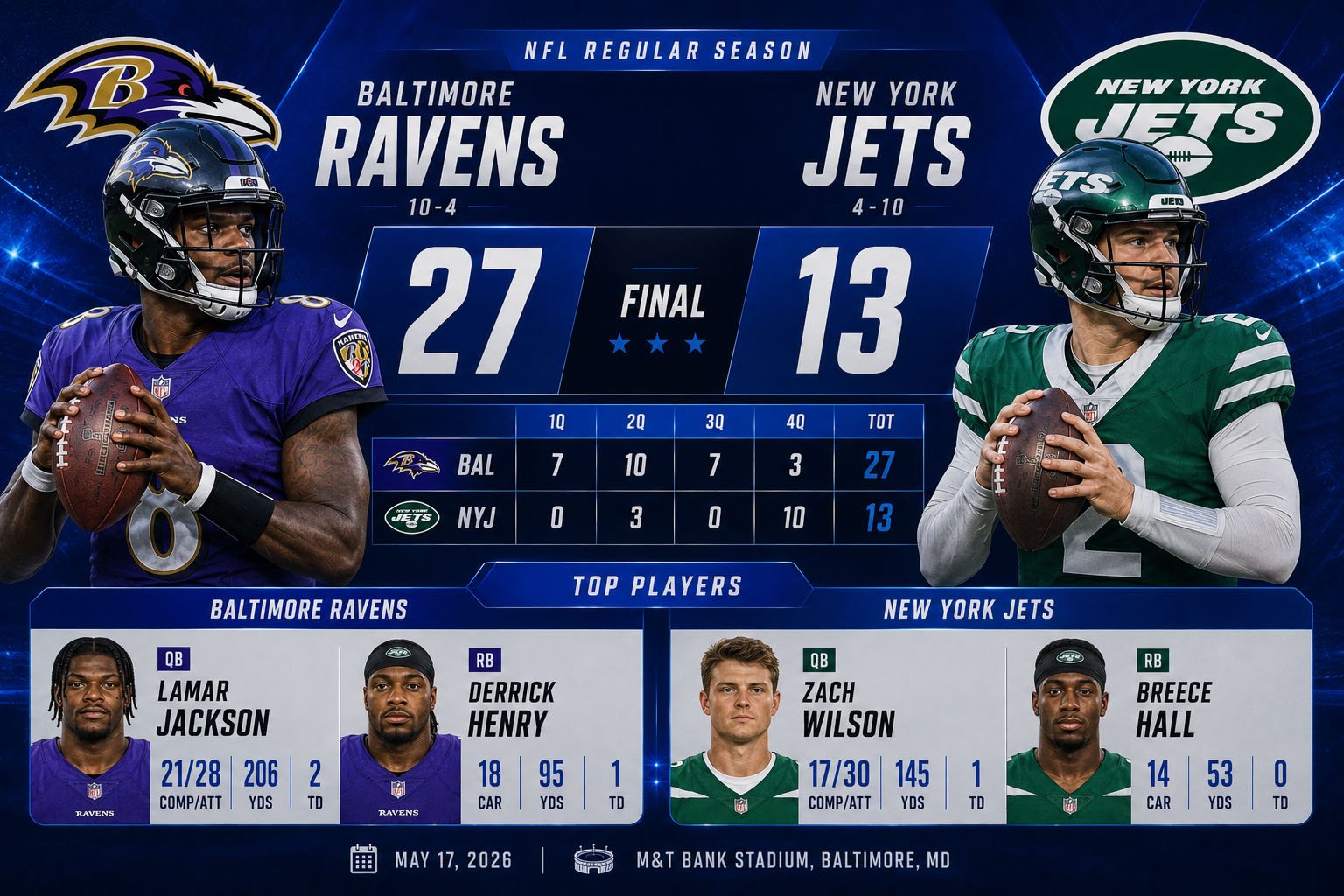
Baltimore Ravens vs New York Jets carried real significance in the 2025 season, arriving right in the middle of one of the more remarkable midseason turnarounds in the NFL. After stumbling to a 1-5 start filled with injuries, Baltimore had rattled off four straight wins heading into this matchup, and a fifth consecutive victory over New York pulled the Ravens back into a first place tie in the AFC North.
This article breaks down that pivotal matchup, the top individual performances from both rosters, and what the game revealed about Baltimore’s resurgence and New York’s ongoing struggles. Every stat below comes from official box scores and team reports.
Quick Team Snapshot
| Team | Game Result | Record After Game | Season Trend |
|---|---|---|---|
| Baltimore Ravens | Won 23-10 | 6-5 | Fifth straight win |
| New York Jets | Lost 23-10 | 2-9 | Continued struggles |
Baltimore’s win completed a remarkable climb from a 1-5 start to a .500 record, pulling the Ravens into a first place tie in the AFC North thanks to a Pittsburgh loss earlier that same day.
Baltimore Ravens Key Player Stats
Lamar Jackson: Efficient if Unspectacular
Quarterback Lamar Jackson did not put up eye popping numbers in this particular contest, completing 13 of 23 passes for 153 yards, but he did enough to help Baltimore control the game against a struggling Jets defense. Jackson appeared less mobile than usual after dealing with recent knee and ankle issues, a reminder of the physical toll the Ravens’ turnaround had taken on their star quarterback throughout a demanding stretch of the season.
Even in a quieter statistical outing, Jackson’s leadership and experience showed up in the moments that mattered most. He orchestrated the drive that set up Baltimore’s go ahead score in the third quarter, understanding exactly when to push the offense and when to lean on Baltimore’s power running attack to control the clock and wear down New York’s defense.
Derrick Henry: The Difference Maker
Running back Derrick Henry delivered the signature performance of the game, scoring two third quarter touchdowns that turned a sluggish offensive start into a comfortable Baltimore win. Henry was held to just 14 rushing yards in the first half, but he broke through after halftime, capping an 11 play, 74 yard drive that consumed more than six minutes of the third quarter with a 2 yard touchdown run that put the Ravens ahead for good.
Henry’s combination of power and continued production, even at an age when most running backs have begun to decline, has remained a cornerstone of Baltimore’s offensive identity throughout the season. His ability to close out games in the second half, wearing down opposing defenses over the course of four quarters, has been a key factor in Baltimore’s five game winning streak heading into this matchup.
New York Jets Key Player Stats
Tyrod Taylor: A Veteran Fill In Performance
With starting quarterback Justin Fields benched, veteran Tyrod Taylor got the start for New York and delivered a respectable performance despite the loss, throwing for 222 yards with a touchdown, though he also threw a costly late interception. Making just his 17th start over the previous eight seasons, Taylor showed the kind of veteran poise that allowed the Jets to remain competitive for a half, even against a Baltimore team that had won four straight games entering the contest.
Taylor’s balanced approach in the first half, mixing an effective running game with play action and quick passing concepts, helped New York build a 7-3 halftime lead, the team’s first lead after two quarters since the season opener. That early success made the eventual result all the more frustrating for a Jets team still searching for consistency throughout a difficult season.
Breece Hall and the Jets Offense
Running back Breece Hall has remained one of the few bright spots for New York throughout a challenging season, entering this game as the team’s leading rusher with 722 rushing yards and two touchdowns on the year, averaging 72.2 yards per game. His dual threat ability as both a runner and receiver, with 226 receiving yards on 24 catches, has given the Jets offense a legitimate playmaker even during a stretch of difficult losses.
New York’s coaching staff faced a difficult decision late in the game, opting to go for it on fourth and 2 from their own 42 yard line rather than punting, a gamble that failed when Taylor’s pass fell incomplete. That aggressive decision reflected head coach Aaron Glenn’s willingness to take risks in an attempt to change the trajectory of a season that had gone off course early, even if the result did not go New York’s way in this particular game.
Ravens vs Jets: Key Player Stats at a Glance
| Player | Team | Comp/Att or Carries | Yards | Touchdowns |
|---|---|---|---|---|
| Lamar Jackson | Ravens | 13/23 | 153 | 0 |
| Tyrod Taylor | Jets | N/A | 222 | 1 |
| Derrick Henry | Ravens | N/A | Key TDs | 2 |
| Breece Hall | Jets | N/A | Season leader | 2 (season) |
Note: Some figures reflect this single matchup while others reflect full season totals, since both types of stats matter for understanding the context of this game.
The Physical Toll of Baltimore’s Turnaround
Baltimore’s remarkable climb from a 1-5 start had not come without significant cost to the roster’s health. Jackson himself had missed three games earlier in the season due to injury, and his somewhat limited mobility against New York reflected the lingering effects of knee and ankle issues that had bothered him during the team’s winning streak. Safety Kyle Hamilton and tight end Mark Andrews had also dealt with notable absences during the season, testing the Ravens’ overall depth even as the team continued to win.
That pattern, key contributors playing through injury or working back from missed time, is common for teams navigating a long turnaround season, and it added extra significance to Baltimore’s ability to still control this particular game against New York. The Ravens’ coaching and medical staff faced constant decisions about how to manage player health while maintaining the winning momentum the team had built since its bye week, a balancing act that would only grow more important as Baltimore pushed further into the season with realistic playoff aspirations.
Defensive Transformation After the Bye Week
One of the most significant factors behind Baltimore’s turnaround involved a dramatic defensive improvement following the team’s Week 7 bye. Before that point, the Ravens defense had ranked among the worst in the league in points allowed, yards allowed, and takeaways generated, a stark contrast to the standard Baltimore had set in previous seasons under defensive minded head coach John Harbaugh. After the bye, however, the unit transformed into one of the league’s best, ranking third in points allowed and fourth in takeaways generated over that stretch.
That defensive turnaround, led by All-Pro performers like cornerback Marlon Humphrey and safety Kyle Hamilton, gave Baltimore’s offense a much needed complement, allowing the Ravens to win games even during stretches when Jackson and the passing attack were not operating at peak efficiency, exactly the situation that played out against New York. The defense’s ability to force stops in the first half against the Jets, despite Baltimore’s offense managing just 72 net yards before halftime, exemplified the complementary football that had fueled the team’s five game winning streak.
New York’s Search for Offensive Identity
Beyond the quarterback situation, New York’s broader offensive struggles reflected a team still searching for a consistent identity under head coach Aaron Glenn. The decision to attempt a fourth down conversion late in the game, rather than playing it safe with a punt, showed a coaching staff willing to take calculated risks in pursuit of a signature win, even if that particular gamble did not pay off against a Baltimore team playing with clear momentum.
That aggressive approach had defined much of Glenn’s tenure, reflecting a belief that New York needed to create its own opportunities rather than simply playing conservative, field position based football while waiting for the roster to develop further. Whether that philosophy would ultimately pay dividends remained an open question, but the competitive effort New York showed for a half against a red hot Baltimore team offered at least some evidence that the underlying approach was moving the roster in the right direction, even if the win loss record did not yet reflect that progress.
What This Game Meant for the AFC Playoff Picture
Beyond the immediate storylines involving both rosters, this game carried real weight for the broader AFC playoff picture. Baltimore’s win, combined with a Pittsburgh loss on the same day, pulled the Ravens into a first place tie in the AFC North, a remarkable development for a team that had looked all but eliminated from playoff contention just weeks earlier following its 1-5 start. That positioning gave Baltimore real momentum heading into the second half of the season, with the Ravens suddenly looking like one of the most dangerous teams in the conference.
For New York, already eliminated from realistic playoff contention at 2-9, the game carried more significance for evaluation purposes than for postseason positioning. Coaches and front office personnel used performances like Taylor’s respectable outing and Hall’s continued production to inform decisions about roster construction and coaching philosophy heading into an offseason that promised to bring significant scrutiny and potential changes to a franchise still searching for sustained success.
The AFC North Race in Broader Context
Baltimore’s turnaround did not happen in isolation, and understanding the full AFC North picture helps explain why this particular win against New York carried such significance. Pittsburgh had also been navigating its own competitive season, and the fact that a Steelers loss coincided with Baltimore’s win over New York created the first place tie that made this game feel especially meaningful for Ravens fans and the broader coaching staff alike. Divisional races often come down to these kinds of simultaneous swings, where results from other games around the league directly affect a team’s own standing without any action required on the field.
That interconnected nature of divisional standings adds an extra layer of drama to every game during the stretch run of an NFL season, since teams must not only focus on their own performance but also track how other results around the league affect their playoff positioning. Baltimore’s coaching staff and front office certainly took notice of the Pittsburgh result, understanding that the path back to divisional contention had suddenly become considerably more direct than it had appeared just weeks earlier during the team’s difficult 1-5 start.
Analyzing Baltimore’s Offensive Balance
One of the most notable aspects of Baltimore’s turnaround involved the offense’s ability to win games through multiple different approaches depending on what a given game script demanded. Against New York, that meant leaning heavily on Henry’s power running once the Ravens established a lead, rather than continuing to ask Jackson to force throws through the air against a Jets defense that had shown some resilience in the first half. That kind of situational flexibility, knowing when to lean on different strengths within the offense, reflects sound coaching and personnel decision making that had developed throughout the season.
Offensive coordinator Declan Doyle deserves credit for building a system flexible enough to adapt to Jackson’s evolving physical condition throughout the season, sometimes emphasizing quicker, higher percentage passing concepts when Jackson’s mobility was limited by injury, as was the case against New York, while still maintaining enough explosive potential in the passing game to keep defenses honest. That adaptability has been a key factor in Baltimore’s ability to win games even during stretches when Jackson has not been at full health, a testament to the overall depth and design of the offensive system.
New York’s Defensive Struggles in Detail
While much of the attention following this game focused on the offensive performances from both teams, New York’s defensive struggles throughout the season deserve equal scrutiny for understanding the team’s overall difficulties. The Jets defense had allowed opposing offenses to control long, clock eating drives throughout the season, a pattern that repeated itself in the third quarter against Baltimore when Henry’s touchdown drive consumed more than six minutes off the clock. That inability to force stops in crucial moments had been a recurring theme in New York’s losses throughout the difficult season.
Defensive coordinator strategies had shifted multiple times throughout the year as New York searched for a formula capable of slowing down the league’s more explosive offenses. Against Baltimore’s dual threat combination of Jackson’s playmaking ability and Henry’s power running, the Jets defense showed flashes of competitiveness, particularly in the first half, but ultimately could not sustain that level of play for a full 60 minutes, a challenge that had plagued the unit throughout the season regardless of the specific opponent or offensive scheme they faced on any given week.
The Historical Significance of Baltimore’s Turnaround
Comebacks from a 1-5 start to playoff contention remain relatively rare in NFL history, making Baltimore’s turnaround a notable storyline regardless of how the remainder of the season ultimately unfolded. Teams that fall significantly below .500 early in the season typically struggle to recover sufficiently to make a serious playoff push, given how competitive the modern NFL landscape has become across nearly every division. Baltimore’s ability to reverse that trajectory so dramatically reflected both the underlying talent on the roster and the coaching staff’s ability to make meaningful adjustments once the team returned from its bye week.
That historical context added weight to every subsequent Baltimore win, including the victory over New York, since each additional win moved the Ravens further away from the disappointment of their early season struggles and closer to validating the roster and coaching decisions that had been questioned during the difficult start. Football analysts and historians will likely point to this stretch of the season as a case study in resilience and effective in season adjustment, regardless of how Baltimore’s season ultimately concluded.
Fantasy Football Implications From This Matchup
For fantasy football managers, this game produced a mixed bag of results depending on which players they had rostered. Henry’s two touchdown performance made him a strong fantasy contributor for the week, continuing a season long trend of touchdown dependent production that had made him a valuable, if occasionally inconsistent, fantasy asset. Jackson’s modest passing output, combined with the absence of a rushing touchdown, made him a more middling fantasy performer in this particular game compared to his typical dual threat ceiling.
On the Jets side, Taylor’s passing yardage and touchdown made him a usable streaming option for fantasy managers desperate for quarterback production in a bye week or injury situation, even though his late interception limited his overall fantasy value. Hall’s continued involvement in both the running and passing game, even in a losing effort, reinforced his standing as a reliable fantasy option throughout the season, one of the few consistent bright spots fantasy managers could count on from an otherwise struggling Jets offense.
Team Comparison
This game reflected two teams heading in dramatically different directions. Baltimore, despite a quiet passing performance from Jackson, showed the kind of physical, complementary football that had fueled its turnaround from a 1-5 start. Henry’s second half touchdowns and Baltimore’s ability to control the clock and wear down New York’s defense demonstrated exactly the formula that had carried the Ravens through their five game winning streak.
New York competed hard for a half, with Taylor providing a steady veteran presence in place of the benched Fields, but the Jets ultimately could not sustain that level of play for a full 60 minutes against a more talented, more experienced Baltimore roster. That pattern, competing well in stretches but ultimately falling short, had defined much of New York’s difficult 2025 season.
Special Teams Contributions in the Turnaround
Special teams play, while often overlooked in game recaps focused on quarterback and skill position performances, contributed meaningfully to Baltimore’s win over New York. Kicker Tyler Loop’s 31 yard field goal in the first half kept Baltimore within striking distance during a stretch when the offense struggled to move the ball consistently, and the Ravens’ late field goal helped extend the lead to the final margin, providing valuable insurance points that ultimately made the outcome more comfortable down the stretch.
Baltimore’s special teams units throughout the season had provided similar value in tight games, whether through reliable placekicking, effective coverage units, or occasional explosive returns that shifted field position in the team’s favor. That often underappreciated phase of the game had quietly contributed to Baltimore’s turnaround alongside the more prominently discussed offensive and defensive improvements, a reminder that comprehensive team success typically requires competent play across all three phases rather than simply relying on standout performances from star skill position players.
Weather and Environmental Factors
Games played in Baltimore during the late fall portion of the NFL season often feature challenging weather conditions that can affect both teams’ offensive approaches. While specific weather details from this particular contest were not the primary focus of postgame coverage, the general pattern of cooler temperatures and potential wind factors common to outdoor stadiums in the Mid-Atlantic region during November typically favors ground based offensive approaches over pass heavy attacks, a dynamic that may have contributed to both teams leaning more heavily on their respective running games throughout the contest.
That environmental context matters for understanding play calling tendencies in games like this one, where both Henry’s power running for Baltimore and New York’s own rushing attempts featured prominently in the game plan. Coaching staffs across the league routinely factor in weather and stadium conditions when constructing game plans, and outdoor stadiums like Baltimore’s home venue often see a more run centric approach during the later months of the regular season compared to the pass heavy attacks more common in early season matchups played in warmer conditions.
Looking Back at the Broader 2025 Season Narrative
Placing this specific matchup within the broader context of the 2025 NFL season reveals just how much both franchises’ storylines had already been written by the time these two teams met in November. Baltimore’s narrative had shifted from concern and criticism during the 1-5 start to genuine optimism and playoff excitement by the time of this game, a remarkable turnaround that dominated football media coverage throughout the middle portion of the season. New York’s story, unfortunately for Jets fans, remained one of continued search for answers, with the quarterback change representing just the latest attempt to find a formula capable of producing sustained success.
Those contrasting season long narratives added extra context and meaning to what might otherwise have been viewed as a fairly routine regular season matchup between an improving contender and a struggling rebuilding team. Football fans and analysts alike used this game as a checkpoint for evaluating both storylines, with Baltimore’s convincing victory reinforcing the legitimacy of the team’s turnaround while New York’s competitive first half, followed by a second half collapse, illustrated the kind of frustrating pattern that had defined much of the Jets’ difficult season.
Head to Head History
The Ravens and Jets have played numerous times over the years, with recent results generally favoring Baltimore, particularly during seasons when the Ravens have fielded a stronger overall roster. This particular meeting continued that trend, extending Baltimore’s dominance in a matchup that carried extra weight given both teams’ contrasting seasons at the time.
Recent Matchup Recap
The November 2025 meeting between these two teams unfolded exactly as Baltimore’s recent form suggested it might, even though the Ravens’ offense started slowly. New York built an early lead behind Taylor’s efficient first half performance, but Baltimore’s third quarter surge, capped by Henry’s touchdown run, flipped the momentum for good. A late Baltimore field goal extended the lead to the final 23-10 margin, completing the Ravens’ fifth consecutive win and pulling the team level with Pittsburgh atop the AFC North standings.
Head coach John Harbaugh acknowledged after the game that the performance was not Baltimore’s most convincing effort, but emphasized that the win itself, representing another step in the team’s remarkable turnaround, mattered more than the style points. Full details from the game are available through CBS Sports’ game recap.
What to Watch Next
For the Ravens, continuing to build offensive rhythm around Jackson as he manages nagging injuries will be important heading into the final stretch of the season. Baltimore’s defense, which transformed from one of the league’s worst units early in the season into a top performing group after the bye week, will also need to maintain that level of play against tougher offensive competition down the stretch.
For the Jets, evaluating the quarterback position remains a central storyline, with questions about whether Fields or Taylor gives New York the best chance to develop a winning identity for the future. The Jets’ ability to develop playmakers like Hall, even during a difficult season, offers some hope for a roster still searching for stability heading into the coming years.
Conclusion
Baltimore Ravens vs New York Jets showcased a Ravens team firmly in the middle of a remarkable turnaround, using a physical rushing attack led by Derrick Henry to overcome a quiet passing performance from Lamar Jackson and secure a fifth consecutive win. New York competed admirably for a half behind a strong outing from fill in starter Tyrod Taylor, but ultimately could not sustain that level of play against a more complete Baltimore roster.
With the Ravens continuing their climb back into playoff contention and the Jets still searching for answers at multiple positions, this matchup offered a clear snapshot of where both franchises stood at this point in the 2025 season.
Frequently Asked Questions
What was the final score of this Ravens vs Jets matchup?
The Baltimore Ravens won 23-10, extending their winning streak to five games and pulling the team into a first place tie in the AFC North.
Why did Tyrod Taylor start at quarterback for the Jets instead of Justin Fields?
Fields was benched ahead of this game, giving veteran Tyrod Taylor the start, and he responded with 222 passing yards and a touchdown despite the loss.
How did Derrick Henry perform in this game?
Henry scored two third quarter touchdowns, including the go ahead score, after being limited to just 14 rushing yards in the first half.
How did Baltimore complete its turnaround from a 1-5 start?
The Ravens won five straight games after their slow start, powered by an improved defense following the bye week and a physical rushing attack led by Henry and Jackson.
Who led the Jets in rushing during the 2025 season?
Running back Breece Hall led New York with 722 rushing yards and two touchdowns on the season, while also contributing as a receiver out of the backfield.