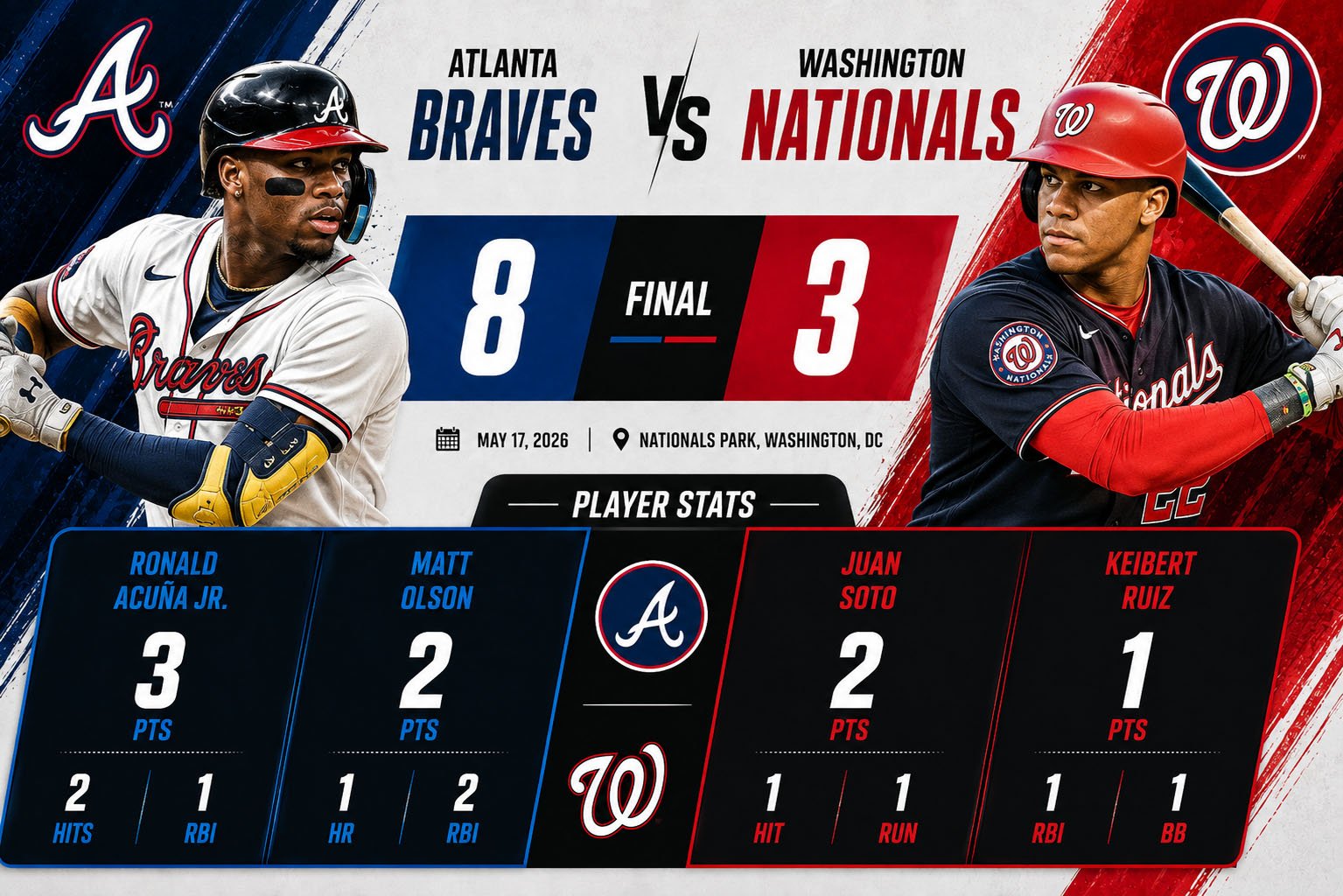
Atlanta Braves vs Washington Nationals played out repeatedly across the 2025 season, with the Braves establishing clear control of the rivalry behind Matt Olson’s power surge and a deep, talented pitching staff. Washington fought back with its own share of memorable individual moments, including multiple milestone home run performances from its young core, even as the Nationals finished the season well below .500. Their September series captured the full range of storylines that defined both teams’ years.
This article breaks down several of the key matchups between these two teams during the 2025 season, the top individual performances from both rosters, and what those results revealed about two franchises at very different points in their competitive cycles. Every stat below comes from official box scores and season reports.
Quick Team Snapshot
| Team | September Series Result | Season Trend | Key Storyline |
|---|---|---|---|
| Atlanta Braves | Won 2 of 3 (Sept 15-16) | Division contender | Matt Olson’s power surge |
| Washington Nationals | Snapped Atlanta’s win streak | Rebuilding season | James Wood’s breakout year |
Atlanta dominated most of its meetings with Washington throughout September, though the Nationals still managed to snap a 10 game Braves winning streak behind a two homer game from James Wood late in the season.
Atlanta Braves Key Player Stats
Matt Olson: Carrying the Offense Through a Hot Stretch
First baseman Matt Olson delivered one of the most productive stretches of his career against Washington in September, homering in four consecutive games at one point during the series and finishing a doubleheader sweep with a bases loaded triple in extra innings that sealed a 5-0 nightcap win. That kind of sustained power production, seven home runs across his final 18 games of that stretch after managing just one homer over a previous 34 game span, showed Olson heating up at exactly the right time as Atlanta pushed for playoff positioning.
Olson’s four hit, four RBI performance in an 11-3 rout of Washington included a three run homer and extended his streak of hitting at least 25 home runs in every season with Atlanta to four consecutive years. That kind of consistent, middle of the order power production gave the Braves lineup a dependable anchor throughout the ups and downs of a long 2025 campaign.
Chris Sale’s Continued Excellence on the Mound
Left hander Chris Sale turned in a dominant pitching performance against Washington, striking out nine batters while allowing just three hits over eight innings in the second game of a day night doubleheader sweep. That outing lowered his ERA to 2.35 on the season, reinforcing his status as one of the most effective starting pitchers in the National League even as he continued adding to an already decorated career resume.
Sale’s ability to work deep into games while limiting hard contact gave Atlanta’s bullpen valuable rest throughout a demanding stretch of the schedule. His strong outing against Washington came during a stretch when the Braves had won three straight games following a four game slide, showing the kind of stabilizing influence a frontline starter can provide during a team’s push toward the postseason.
Washington Nationals Key Player Stats
James Wood: A Breakout Star Even in a Difficult Season
Outfielder James Wood authored one of the signature individual performances against Atlanta in late September, hitting two solo home runs to help the Nationals snap the Braves’ 10 game winning streak with a 4-3 victory. Those two home runs, coming in the sixth and eighth innings, gave Wood 30 for the season and capped a breakout campaign that established him as one of the most exciting young players in baseball despite Washington’s difficult overall record. Full details from that game are available through CBS Sports’ game recap.
Wood’s power surge against Atlanta reflected a season long trend of standout production from Washington’s young core, giving Nationals fans genuine reasons for optimism even during a campaign that saw the team lose 90 or more games for a fifth consecutive year. His combination of power and continued offensive development throughout the season made him a focal point of Washington’s rebuilding efforts heading into future seasons.
Josh Bell and Dylan Crews Add to the Offense
First baseman Josh Bell contributed his own power to Washington’s upset win over Atlanta, leading off the fourth inning with his 21st home run of the season. That kind of complementary power production alongside Wood gave the Nationals lineup multiple threats capable of doing damage against even a talented Atlanta pitching staff, even during a season when the team’s overall results left much to be desired.
Rookie outfielder Dylan Crews also factored into several key moments across the season series, including an early season tiebreaking home run against Atlanta ace Spencer Strider in May. Crews, the second overall pick in the 2023 MLB draft, showed flashes of the talent that made him such a highly regarded prospect, even though a sore back forced him out of that particular game before it concluded.
Braves vs Nationals: Key Player Stats at a Glance
| Player | Team | Series Highlight | Season Total | Notable Achievement |
|---|---|---|---|---|
| Matt Olson | Braves | 4-for-5, 3-run HR | 4 straight 25+ HR seasons | Doubleheader sweep contributor |
| Chris Sale | Braves | 9 K over 8 innings | 2.35 ERA | Continued ace-level production |
| James Wood | Nationals | 2 HR in win over Atlanta | 31 HR season | Snapped Braves’ 10-game streak |
| Josh Bell | Nationals | Leadoff HR | 21 HR season | Complementary power threat |
Note: All figures reflect specific games from the Braves-Nationals season series in 2025, part of both teams’ broader campaigns that took very different competitive trajectories.
Team Comparison
This season series highlighted the gap between a legitimate playoff contender and a team firmly in rebuilding mode, even though Washington’s roster showed genuine flashes of exciting young talent throughout the year. Atlanta’s deep pitching staff, headlined by Sale’s continued excellence, combined with Olson’s middle of the order power to give the Braves multiple paths to victory in nearly every meeting between the two teams.
Washington’s competitiveness, when it appeared, came almost entirely from individual breakout performances by young players like Wood, Bell, and Crews rather than complete team execution across a full game. That pattern, explosive individual moments amid a difficult overall season, reflected exactly the kind of up and down campaign typical of a rebuilding franchise still developing its young core toward future sustained competitiveness.
Head to Head History
The Braves and Nationals share the National League East division, guaranteeing frequent meetings between the two teams every season and adding extra intensity to their divisional matchups. Atlanta’s recent dominance in the rivalry reflects the broader gap between the two organizations’ competitive windows, with the Braves building sustained success around a talented young core while Washington continues working through a longer term rebuild following the departure of star players in previous seasons.
Recent Matchup Recap
The September portion of the season series showcased the full range of storylines that defined both teams’ years. Atlanta’s doubleheader sweep on September 15 and 16, punctuated by Olson’s big performances and Sale’s dominant complete outing, extended the Braves’ winning streak and reinforced the team’s playoff positioning down the stretch. Washington’s response came days later, with Wood’s two homer game snapping Atlanta’s 10 game winning streak and providing a signature moment for the Nationals’ young core.
That back and forth across the series, dominant Atlanta stretches interrupted by individual Washington breakthroughs, captured the broader dynamic of the 2025 season series between these two division rivals, one defined by a clear talent and depth gap that still left room for memorable individual moments from Washington’s emerging young talent.
What to Watch Next
For the Braves, continuing to get standout production from veteran cornerstones like Olson and Sale while developing the surrounding pieces necessary for a deep postseason run remains the organizational priority. Atlanta’s ability to overcome a difficult stretch in the summer and push toward the playoffs behind performances like the September doubleheader sweep showed the kind of resilience the team will need heading into October.
For the Nationals, building on the breakout seasons from young players like Wood while continuing to develop the roster around them represents the clearest path toward future competitiveness. Wood’s emergence as a genuine power threat, even during a difficult team season, offers Washington fans real hope that the current rebuilding process is producing the foundational talent needed for sustained success in future years.
The Broader NL East Playoff Race
Atlanta’s meetings with Washington throughout September carried real significance for the broader National League East and wild card playoff pictures, with every win helping solidify the Braves’ postseason positioning during a competitive stretch across the National League. That context added extra weight to Atlanta’s dominant doubleheader sweep, since divisional wins carry particular importance for tiebreaker scenarios and overall playoff seeding calculations.
Washington’s position outside playoff contention meant the team’s September games carried different stakes, focused more on individual player development and evaluation than immediate postseason positioning. That context helps explain why performances like Wood’s breakout two homer game mattered so much to the Nationals organization, even though the win itself had no bearing on the team’s own playoff outlook for the season.
Matt Olson’s Remarkable Consistency
Beyond his standout September performance against Washington, Olson’s ability to consistently produce at an elite level throughout his tenure with Atlanta deserves significant recognition. His streak of hitting at least 25 home runs in every season with the organization reflects a level of durability and consistent power production that few hitters in baseball can match, making him one of the most reliable offensive cornerstones in the entire National League.
That consistency proved especially valuable during stretches of the season when other parts of Atlanta’s lineup struggled to produce, giving the Braves coaching staff confidence that their middle of the order would continue delivering runs even during difficult team wide slumps. Olson’s September surge against Washington, coming after a relatively quiet stretch earlier in the summer, exemplified exactly the kind of resilient, sustained excellence that has defined his entire Atlanta tenure.
James Wood’s Historic Rookie Progression
Wood’s development throughout the 2025 season represented one of the more encouraging individual storylines across all of baseball, with his home run total climbing steadily as the year progressed and his overall approach at the plate showing clear signs of maturation. His two homer performance against Atlanta in September pushed his season total to 31, a remarkable number for a player still establishing himself at the major league level.
That kind of power production from such a young player gives Washington’s front office real confidence in building the next competitive core around him, alongside other young talents like Crews and Bell. Wood’s continued development throughout the season, even amid a difficult team record, offered Nationals fans a clear reason for optimism about the direction of the franchise’s ongoing rebuild.
Pitching Depth as Atlanta’s Foundation
Beyond Sale’s individual excellence, Atlanta’s broader pitching depth played a crucial role in the team’s ability to consistently outperform Washington throughout the season series. That depth allowed the Braves coaching staff to manage workloads carefully across a long season while still fielding competitive starting pitching in nearly every game against the Nationals, a luxury not every team in baseball can claim.
Washington’s own pitching staff, by contrast, continued developing throughout a challenging season, with young arms getting valuable major league experience even during difficult outings. That development process, while producing mixed short term results, represented an important long term investment for a Nationals organization working to build sustainable pitching depth to eventually complement its emerging core of position player talent.
Ronald Acuña Jr.’s Continued Defensive Brilliance
While Olson and Sale captured most of the offensive and pitching headlines during Atlanta’s dominant stretch against Washington, outfielder Ronald Acuña Jr. contributed his own crucial moments throughout the series, including a leaping catch at the wall that ended a ninth inning threat and helped send one contest to extra innings. That kind of defensive excellence, often overshadowed by his considerable offensive talents, has become an increasingly important part of Acuña’s overall game and his value to Atlanta’s roster construction.
Acuña’s all around ability, combining speed, power, and defensive range, gives Atlanta a true five tool talent capable of impacting games in multiple ways beyond the traditional offensive statistics that typically capture the most attention. His continued excellence throughout the 2025 season, including moments like that game saving catch against Washington, reinforced his standing as one of the cornerstone talents anchoring Atlanta’s championship aspirations.
Drake Baldwin’s Emergence Behind the Plate
Catcher Drake Baldwin emerged as a significant offensive contributor for Atlanta throughout the season series against Washington, hitting a go ahead double in one contest and adding a solo home run in another as part of a broader pattern of increased offensive production from the catching position. That kind of two way value, combining defensive reliability behind the plate with legitimate offensive contribution, gives Atlanta’s coaching staff a valuable everyday option at a position where many teams struggle to find consistent production.
Baldwin’s defensive contributions extended beyond his offensive production as well, including a heads up defensive play in one game against Washington where he fielded a dribbler, tagged home, and then threw out a Nationals baserunner to end a scoring threat. That kind of complete, well rounded performance from a young catcher reflects positively on Atlanta’s player development system and offers the organization confidence in the position’s long term outlook.
Washington’s Broader Rebuilding Philosophy
Washington’s front office has approached the current rebuilding phase with a clear focus on accumulating and developing young talent through the draft and international signings, a strategy that has begun paying dividends with players like Wood, Crews, and Bell all showing significant promise throughout the 2025 season. That patient, long term approach to roster construction reflects lessons learned from the organization’s previous championship window, which ultimately proved difficult to sustain once key veteran contributors departed in subsequent seasons.
The current core of young talent developing in Washington offers genuine hope for a return to sustained competitiveness, even though the immediate results throughout 2025 remained difficult for Nationals fans to watch. Building a roster capable of competing with a team like Atlanta requires exactly the kind of patient talent accumulation and development process Washington has undertaken, even if the timeline for a return to true postseason contention remains uncertain based on the current roster’s development trajectory.
Spencer Strider’s Return From Injury
Atlanta ace Spencer Strider’s season included his own challenging return from injury, having strained his hamstring earlier in the year before working his way back into the rotation. His performance against Washington in an early season meeting, completing 4 and 1/3 innings in just his second start back from that injury, showed both promising signs and the natural rust that often accompanies a return from a significant physical setback.
That kind of injury management storyline played out across Atlanta’s pitching staff throughout the season, testing the organization’s overall depth even as frontline performers like Sale continued producing at an elite level. Strider’s eventual return to full effectiveness would prove crucial for Atlanta’s championship aspirations, given his standing as one of the most talented power pitchers in the entire National League when healthy and performing at his peak level.
The Financial and Competitive Gap Between Divisional Rivals
The National League East has featured significant financial and competitive disparities between its member franchises in recent seasons, with Atlanta’s sustained investment in retaining and developing star talent creating a clear gap compared to Washington’s more constrained approach during its current rebuilding phase. That financial reality shapes how each organization approaches roster construction, with Atlanta able to prioritize immediate championship contention while Washington necessarily focuses on longer term sustainable team building.
Despite that financial and competitive gap, divisional rivalries in baseball maintain their intensity regardless of each team’s current standing, since every game still counts equally in the standings and carries the same tiebreaker implications for playoff positioning. That reality explains why even lopsided season series like this one between Atlanta and Washington still produced genuinely compelling individual moments and competitive baseball throughout the year.
Statistical Trends Across the Full Season Series
Looking beyond the specific September meetings highlighted throughout this article, the broader season series between these two teams reflected the clear talent gap between a legitimate championship contender and a team in an earlier stage of its competitive rebuild. Atlanta’s superior pitching depth, in particular, proved to be a decisive factor across most meetings between the two teams, giving the Braves a significant advantage in run prevention that Washington’s offense, even with its emerging young talent, struggled to consistently overcome.
That statistical pattern, Atlanta’s pitching advantage outweighing Washington’s occasional offensive explosions, defined much of the season series and reflected the broader organizational priorities each team had established heading into the 2025 campaign. Washington’s front office understood that developing young pitching depth to match the team’s improving offensive talent would represent a crucial next step in the organization’s broader rebuilding timeline.
Fantasy Baseball Value From Both Rosters
For fantasy baseball managers, this season series produced significant value from several key contributors on both sides. Olson’s power surge made him an essential weekly starting option throughout his hot stretch, while Sale’s continued strikeout production and low ERA reinforced his standing as a top tier starting pitching option in most fantasy formats.
Wood’s continued power development throughout the season made him one of the more exciting waiver wire additions and trade targets in dynasty and keeper league formats, with his 31 home run season representing exactly the kind of breakout performance fantasy managers hope to identify early in a player’s career. That combination of established veteran production from Atlanta’s roster and emerging young talent from Washington’s core gave fantasy managers plenty of reasons to closely track this particular season series throughout 2025.
Looking Ahead to Future Seasons
As both organizations look toward future seasons, the trajectory established throughout this 2025 season series offers useful context for understanding each team’s competitive outlook. Atlanta’s continued championship aspirations, built around the sustained excellence of players like Olson, Sale, and Acuña, position the Braves as a perennial contender in the National League for the foreseeable future, assuming the organization can continue managing its roster and financial resources effectively.
Washington’s path forward depends heavily on the continued development of its young core, particularly Wood’s ability to build on his breakout 2025 season and the organization’s success in developing sufficient pitching depth to complement its improving offensive talent. If that development continues along its current promising trajectory, the gap between these two divisional rivals could narrow considerably in future seasons, setting up potentially even more competitive and meaningful matchups between Atlanta and Washington in the years ahead.
Conclusion
Atlanta Braves vs Washington Nationals showcased two franchises at very different stages of their competitive cycles throughout the 2025 season. Matt Olson’s power surge and Chris Sale’s continued excellence helped Atlanta dominate most of the season series and push toward playoff contention, while James Wood’s breakout performance and continued development gave Washington fans genuine reasons for optimism despite a difficult overall team record.
With Atlanta building toward sustained postseason success and Washington continuing to develop its exciting young core around players like Wood, Bell, and Crews, this NL East rivalry figures to remain compelling in the years ahead, even as the current competitive gap between the two franchises remains significant.
Frequently Asked Questions
How did the Braves perform against the Nationals in September?
Atlanta won a doubleheader sweep on September 15 and 16 behind big performances from Matt Olson and Chris Sale, extending a winning streak that eventually reached 10 games before Washington snapped it.
What was James Wood’s signature performance against Atlanta?
Wood hit two solo home runs in a 4-3 Nationals win that snapped Atlanta’s 10 game winning streak, pushing his season home run total to 31.
How consistent has Matt Olson been during his Atlanta tenure?
Olson has hit at least 25 home runs in each of his four seasons with the Braves, reflecting one of the most consistent power production streaks in the National League.
Did the Nationals make the playoffs in 2025?
No, Washington finished with 90 or more losses for the fifth consecutive year, a first in franchise history, while continuing to develop its young core led by players like Wood.
How did Chris Sale perform against Washington?
Sale struck out nine batters while allowing just three hits over eight innings in one meeting, lowering his ERA to 2.35 and reinforcing his standing as one of the National League’s top starting pitchers.